
Transfer Pricing Comparability Analysis: Why Access to Data Matters More Than the Tools
Transfer Pricing Comparability Analysis depends on access to reliable financial, ownership and transactional data. Discover where to find comparable company information, why tools such as Moody’s TP Catalyst have limitations, and how restricted access to confidential data can affect tax disputes and the fairness of transfer pricing assessments.
Comparability analysis is a fundamental part of transfer pricing compliance, but finding reliable financial and ownership information about independent companies remains a major challenge. The quality of the analysis depends not only on the methodology applied but also on the availability and relevance of the underlying data. Without sufficient information about independent transactions, demonstrating compliance with the arm’s length principle becomes increasingly difficult.
Transfer Pricing Comparability Analysis: Where Can We Find Reliable Data?
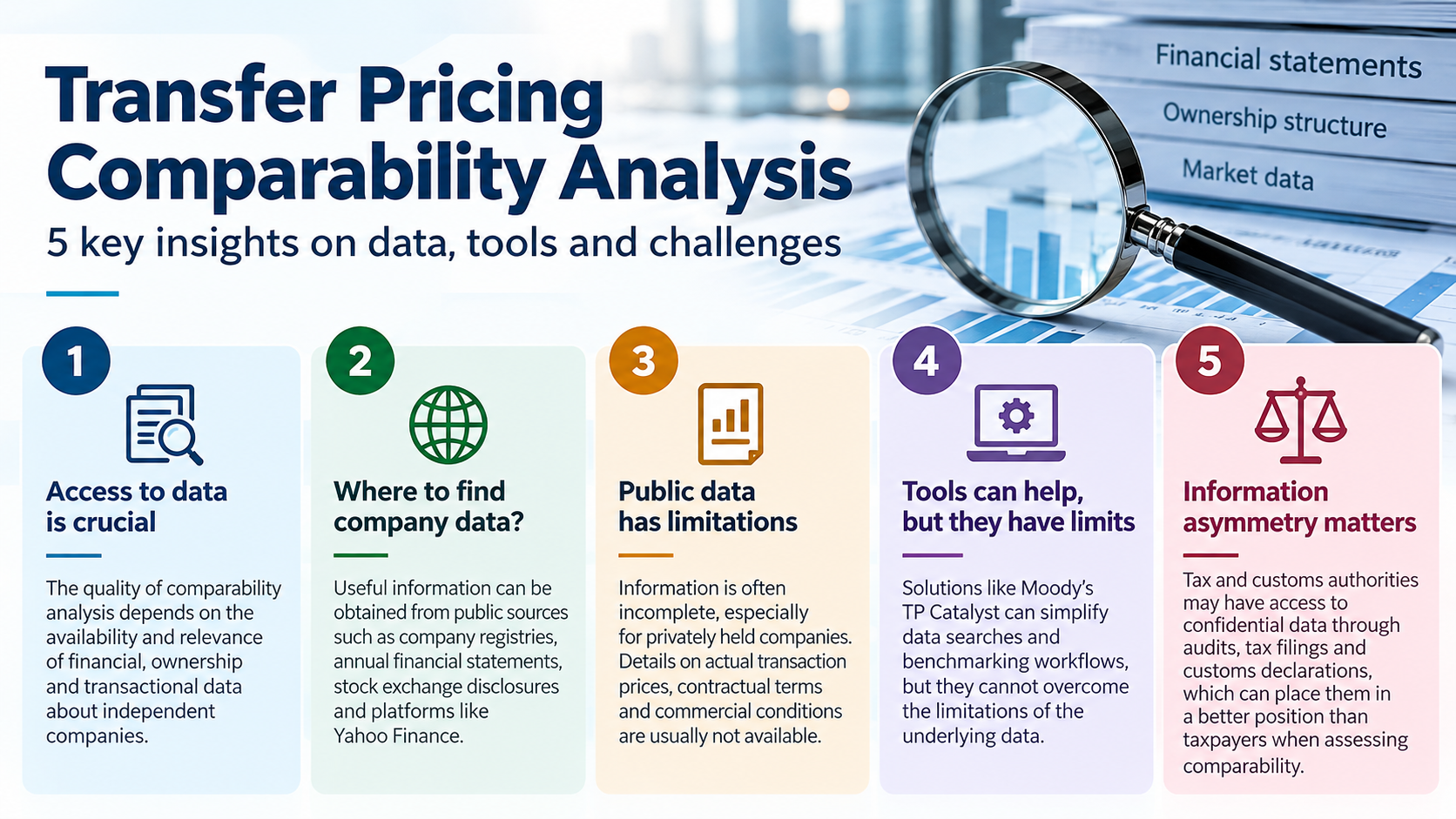
Where can we find the data needed to compare our intercompany transactions with those of independent competitors? Publicly accessible sources, such as company registries, annual financial statements and Yahoo Finance, can provide useful information about financial performance, business activities and ownership structures. However, these sources rarely disclose detailed information about prices, contractual terms and commercial conditions agreed between independent parties.
Commercial databases, including Moody’s Orbis and other financial information providers, offer additional company-level data that can support benchmarking. Nevertheless, access to financial statements does not necessarily mean access to genuinely comparable transactions. Companies operating in the same industry may have substantially different business models, functions, assets and risks.
For example, publicly reported operating margins may help compare the profitability of independent distributors. However, they do not necessarily reveal product-level prices, contractual obligations, volume discounts or the allocation of commercial risks. Such differences can significantly affect the reliability of a comparability analysis.
This creates a fundamental challenge: how can taxpayers demonstrate that their intercompany prices reflect market conditions when the most relevant transactional information remains confidential? The OECD Transfer Pricing Guidelines recognize the importance of comparability adjustments and appropriate economic analysis. Yet even sophisticated methodologies cannot fully compensate for missing or unreliable data.
Transfer Pricing Comparability Analysis: Can Specialized Tools Overcome Data Limitations?
Specialized tools such as Moody’s TP Catalyst may simplify data searches, comparable-company screening and benchmarking calculations. They can help organize financial information and automate certain stages of transfer pricing documentation. However, their usefulness ultimately depends on the quality and scope of the underlying databases.
If a tool relies on publicly available information or licensed datasets containing primarily company-level financial results, it cannot automatically provide confidential transaction-level data. Information about actual prices, contractual conditions and commercial arrangements between independent companies may remain inaccessible. Consequently, faster processing does not necessarily produce more reliable comparability results.
For example, an automated search may identify companies with similar industry classifications and calculate an interquartile range of operating margins. Nevertheless, these companies may perform different functions, assume different risks or operate under different economic conditions. Such differences require careful examination before the companies can be accepted as reliable comparables.
The central question is whether analytical tools improve access to genuinely comparable information or merely make existing data easier to process. Technology can improve efficiency, consistency and documentation, but it cannot eliminate fundamental information gaps. Reliable benchmarking still requires economic reasoning, functional analysis and professional judgement.
Information Asymmetry: Are Taxpayers and Tax Authorities on Equal Terms?
Are taxpayers and tax or customs authorities operating on a level playing field when it comes to access to comparable data? Tax authorities may possess confidential information obtained through tax returns, audits, financial disclosures and international information exchanges. Customs authorities may also have access to transaction-level import data that is unavailable to individual taxpayers.
This creates a potential information asymmetry, particularly when authorities rely on data that taxpayers cannot independently verify. For example, an authority may have access to financial or transactional information concerning independent businesses operating in the same market. Taxpayers may be unable to examine the underlying contracts, accounting figures or commercial circumstances.
The use of confidential comparables raises important questions about transparency and procedural fairness. The OECD Transfer Pricing Guidelines acknowledge concerns about so-called secret comparables, particularly where taxpayers cannot adequately defend themselves against the information used. The ability to examine and challenge the evidence supporting a transfer pricing adjustment is therefore an important consideration.
Can a transfer pricing adjustment be considered sufficiently transparent when the taxpayer cannot access the data used to justify it? Authorities have legitimate obligations to protect confidential taxpayer information, but these obligations must be balanced against procedural rights. The appropriate balance depends on the applicable legal framework and safeguards available during tax proceedings.
Transfer Pricing Comparability Analysis in Tax Disputes: Where Can We Obtain Confidential Data?
Where can taxpayers obtain non-public comparable transaction data, and can such information legally be used in transfer pricing disputes? Potential sources include licensed commercial databases, industry studies, legally obtained third-party information and disclosures made during administrative or judicial proceedings. However, the availability and admissibility of such information depend on national legislation, confidentiality restrictions and procedural rules.
Commercial databases may provide financial information about private companies that is not freely accessible online. Nevertheless, access to such databases does not necessarily include the right to disclose or reproduce all underlying information in tax proceedings. Licensing agreements and confidentiality obligations may impose additional restrictions.
Another possibility is obtaining relevant information through procedural mechanisms during tax audits or litigation. Depending on the jurisdiction, taxpayers may be entitled to request access to evidence, challenge the comparability criteria applied by authorities or seek judicial review of undisclosed information. These rights are particularly important when tax adjustments rely on confidential third-party data.
The fundamental issue is whether taxpayers can effectively defend their transfer pricing positions when the most relevant comparable data is unavailable to them. Reliable comparability analysis requires more than sophisticated software or extensive financial databases. It also depends on transparent evidence, legally accessible information and a fair opportunity to challenge the economic assumptions underlying tax adjustments.