
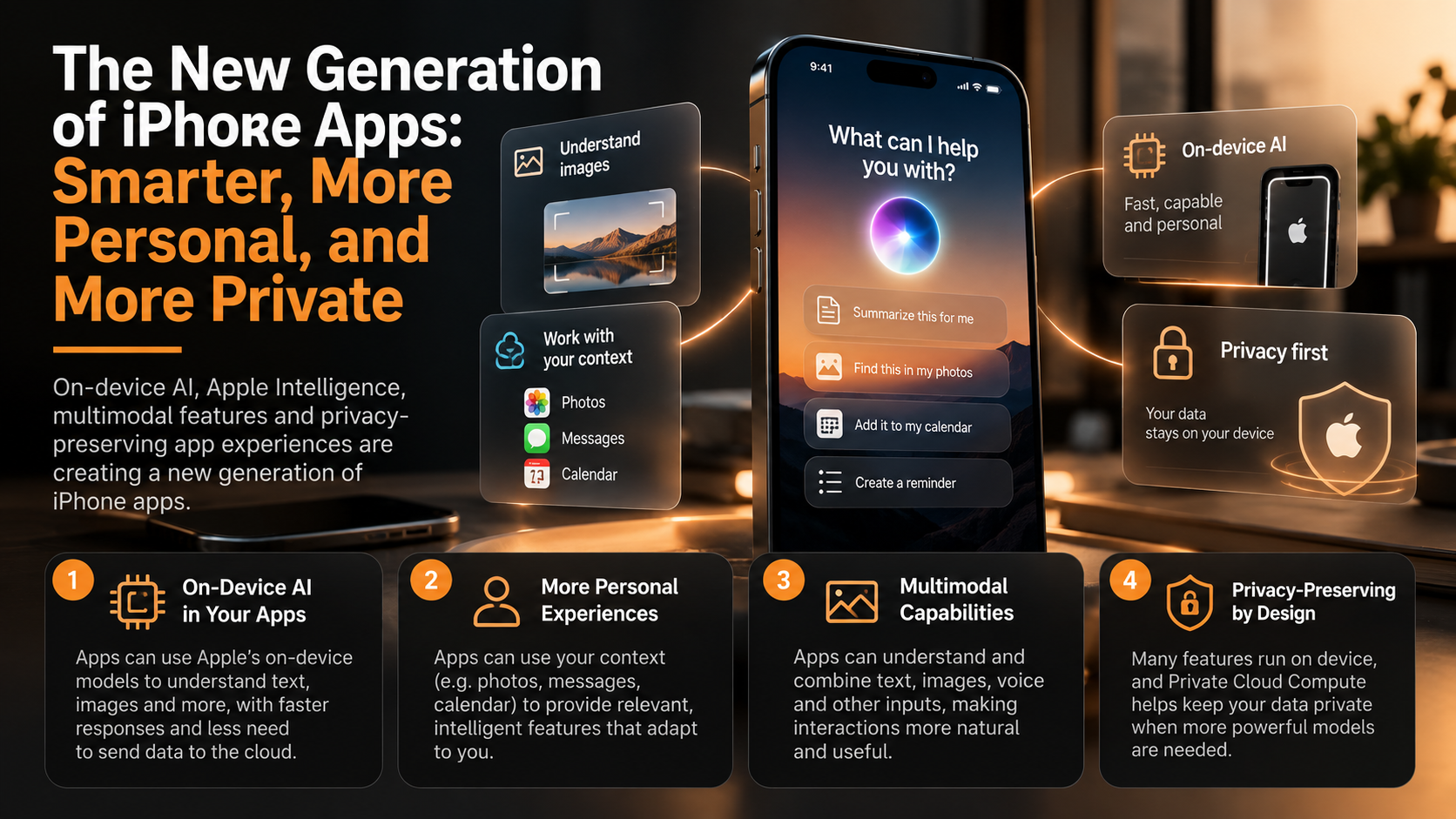
The New Generation of iPhone Apps: Smarter, More Personal, and More Private
A new generation of iPhone apps can understand text and images, respond to personal context, perform intelligent tasks on device and connect naturally with Siri and Apple Intelligence. Apple’s expanding AI architecture gives developers new ways to create personalized experiences while reducing how much sensitive information needs to leave the device.
For most of the App Store’s history, an iPhone application has behaved largely according to rules explicitly programmed by its developers. A weather app retrieved weather data, a productivity app organized tasks, and a travel app displayed information based on menus, filters and predefined workflows. Generative AI changes that model because applications can increasingly interpret natural language, understand images, summarize information and adapt their responses to context. The next generation of iPhone apps is moving from executing predefined commands toward understanding what the user is trying to accomplish.
Apple is making this transition increasingly accessible to developers through Apple Intelligence and its expanding collection of AI frameworks. The Foundation Models framework provides a native Swift API for accessing Apple Foundation Models running on device and through Private Cloud Compute, while also supporting other model providers that conform to Apple’s Language Model protocol. Developers can use multimodal prompts, tools and dynamic profiles to build applications that reason about different types of information rather than merely processing fixed inputs. AI is becoming a platform capability that ordinary iPhone apps can build into their own experiences.
This development matters because smartphones occupy a uniquely personal position in computing. An iPhone can contain messages, photographs, schedules, documents, location-related information, financial applications and years of personal activity, creating enormous potential for AI that understands context. The same intimacy creates an equally important requirement: users should not have to surrender unlimited amounts of private information simply to receive more intelligent features.
Apple’s approach increasingly attempts to address both sides of that equation. Its current architecture combines on-device processing with Private Cloud Compute for requests requiring larger models, while system technologies such as App Intents make app content and capabilities accessible to Apple Intelligence and Siri AI. The result is a model in which intelligence can become more personal while significant parts of the processing remain close to the user.
On-Device AI Changes What an iPhone App Can Do
Cloud-based AI normally requires an application to send a request to a remote server, wait for the model to process it and receive the response over the network. On-device AI changes this architecture by allowing suitable models to execute directly on the iPhone’s hardware. When intelligence runs locally, an app can potentially provide AI functionality with lower dependence on connectivity and less need to transmit user information to an external server.
Apple’s Foundation Models framework gives developers access to the on-device model used by Apple Intelligence. Apple identifies tasks including summarization, entity extraction, text and image understanding, refinement, dialogue and creative generation as potential uses, while the framework also supports structured generation and tool calling. Developers can therefore build intelligence around an application’s specific purpose instead of creating an entirely separate AI infrastructure.
Imagine a personal-journal application. Instead of uploading every entry to a remote AI provider, the app could use an on-device model to summarize recent notes, identify themes or organize information locally when the relevant model capabilities are sufficient. A travel application could similarly extract places from text, while a productivity application could transform unstructured notes into structured tasks.
This architecture can also support offline functionality. Apple’s developer documentation states that on-device models can enable privacy-preserving generative features while allowing applications to perform suitable tasks without depending on a server connection. AI no longer has to mean that every intelligent interaction begins with sending data to the cloud.
On-device execution also changes the economics of AI applications. Traditional generative-AI apps may incur a server inference cost whenever a user sends a prompt, which can make heavy usage expensive for developers. Apple’s Core AI developer materials describe on-device deployment as having no server dependency and no token cost, although developers still bear the ordinary costs of building, maintaining and distributing their applications.
There are limits, however, because a smartphone cannot always provide the same computing resources as a large data center. More demanding reasoning or larger-context tasks may require Private Cloud Compute or another server model, and developers must choose the appropriate architecture for their application. The emerging model is therefore not “device versus cloud,” but intelligent selection of where a particular AI task should run.
Multimodal and Personal AI Can Make Apps Understand More Than Text
The next important transition is from text-only AI toward multimodal intelligence. Human interaction is naturally multimodal: people look at an object, read a document, speak a question and combine visual information with language when making decisions. Applications that can reason across these formats can consequently offer experiences that feel less like traditional software interfaces.
Apple’s current Foundation Models framework supports multimodal prompts that can pass images alongside text. On-device Vision framework capabilities such as optical character recognition and barcode reading can also be made available as tools for models to use. An iPhone app can increasingly combine what the camera or an image sees with what the user asks in natural language.
Consider a food application in which someone photographs a collection of ingredients and asks what could be prepared from them. A shopping app might analyze an image while extracting relevant text, while a document application could combine OCR with language understanding to help organize information from a photographed page. These experiences reduce the need for users to manually translate what they see into structured inputs.
Visual intelligence expands this idea beyond an individual app. Apple’s developer tools allow apps to expose entities and actions that can participate in visual-intelligence experiences, enabling users to discover relevant content and perform actions from visual information. The camera can increasingly become an input not merely for taking photographs, but for understanding and acting on the world around the user.
Personalization adds another dimension. Apple’s 2026 Siri AI architecture can use personal context to search across sources such as messages, emails and photos and can work across apps through systemwide actions. Apple says core technologies including its Spotlight index and App Toolbox operate on device, helping keep personal contextual information under local control.
For app developers, App Intents provides an important connection point. Apple describes App Intents schemas as a way for an application’s content to become discoverable and its capabilities accessible through natural language, while entity schemas can contribute content to Spotlight’s semantic index. The app of the future may not always require the user to open it, navigate through several screens and press the correct button before its functionality becomes useful.
This changes the concept of an app interface. Traditional interfaces require people to learn where features are located, whereas an intelligence layer can potentially translate natural-language intentions into application actions. Buttons and screens will remain important, but they can coexist with an increasingly intent-driven interaction model.
Privacy Can Become Part of the AI Architecture
Greater personalization creates an obvious tension. The more an AI system knows about a person, the more useful it can potentially become—and the more sensitive the information it may need to process. This makes privacy architecture one of the defining technical questions for the next generation of intelligent iPhone applications.
Apple’s first answer is on-device processing. When a suitable AI task can run locally, information does not need to be transmitted to a remote model simply to generate the result. Apple’s Foundation Models and Core AI technologies are therefore significant not only because they provide AI capabilities, but because they give developers additional options for keeping processing on the user’s device.
The second layer is Private Cloud Compute, which Apple uses when larger server-side models are needed for supported Apple Intelligence requests. Apple states that personal data processed through Private Cloud Compute is not stored or made accessible to Apple or others, and that outside experts can inspect relevant server software to verify the privacy claims. The architecture uses Apple silicon servers and is intended to extend device-style privacy protections into cloud computation.
This distinction is important because “AI in the cloud” does not describe one universal privacy model. Different providers can have different architectures, retention practices and contractual arrangements, and developers need to understand where information is processed and what happens to it. Privacy-preserving AI requires architectural decisions, not simply a privacy statement attached after the feature has been built.
Apple’s latest Foundation Models framework also gives developers more flexibility over model selection. Applications can use Apple Foundation Models, models brought to the device through Core AI or compatible external model providers through the Language Model protocol. Dynamic Profiles can switch models, tools and instructions within an ongoing session, potentially allowing developers to choose different capabilities for different tasks.
This flexibility creates responsibility. A feature that can operate entirely on device may have different privacy characteristics from one that sends information to an external server model, even when the interface appears identical to the user. Developers therefore need to consider data minimization, permissions, transparency and model selection as part of product design.
Privacy can become a competitive feature of intelligent applications rather than merely a compliance requirement. An app that can summarize, classify or understand sensitive personal information locally may offer users a materially different proposition from one that requires continuous transmission of that information to a remote service. On a device as personal as the iPhone, that distinction can become increasingly important.
Smarter Apps Will Change What Users Expect From Software
The cumulative effect of these technologies is larger than adding a chatbot to every application. On-device models, multimodal inputs, personal context, App Intents and private cloud intelligence can change the basic relationship between a user and software. The most successful AI-powered iPhone apps may be those where the AI gradually disappears into the experience rather than becoming the experience itself.
A calendar app does not necessarily need a permanent chatbot window. It might instead understand an unstructured message, identify a proposed meeting and prepare the appropriate action. A photo application might understand what the user wants to change from a natural-language description rather than requiring several editing menus.
A shopping application could recognize a product from an image and connect it with relevant information. A financial application could summarize complex information into a more understandable explanation while still requiring appropriate safeguards for consequential decisions. A travel application could combine text, images, itinerary information and app actions to help users accomplish a task through fewer manual steps.
Apple’s current architecture is increasingly designed around this idea of applications exposing both content and capabilities to an intelligence layer. App Intents connects apps with Siri AI and Apple Intelligence, while the Foundation Models framework allows intelligence to operate within the app itself. These two directions can make apps simultaneously smarter internally and more accessible from the operating system.
The developer’s challenge consequently changes. Adding AI is not enough; developers must determine where intelligence genuinely removes friction, which information should remain local and when a more powerful cloud model is actually necessary. An AI feature creates value when it makes the application more useful—not merely when it demonstrates that the application contains AI.
Reliability will remain especially important. Apple now provides an Evaluations framework intended to help developers test AI behavior across dynamic conditions beyond what ordinary unit tests alone can cover. Apple also warns developers that changes to the underlying on-device model between operating-system versions can require prompts to be retested, demonstrating that AI functionality introduces a new form of application maintenance.
That requirement is easy to underestimate. Traditional software generally produces deterministic results when given the same inputs, while generative models can behave less predictably and evolve when the underlying model changes. Building intelligent apps therefore requires developers to test not only whether the software runs, but whether the AI continues to behave acceptably.
The new generation of AI-powered iPhone apps is being shaped by several technologies arriving simultaneously. On-device foundation models make local intelligence practical, multimodal capabilities allow applications to combine images and language, and App Intents connect app content and actions with Apple Intelligence and Siri AI. Private Cloud Compute provides another processing layer when supported requests require more powerful server-side intelligence.
Together, these technologies can produce applications that require fewer explicit instructions from users. Instead of manually navigating through rigid workflows, people can increasingly express an intention, show the app something or allow relevant contextual information to help determine the next action. The interface begins to shift from “tell the software exactly what to do” toward “tell the software what you are trying to accomplish.”
The privacy dimension may prove just as consequential as the intelligence itself. Apple Intelligence’s architecture prioritizes on-device processing where appropriate and uses Private Cloud Compute for supported requests requiring larger models, while Apple says data processed there is not stored or made accessible to Apple or others. This creates a technical foundation for applications that can become more context-aware without assuming that every personal interaction must be permanently centralized in the cloud.
Developers nevertheless remain responsible for how these capabilities are used. They must decide which model is appropriate, what data it should receive, how results are validated and whether an AI feature genuinely improves the user experience. Smarter software is valuable only when its intelligence is reliable, relevant and proportionate to the information users are being asked to share.
The broader transformation is therefore not simply about adding generative AI to existing applications. It is about changing how apps understand users, how users communicate intentions and where computation occurs. The defining iPhone apps of the AI era may be simultaneously more capable, more personal and more private—because intelligence increasingly happens closer to the person using it.