
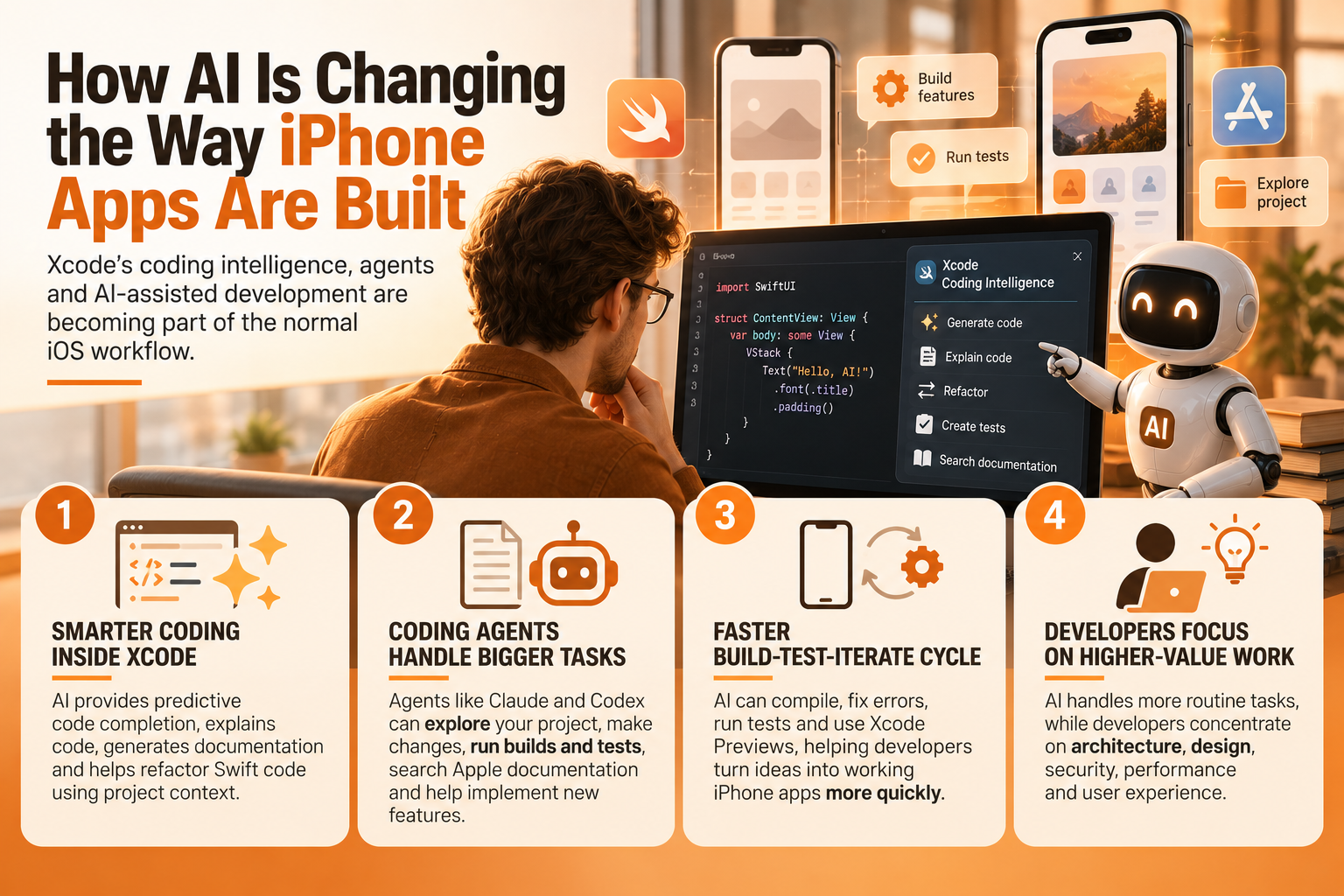
How AI Is Changing the Way iPhone Apps Are Built
AI is moving directly into the iPhone development workflow. Xcode now combines predictive code completion, coding intelligence and autonomous agents that can explore projects, write and refactor Swift code, run builds and tests, search Apple documentation and help developers iterate on interfaces.
Building an iPhone app has traditionally required developers to translate ideas into Swift or Objective-C, construct interfaces, interpret compiler errors, search documentation, write tests and repeatedly run the application in simulators or on physical devices. AI initially appeared around this workflow through external chatbots and code-completion services, but Apple’s development environment is increasingly bringing intelligence directly into Xcode. As of 2026, Xcode’s coding intelligence can help developers generate code, navigate unfamiliar projects, fix and refactor implementations, create tests and documentation, and work with coding agents capable of handling broader tasks. AI is therefore moving from being a separate coding assistant to becoming part of the environment in which iPhone apps are actually built.
The shift has happened quickly. Xcode 26 introduced an integrated coding assistant and broader coding-intelligence features, Xcode 26.3 added agentic coding with agents including OpenAI’s Codex and Anthropic’s Claude Agent, and Xcode 27 has expanded the agent-oriented workflow further. Apple describes Xcode 27 as allowing agents to assist at different stages, from generating an initial prototype to implementing details and polishing the finished experience. The direction is increasingly clear: developers describe more of what they want to accomplish, while AI takes responsibility for more of the mechanical steps required to accomplish it.
This does not mean developers simply describe an app and stop programming. Architecture, security, privacy, performance, user experience and product requirements still require informed human decisions, while AI-generated changes need review and testing. What is changing is the division of labor between the developer and the development environment.
The transformation is particularly significant for iOS because Xcode is not merely a text editor. It understands projects, build systems, simulators, Apple SDKs, previews, tests and platform documentation, giving an integrated agent considerably more useful context than a generic chatbot working from an isolated code snippet. The important development is not simply that AI can write Swift—it is that AI can increasingly interact with the complete process surrounding Swift code.
From Code Completion to Coding Intelligence
The first layer of AI-assisted development is relatively familiar: intelligent code completion. Xcode provides predictive code completion powered by an on-device machine-learning model trained for Swift and Apple SDKs, allowing it to suggest code based on the developer’s project and coding style. This can reduce repetitive typing while keeping the developer directly in control of implementation.
Generative intelligence takes the process considerably further. Xcode’s coding tools can explain selected code, generate documentation, create previews and playgrounds, make inline modifications and help developers work through existing codebases. Developers can interact with code using natural-language instructions while Xcode gathers relevant project context.
Instead of manually navigating through numerous files to understand an unfamiliar feature, a developer can ask the coding assistant to explain how that feature works. Instead of writing repetitive documentation from scratch, the developer can ask AI to produce a first version and then review it. The workflow begins to move from “write every instruction yourself” toward “describe the intended result, inspect the implementation and refine it.”
Xcode also maintains conversations and presents changes made to project files for developer review. Apple’s current documentation says developers can continue prompting, undo changes and roll back to an earlier state, while multiple agents can be arranged in parallel alongside ordinary editing. Human oversight remains embedded in the workflow because generated code is still part of a software project that must be reviewed, tested and maintained.
This distinction matters because generating code is only one part of software engineering. A plausible Swift function can still contain a logic error, misunderstand an API or introduce an architectural problem that becomes expensive later. Faster code generation creates value only when the resulting application remains correct, secure and maintainable.
AI therefore changes the value of developer expertise rather than simply eliminating it. Knowing how to type a particular implementation may become less important for some tasks, while knowing what should be built, how components should interact and whether the AI’s solution is technically sound becomes more important. The developer increasingly acts as both creator and reviewer.
Coding Agents Can Now Work Across the Project
The more consequential development is agentic coding. A conventional coding assistant generally responds to a request with an explanation or a proposed code change, while an agent can break a larger objective into steps, inspect the project and use available development tools to work toward the requested outcome. Xcode 26.3 introduced this approach directly into Apple’s development environment.
Apple says agents such as Claude Agent and Codex can search documentation, explore project file structures, update project settings and verify their work using Xcode Previews, builds and fixes. Agents can also use Xcode’s capabilities to build and test applications rather than stopping after generating source code. That transforms AI from a code generator into something closer to an active participant in the development loop.
Consider adding a new feature to an existing iPhone application. The work might require understanding the current architecture, identifying the appropriate files, modifying a SwiftUI view, connecting a data source, updating project configuration, compiling the application and fixing errors. Traditionally, the developer manually coordinates every stage of this sequence.
An agent can potentially coordinate more of those steps. The developer specifies the goal, while the agent investigates the project, proposes or implements changes, runs development tools and responds to problems discovered during the process. The unit of AI assistance is therefore expanding from a line of code to an entire development task.
This is particularly important for large projects. Mature iOS applications may contain thousands of source files, multiple frameworks, tests, packages and years of architectural decisions, making understanding the codebase itself a substantial part of development work. An agent capable of navigating that structure can potentially reduce the time developers spend searching before they begin solving the actual problem.
Apple has also opened Xcode capabilities to external agents through standards including the Model Context Protocol, while later Xcode releases have expanded agent connectivity. Xcode 26.3 introduced MCP access, and Xcode 26.6 added support for the Agent Client Protocol as well as Google Gemini in the coding assistant. The emerging Xcode model is not one fixed AI assistant but a development environment capable of working with multiple models and agents.
AI Can Shorten the Build-Test-Fix Cycle
Software development is fundamentally iterative. A developer writes code, builds the project, encounters an error, identifies the cause, modifies the implementation, runs tests and repeats the process until the feature behaves correctly. Much of the productivity opportunity from coding agents comes from accelerating this feedback loop rather than simply generating the first version of the code.
Apple’s agentic coding tools are designed to participate in this cycle. Agents can build and test projects, search Apple documentation and fix issues, allowing them to react to compiler output or test failures rather than simply handing the developer unverified source code.
Visual development provides another important capability. Apple says agents can capture Xcode Previews and use them while iterating through builds and fixes, giving the system information about the interface rather than limiting it to source text. For iPhone development, where interface behavior is central to product quality, AI that can inspect the result has an important advantage over AI that only generates code.
Xcode’s newer tooling extends this visual feedback. Xcode 26.6 added a Preview Snapshot MCP tool capable of rendering variations including light and dark appearance, portrait and landscape orientation, and different type-size overrides. These capabilities create opportunities for agents to examine how an interface behaves across multiple presentation conditions.
The same concept can extend into accessibility and localization. Apple’s coding-intelligence documentation specifically identifies skills that agents can use for tasks such as localization and accessibility, while Xcode 27 further expands the use of skills to help agents apply specialized Apple-platform expertise. AI can therefore assist not only with creating features, but with some of the repetitive work required to make those features production-ready for a broader range of users.
Testing remains essential because an agent completing a build does not prove that the feature is correct. Applications can compile successfully while containing logical errors, security problems, accessibility issues or incorrect assumptions about user behavior. AI makes iteration faster, but it does not eliminate the need for engineering validation.
The Developer's Job Moves Toward Architecture, Judgment and Review
The most interesting consequence may ultimately concern what iOS developers spend their time doing. When AI can generate boilerplate, explain unfamiliar code, create tests, search documentation and attempt multi-file changes, developers can spend less time on certain mechanical tasks. The scarce skill gradually shifts from producing every line of code to making good technical decisions about what the code should accomplish.
Prompting itself is only a small part of this change. Developers still need to understand data models, concurrency, networking, security, privacy, persistence, performance and Apple’s platform conventions in order to evaluate what an agent produces. A developer who cannot recognize a poor architectural decision may simply allow AI to create technical debt faster.
Architecture may therefore become more important rather than less important. AI can generate implementation details rapidly, but a weak initial specification can cause it to generate large amounts of internally consistent code around the wrong design. The faster code can be produced, the more valuable it becomes to decide correctly what should be produced before implementation expands.
Code review also changes. Instead of reviewing only changes written by colleagues, developers increasingly need to inspect AI-generated modifications and understand their consequences across the project. Xcode’s approach of presenting changes for review, preserving conversation history and supporting undo or rollback reflects this requirement for human supervision.
Privacy and intellectual-property considerations also remain relevant. Apple’s setup documentation notes that enabled agents or models may access project files and other information when processing developer requests, and developers control which tools, commands and skills agents can use. AI-assisted development therefore introduces a governance question alongside the productivity question: what project information should a particular model or agent be allowed to access?
Teams will consequently need development policies as AI adoption matures. Organizations may determine which models can access proprietary repositories, which types of changes require additional review, whether generated tests are sufficient and how AI-assisted contributions should be documented. The technical capability to delegate work to an agent does not remove organizational responsibility for the resulting software.
The strongest developers may ultimately become those who combine programming knowledge with effective delegation. They can define a problem precisely, give an agent useful context, recognize when its approach is wrong and intervene before an implementation becomes unnecessarily complex. AI reduces the cost of producing code, but it can increase the value of engineering judgment.
AI is not replacing Xcode; it is becoming integrated into Xcode. Predictive completion helps with individual lines, coding intelligence can generate and modify larger pieces of code, and agents can work across projects using builds, tests, previews and documentation. The progression represents a fundamental expansion in the scope of AI iPhone app development.
The change can be understood as a sequence: completion → assistance → agency. Code completion predicts what the developer may type next, an assistant responds to a developer’s instructions, and an agent can plan and execute multiple steps toward a broader objective. Each stage transfers a larger portion of routine implementation work from the human developer to the development environment.
Xcode 27 pushes this approach further by allowing coding agents to participate at different stages of development, from early prototypes through implementation and final refinement. Apple’s stated design is to let agents handle more repetitive or mechanical work while developers remain focused on decisions involving architecture, design and the details defining the application.
That does not make software engineering automatic. Someone must still understand what users need, choose the architecture, verify security and privacy, evaluate performance, test unusual conditions and determine whether the finished application actually solves the intended problem. AI can accelerate implementation, but responsibility for the application still belongs to the people building and shipping it.
The larger shift is therefore not simply that developers can generate Swift code faster. It is that the development environment itself is becoming capable of reasoning about tasks, manipulating projects, using tools and iterating toward a result. That changes what developers can delegate and what they need to supervise.
For iPhone development, the traditional image of a programmer manually writing every line of an application is becoming less representative of the workflow. Developers increasingly work alongside predictive models, coding assistants and agents while concentrating more attention on architecture, product decisions and verification. The next generation of iPhone apps will still be built by developers—but increasingly, developers will be directing intelligent tools that help build alongside them.