
Common Types of Non-Tariff Measures: How Modern Trade Is Regulated Beyond Tariffs
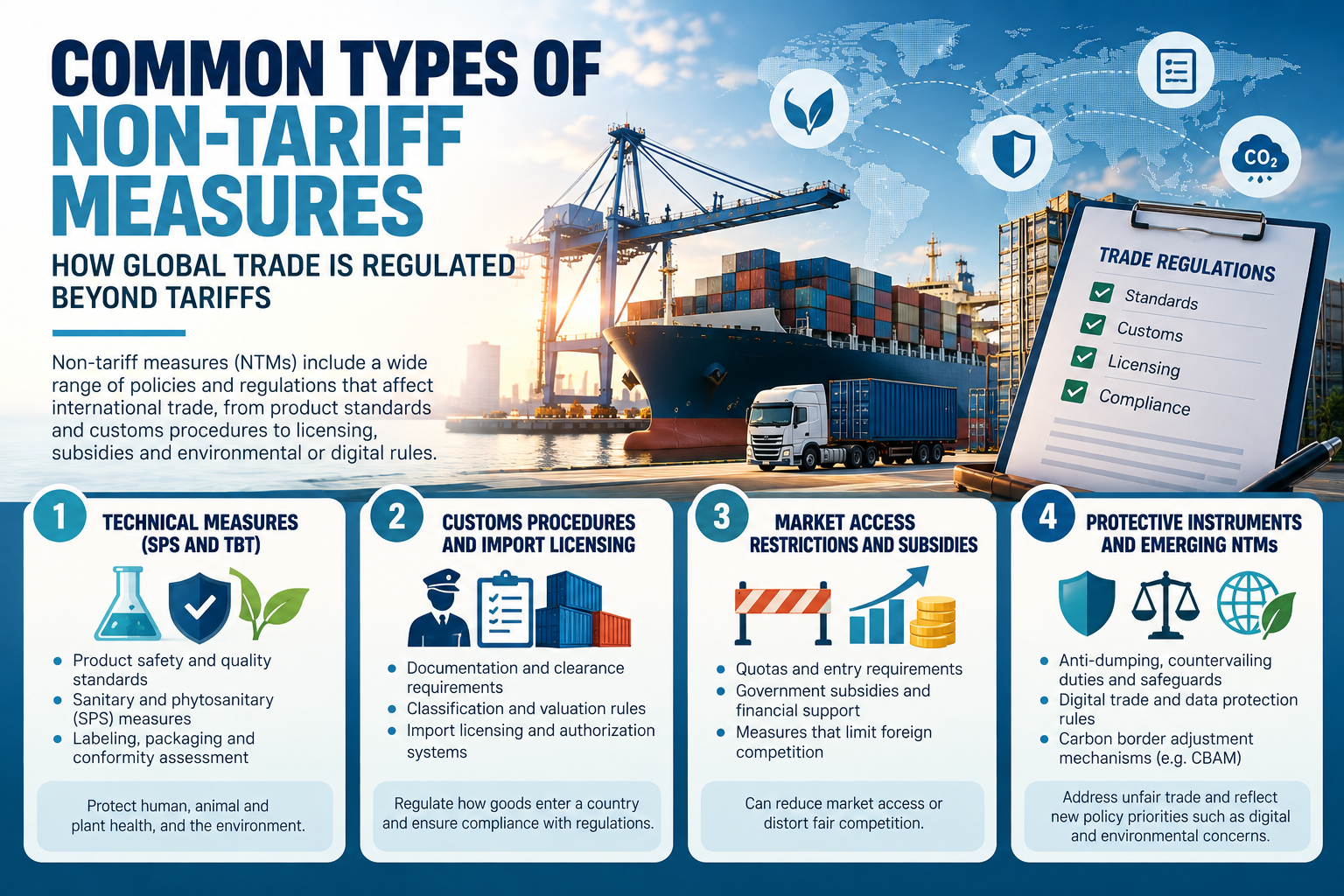
Non-tariff measures influence international trade through technical standards, customs procedures, licensing systems, subsidies and trade-remedy instruments. As global commerce evolves, businesses must also navigate newer regulatory areas involving digital trade, data, environmental standards and carbon-related measures.
Traditional discussions of international trade frequently concentrate on tariffs. A government imposes a customs duty on imported products, raising their cost and potentially changing the competitive relationship between foreign and domestic producers. Yet for many companies entering international markets, the tariff is only one part of the actual cost and complexity of market access.
Non-tariff measures, or NTMs, encompass a much broader collection of policies affecting internationally traded goods. They can include product standards, sanitary requirements, certification procedures, import licensing, quotas, price controls and other regulatory instruments. UNCTAD defines NTMs broadly as policy measures other than ordinary customs tariffs that can potentially affect international trade in goods by changing quantities traded, prices, or both.
Importantly, NTMs should not automatically be interpreted as protectionism. Many exist to protect consumers, public health, animal and plant health, national security or the environment. Others form part of governments’ broader trade, industrial or economic policies.
The practical challenge is that even a legitimate regulation can materially affect the cost, speed and commercial viability of international trade. A product might face a low or zero tariff but still require laboratory testing, certification, special labeling, import authorization and extensive customs documentation before it can reach customers.
Modern businesses therefore need to evaluate market access from a wider perspective. The real question is no longer simply “What is the tariff?” but “What must we do, pay and prove before this product can legally and commercially enter the market?”
Technical Measures: SPS Rules, Product Standards and Certification
Technical measures are among the most important categories of NTMs because they determine whether products satisfy the regulatory requirements of the destination market. Two major groups are Sanitary and Phytosanitary (SPS) measures and Technical Barriers to Trade (TBT) measures. SPS measures address risks associated with food safety and animal and plant health. They can include maximum pesticide-residue levels, veterinary requirements, quarantine rules, microbiological standards, inspection procedures and restrictions intended to prevent pests or diseases from entering a country. The WTO SPS Agreement recognizes governments’ right to establish measures necessary to protect human, animal and plant life or health, while imposing disciplines on how those measures are designed and applied. The WTO explains that SPS measures should be scientifically justified and should not arbitrarily or unjustifiably discriminate between countries where identical or similar conditions prevail.
Technical Barriers to Trade cover another extensive regulatory area. Technical regulations can specify product characteristics, production methods, terminology, symbols, packaging, marking or labeling requirements. Conformity-assessment procedures then determine how regulators verify whether products actually comply with those requirements. For exporters, compliance can therefore require much more than manufacturing a technically acceptable product. Companies may need laboratory reports, certificates, inspections, registration, translated labels or evidence that their production processes satisfy the destination country’s rules.
These requirements can produce significant fixed costs. A large multinational can distribute testing and certification expenses across millions of units, whereas a small exporter may have to recover the same compliance expenditure from a much smaller sales volume. Consequently, technically neutral requirements can still have unequal economic effects on different exporters. At the same time, technical standards can facilitate trade when regulatory systems are transparent and compatible. International standards and mutual recognition arrangements can reduce duplication and increase confidence in imported products. Technical regulation is therefore not inherently anti-trade; its design and implementation determine much of its commercial effect. This distinction is particularly important when assessing market-access risk. Companies should examine not only the written standard but also the testing process, certification authority, approval timeline, renewal requirements and practical consistency of enforcement.
Customs Procedures, Licensing and Market-Access Restrictions
A second major category concerns what happens when products actually approach the border. Customs procedures determine how goods are declared, classified, valued, documented, inspected and released. The efficiency of these procedures can be almost as important to traders as the formal tariff rate. Complex documentation requirements can increase administrative costs and delay delivery. Repeated physical inspections, inconsistent classification decisions or unpredictable clearance times can also create inventory and working-capital costs. For time-sensitive goods, several days of additional clearance can materially change the economics of a transaction. The WTO Trade Facilitation Agreement addresses many of these issues by establishing provisions intended to expedite the movement, release and clearance of goods while improving cooperation between customs and other relevant authorities. The agreement entered into force in February 2017.
Import licensing represents another important type of NTM. Licensing systems require an importer to obtain authorization or submit specified documentation before particular goods can enter the country. Depending on their design, they can serve regulatory, monitoring or trade-policy purposes. The WTO distinguishes between automatic and non-automatic import licensing. Automatic licensing is generally used where approval is granted in all cases, while non-automatic systems can administer restrictions or other policies and therefore have greater potential to affect market access.
Licensing becomes commercially significant when companies cannot predict whether authorization will be granted or how long approval will take. An unpredictable license can function as a stronger commercial restriction than a predictable tariff because the exporter cannot reliably determine whether the transaction can occur at all. Quantitative restrictions provide a more direct form of market-access limitation. Import quotas can establish how much of a product may enter a country during a particular period. Other mechanisms may condition imports on particular requirements or approvals.
For businesses, these measures affect more than compliance departments. They influence inventory planning, supplier contracts, pricing, working capital and decisions about whether to manufacture locally rather than export. The combined effect can be substantial. A company may face no significant tariff but still encounter licensing, certification, customs documentation and inspection requirements. Market access therefore needs to be evaluated as a regulatory system rather than as a single tax at the border.
Subsidies and Trade-Remedy Instruments Can Reshape Competition
Government intervention can also influence trade without operating as a conventional tariff. Subsidies can provide financial or economic support to domestic industries, potentially affecting production costs, investment decisions and international competitiveness. Support can take different forms, including grants, preferential financing, tax incentives or other benefits. Whether a particular program constitutes a subsidy under international trade rules, and whether action may be taken against it, depends on the applicable legal requirements rather than simply on whether a company receives government support. The WTO Agreement on Subsidies and Countervailing Measures addresses subsidies affecting trade in goods and establishes disciplines concerning prohibited and actionable subsidies as well as the use of countervailing measures.
The commercial importance of a subsidy comes from its ability to change the economics of competition. A producer benefiting from significant government support may be able to invest more rapidly, finance capacity more cheaply or compete under cost conditions that differ from those faced by unsupported rivals. Governments also use trade-remedy instruments when particular conditions are satisfied. These include anti-dumping measures, countervailing measures and safeguards, although their legal bases and requirements differ significantly.
Anti-dumping action addresses circumstances in which products are exported at less than their normal value and the applicable requirements concerning injury and causation are established. Countervailing measures can address certain subsidized imports that cause injury to domestic industry. Safeguards, by contrast, concern increased imports causing or threatening serious injury and do not require a finding of unfair trade in the same sense.
These distinctions matter because describing all three instruments simply as protection against “unfair competition” can be misleading. Safeguards are particularly different: they can restrict imports temporarily even without a finding that foreign exporters engaged in dumping or benefited from a countervailable subsidy.
For exporters, trade remedies create substantial commercial uncertainty. An anti-dumping or countervailing investigation can lead to additional duties, while safeguards can restrict access to a market experiencing rapid import growth. Businesses entering foreign markets therefore need to examine industry conditions as well as formal regulations. Rapid increases in imports, significant price differences, government support and complaints from domestic producers can all influence trade-policy risk. The competitive environment is shaped not only by the rules that exist today, but also by the trade instruments governments can activate when market conditions change.
Digital Trade, Data Rules and Carbon Policies Expand the NTM Landscape
Non-tariff regulation continues to evolve because international commerce itself is changing. Goods increasingly contain software, generate data and depend on digital services, while governments are simultaneously expanding climate-related regulation and supply-chain requirements. Digital trade creates questions involving data protection, cybersecurity, electronic transactions and cross-border data flows. These rules may pursue legitimate privacy or security objectives while still affecting how foreign companies structure their international operations.
A company may consequently need to consider where data can be stored, whether information can move across borders, which cybersecurity standards apply and whether particular digital services require local registration. Market access increasingly depends on the movement of both physical goods and the data connected to them.
Environmental policy is creating another important frontier. The European Union’s Carbon Border Adjustment Mechanism, or CBAM, is designed to apply a carbon price to embedded emissions associated with specified carbon-intensive imports. Following a transitional period beginning in October 2023, the definitive regime started on January 1, 2026. CBAM illustrates how the boundary between environmental regulation and trade policy is becoming more complex. Importers need emissions information from producers, creating compliance obligations that extend through international supply chains. Carbon intensity can therefore become a market-access and competitiveness variable alongside price, quality and traditional customs costs. These developments also demonstrate why NTM analysis cannot remain static. Regulations that barely affected international business twenty years ago can now determine whether a digital platform, industrial product or complex supply chain can operate economically in a particular jurisdiction.
For multinational companies, this means trade compliance increasingly requires cooperation among customs, legal, tax, sustainability, cybersecurity, procurement and operational teams. A regulation introduced for environmental or digital-policy reasons can ultimately change sourcing decisions, supplier selection and investment strategy. The modern NTM landscape is moving beyond the physical border: regulatory requirements increasingly follow products, data, emissions and supply chains across jurisdictions.
The common types of non-tariff measures extend across almost every stage of international commerce. Technical standards determine which products can legally be sold, SPS requirements protect health and agricultural systems, customs procedures determine how efficiently goods cross borders, and licensing systems influence whether imports can enter at all. Subsidies and trade remedies affect the competitive environment from another direction. Government support can alter production economics, while anti-dumping, countervailing and safeguard measures can change the cost or availability of imports when applicable legal conditions are satisfied. At the same time, newer forms of regulation are expanding the traditional definition of trade compliance. Digital rules increasingly influence data-intensive international business, while environmental instruments such as CBAM connect market access with information about emissions embedded in internationally traded products.
For companies, this creates a fundamental strategic lesson. A low tariff does not necessarily mean easy market access.The economic burden of certification, licensing, documentation, customs procedures, regulatory adaptation and emerging environmental requirements can sometimes matter more than the customs duty itself. Businesses evaluating new markets should therefore map the complete regulatory pathway from production to final sale. That means identifying applicable technical requirements, approval processes, customs procedures, licenses, potential trade-remedy exposure and emerging regulatory obligations before making pricing or investment assumptions.
For governments, the challenge is to pursue legitimate public objectives without imposing unnecessary commercial friction. Transparent requirements, predictable administration and internationally compatible standards can reduce compliance costs while preserving regulatory objectives. Tariffs determine only part of the price of crossing a border. Non-tariff measures increasingly determine whether, how quickly and under what conditions a company can cross that border at all.