
Non-Tariff Measures vs. Non-Tariff Barriers: What Is the Difference?
Non-tariff measures regulate international trade without using ordinary customs tariffs. Many serve legitimate objectives such as food safety, environmental protection and consumer protection, but poorly designed, discriminatory or unnecessarily restrictive measures can become significant trade barriers.
Tariffs are the most visible instruments of international trade policy because their economic effect is relatively straightforward. A government imposes a customs duty on an imported product, increasing the cost of bringing that product into the domestic market. Yet modern international trade is influenced by a much wider collection of regulations, standards, licensing procedures, inspections and administrative requirements.
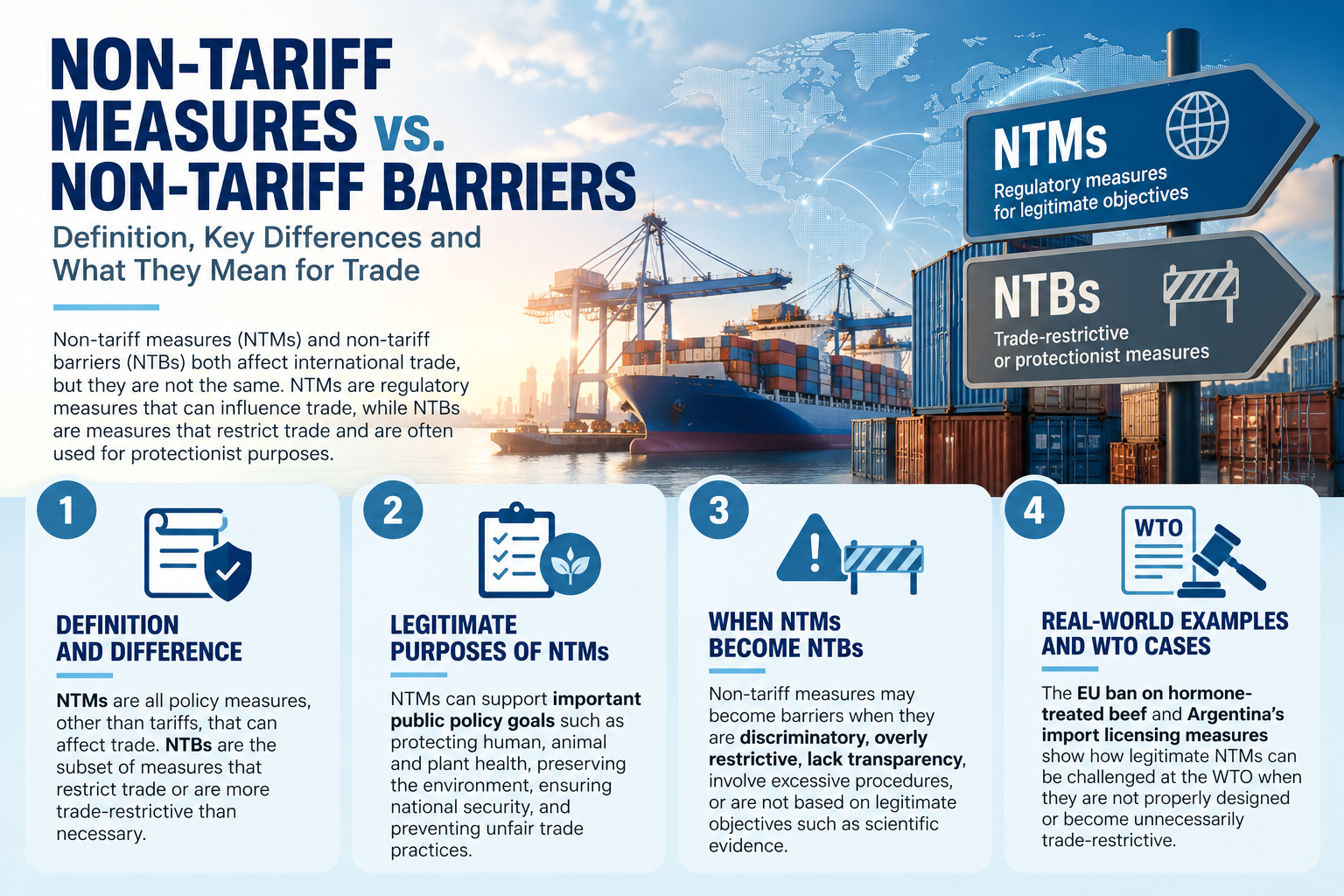
These instruments are generally discussed under the concept of non-tariff measures (NTMs). UNCTAD defines NTMs as policy measures other than ordinary customs tariffs that can potentially affect international trade in goods by changing quantities traded, prices, or both. The definition deliberately does not determine whether a measure is legitimate, discriminatory or desirable.
This distinction is essential because many measures affecting trade exist for legitimate reasons. Food-safety standards can protect consumers, plant-health rules can prevent invasive pests, technical requirements can improve product safety and environmental regulations can address pollution. A measure can make importing more difficult or expensive without automatically being an illegitimate trade barrier.
The terminology becomes confusing because non-tariff measures and non-tariff barriers are often used interchangeably even though they describe different concepts. UNCTAD treats NTMs as the broader neutral category, while NTBs can be understood as a subgroup involving protectionist intent or restrictions greater than necessary to achieve legitimate public-policy objectives.
Understanding non-tariff measures vs non-tariff barriers therefore requires looking beyond whether a regulation affects trade. The more important questions are why the measure exists, how it is designed, whether it discriminates, how it is administered and whether the trade restriction is justified by the policy objective being pursued.
Non-Tariff Measures: Regulation That Can Affect Trade
NTMs encompass an extremely broad range of government policies. UNCTAD’s definition includes traditional trade-policy instruments such as quotas and price controls as well as technical regulatory measures intended to achieve objectives such as health and environmental protection.
Technical NTMs include sanitary and phytosanitary (SPS) measures, technical regulations and conformity-assessment requirements. SPS rules address risks involving areas such as food safety and animal or plant health, while technical regulations can cover product characteristics, labeling, packaging, safety requirements and other specifications.
These regulations can impose real costs on exporters. A food producer may need laboratory testing, certification and additional documentation before entering another country’s market. A manufacturer may need to redesign packaging or demonstrate compliance with technical standards.
Those costs do not automatically make the requirements improper. The WTO’s Technical Barriers to Trade Agreement recognizes governments’ right to pursue legitimate objectives, including protection of human health and safety and the environment, while seeking to ensure that technical requirements are non-discriminatory and do not create unnecessary obstacles to trade.
The defining characteristic of an NTM is therefore not that it unfairly blocks trade, but that it is a policy measure other than an ordinary tariff capable of affecting trade. Some NTMs restrict trade, while others can potentially facilitate it—for example, by increasing consumer confidence that imported products satisfy credible safety standards.
UNCTAD’s classification also distinguishes technical and non-technical measures. Its current framework contains 16 chapters, with technical measures covering SPS, TBT and pre-shipment inspections and other formalities, while other chapters cover various non-technical and export-related measures.
This broad classification is important for businesses because regulatory market access can be more complicated than tariff analysis. Knowing that a destination market charges a 5% tariff tells an exporter relatively little if the product must also satisfy testing, certification, labeling, licensing and documentation requirements.
The burden can be particularly significant for SMEs. A multinational exporting millions of units can spread a $100,000 compliance expense across a large sales base, while a small exporter may find the same fixed requirement economically prohibitive. UNCTAD notes that compliance and procedural costs associated with NTMs can be particularly challenging for smaller businesses. The economic effect of an NTM can therefore be substantial even when the regulation has a legitimate public-policy purpose.
Non-Tariff Barriers: When Regulation Becomes a Trade Obstacle
The concept of an NTB is narrower and more evaluative. The WTO notes that there is no single official definition but describes the term generally as referring to a non-tariff measure that protects domestic industry. At the same time, it emphasizes that many non-tariff measures pursue legitimate objectives and can be implemented consistently with WTO rules.
UNCTAD provides a particularly useful distinction: non-tariff barriers are a subgroup of NTMs that have protectionist intent or are more restrictive than necessary to achieve public-policy objectives. This means the existence of additional compliance costs does not by itself establish that an NTM should be characterized as an NTB.
Consider a legitimate food-safety requirement. Requiring imported meat to satisfy scientifically justified health standards can constitute an NTM without necessarily becoming an improper barrier. But a discriminatory requirement applied only to foreign producers, or a requirement imposing substantially greater restrictions than necessary to address the relevant risk, raises a different set of trade concerns.
Administrative implementation can be equally important. A reasonable rule can become commercially restrictive through unreasonable administration. Unpredictable approval delays, opaque licensing decisions, duplicate documentation and inconsistent enforcement can prevent market access even when the formal regulation appears neutral.
Transparency consequently becomes central to good regulatory design. Exporters need to know which rules apply, what documentation is required, how compliance will be evaluated and how long approval should reasonably take. Frequent unexplained changes can transform compliance into uncertainty. This matters because companies do not make investment decisions based solely on written regulations. They also evaluate the time, cost and predictability of complying with those regulations. A licensing requirement taking five predictable days creates a fundamentally different commercial environment from one taking anywhere between five days and six months without explanation.
The WTO’s SPS and TBT frameworks seek to preserve governments’ ability to pursue legitimate objectives while limiting unnecessary obstacles to trade. Both emphasize principles such as transparency and avoidance of unnecessary trade restrictions, although their legal disciplines and areas of coverage differ. The practical distinction can therefore be summarized simply: an NTM describes a measure; calling something an NTB makes a claim about its restrictive or protectionist character.
When Legitimate NTMs Become Barriers: Lessons From WTO Disputes
The European Communities’ restrictions on hormone-treated beef provide a useful example of the tension between legitimate regulatory objectives and international trade obligations. The EC prohibited imports of meat and meat products from cattle treated with six specified hormones for growth-promotion purposes, leading the United States and Canada to challenge the measures through WTO dispute settlement. The policy objective involved food safety, an area in which governments plainly have legitimate regulatory interests. The dispute therefore was not simply about whether governments could regulate food safety. The critical question was whether the particular measure satisfied the disciplines of the WTO SPS Agreement.
The WTO panel found inconsistencies with several provisions of the SPS Agreement. On appeal, the Appellate Body upheld the finding that the import prohibition was inconsistent with Article 5.1, while reversing the panel’s findings concerning Articles 3.1 and 5.5. The Article 5.1 issue concerned the requirement that SPS measures be based on an appropriate risk assessment. This nuance matters. The case should not be reduced to the proposition that governments cannot impose strict food-safety rules. A legitimate objective does not automatically validate every regulatory method used to pursue it.
The hormone dispute subsequently continued through further WTO proceedings and negotiated arrangements, making the history more complicated than a simple 1998 ruling followed immediately by permanent resolution. For explaining NTMs, however, its enduring lesson is that health regulation and trade obligations must be evaluated together rather than treating one as automatically overriding the other.
Argentina’s import measures provide a different illustration. Beginning in 2012, Argentina required an Advance Sworn Import Declaration (DJAI) for most imports and also imposed various trade-related requirements on economic operators. These included requirements involving import-export balancing, limitations on imports, local content, domestic investment and non-repatriation of profits.
The European Union, United States and Japan challenged the measures. The panel found the DJAI procedure inconsistent with GATT Article XI:1 because it had a limiting effect on imports, and it found the trade-related requirements inconsistent with Article XI:1 as well. The local-content component was additionally found inconsistent with Article III:4 because it altered competitive conditions to the detriment of imported products. The Appellate Body upheld the central Article XI:1 finding concerning the DJAI procedure, and the WTO Dispute Settlement Body adopted the reports on January 26, 2015.
An important technical correction is necessary here: the panel did not ultimately find an Article X:3(a) violation concerning the DJAI procedure. It exercised judicial economy on the additional Article X claims after finding the procedure inconsistent with Article XI:1. The Argentina dispute demonstrates how administrative requirements can have trade effects comparable to explicit quantitative restrictions. A country does not necessarily need to announce an import quota if its administrative system effectively limits companies’ ability to import.
These cases illustrate two different pathways through which NTMs can generate trade disputes. In one, a legitimate health measure fails applicable WTO disciplines governing its design or evidentiary basis. In the other, administrative and trade-related requirements operate directly as restrictions on imports. The critical issue is therefore not whether regulation exists, but whether its objective, design and implementation are consistent with the applicable trade rules.
The distinction between non-tariff measures vs non-tariff barriers is more than terminology. NTMs are a broad category covering policies other than ordinary customs tariffs that can affect international trade. They include measures ranging from food-safety rules and technical standards to quotas and other trade-policy instruments.
Many NTMs serve essential public purposes. Governments need mechanisms to protect consumers, prevent animal and plant diseases, safeguard the environment, address national-security concerns and prevent deceptive practices. International trade rules do not require governments to abandon these objectives simply because compliance affects exporters.
The problem begins when a measure becomes protectionist, discriminatory or more restrictive than necessary, or when its administration creates unjustified obstacles to market access. An NTM can therefore be legitimate in objective but problematic in design or implementation.
For companies, this means market-access analysis should go well beyond tariffs. Exporters need to examine certification requirements, testing, labeling, licensing, customs procedures, documentation and the practical predictability of enforcement. In many markets, the effective cost of regulatory compliance can matter as much as the customs duty itself.
For governments, the challenge is equally important. Strong regulation and open trade are not necessarily competing objectives. Transparent rules, appropriate evidence, proportionate requirements and predictable administration can protect legitimate domestic interests without creating unnecessary commercial friction.
The simplest distinction is also the most useful: NTMs describe the broad universe of non-tariff policies affecting trade; NTBs describe the problematic part of that universe where measures become protectionist or unnecessarily restrictive. Understanding that difference helps businesses evaluate real market-access risk while allowing policymakers to distinguish legitimate regulation from disguised protectionism.