
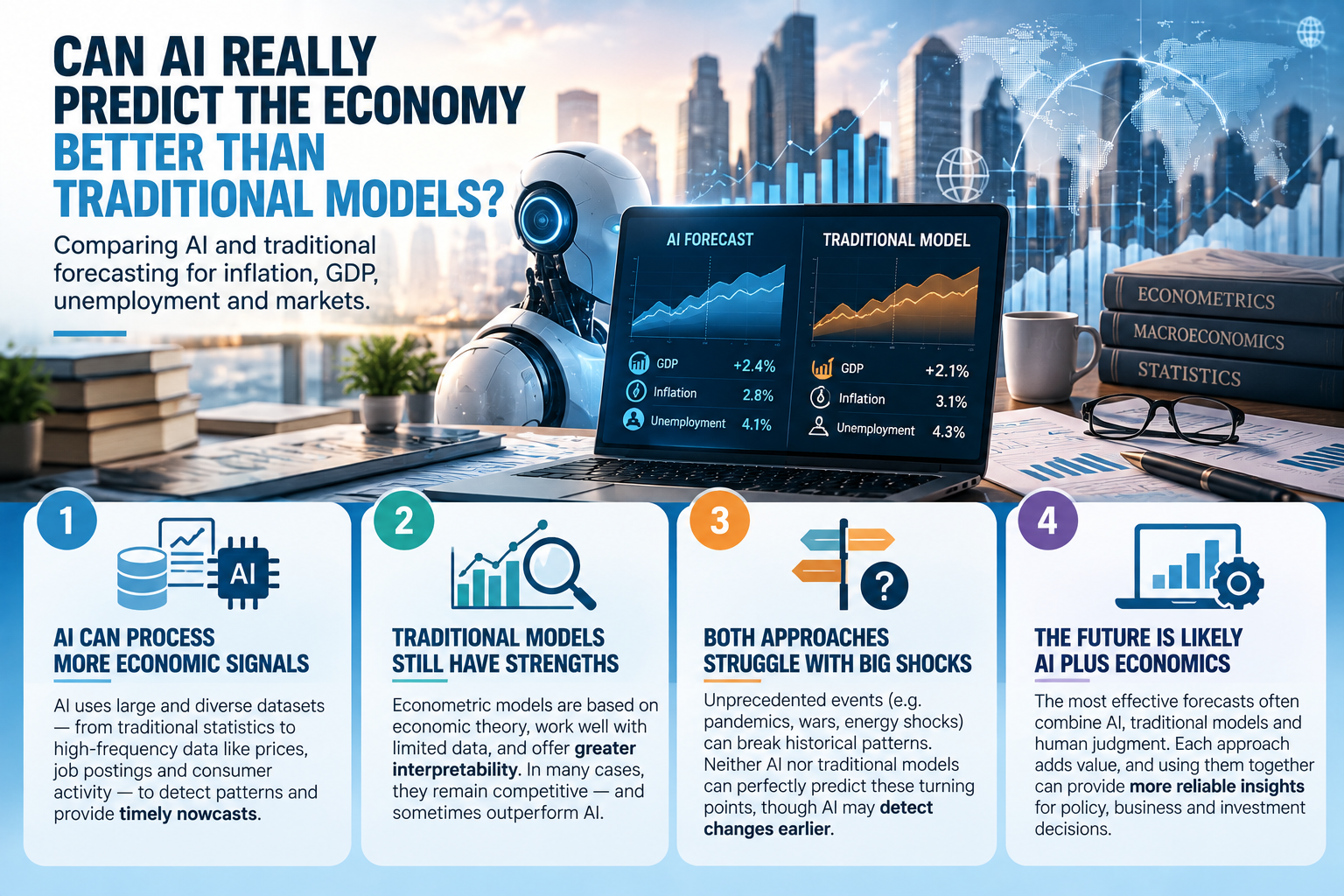
Can AI Really Predict the Economy Better Than Traditional Models?
Artificial intelligence can process enormous datasets, identify nonlinear relationships and update economic forecasts faster than many traditional models. But recent evidence shows that more sophisticated AI does not automatically produce more accurate forecasts, particularly when historical data are limited or the economy experiences an unprecedented shock.
For decades, economists have tried to forecast inflation, GDP growth, unemployment and financial conditions using statistical relationships built from historical economic data. Central banks, governments, banks and investment firms combine these models with surveys, market information and professional judgment to estimate what the economy may look like several months or years ahead. Artificial intelligence and machine learning are now adding another layer by processing much larger datasets and identifying relationships that conventional models may overlook. The important question is not whether AI can forecast the economy, but whether it can consistently forecast it better than established economic models.
At first glance, AI appears to have an enormous advantage because modern economies generate extraordinary quantities of information. Credit-card transactions, online prices, shipping activity, job postings, business surveys, financial markets and other high-frequency indicators can potentially reveal changes before official GDP or inflation statistics are published. The BIS notes that nowcasting systems can process dozens or hundreds of indicators, including conventional economic statistics as well as credit-card spending and web-based data. AI’s strongest advantage may therefore be its ability to understand what is happening now rather than its ability to see years into the future.
Traditional forecasting models have a different advantage: economic structure. Econometric models are usually constructed around explicit relationships between variables such as income, consumption, employment, interest rates, inflation and investment. This structure makes them useful not only for forecasting but also for explaining scenarios and evaluating how economic changes might propagate through the economy.
Recent evidence suggests that neither approach universally dominates. Some machine-learning models have beaten conventional benchmarks in inflation or macroeconomic forecasting, while other comparisons have found traditional econometric approaches outperforming sophisticated machine-learning algorithms. The emerging lesson is less dramatic than “AI replaces economists”: different forecasting tools perform better under different conditions.
AI Has a Major Advantage: It Can Process More Economic Signals
Traditional economic forecasting has always faced an information problem. GDP is measured quarterly, important official statistics arrive with delays, and initial estimates are sometimes revised substantially. Economists trying to understand the economy in real time are therefore effectively driving while looking through a rear-view mirror.
Machine learning can expand the information set dramatically. Models can potentially combine industrial production, retail sales, financial conditions, business surveys and labor-market information with much higher-frequency indicators. Instead of waiting for one official statistic, AI can search across hundreds of signals for evidence that economic momentum is changing.
This is particularly valuable for nowcasting, which estimates the present or very near-term state of the economy before complete official statistics are available. BIS research describes nowcasting as an area where AI can exploit large and complex datasets and incorporate new information as it becomes available. That capability can make AI particularly useful when policymakers or investors need a continuously updated assessment rather than an annual forecast produced once every quarter.
AI can also identify nonlinear relationships that simpler models may struggle to capture. The economic effect of rising energy prices, for example, may be different when inflation is already high, unemployment is low and consumer expectations are deteriorating than when the same energy shock occurs during a recession. Machine learning does not necessarily need to assume that the relationship between two economic variables remains constant across every economic environment.
That flexibility matters during periods of rapid change. BIS officials have highlighted machine learning’s potential to detect patterns, structural breaks and nonlinear relationships and to process real-time information more efficiently. Central banks are consequently exploring these technologies as additions to their analytical toolkits rather than treating them purely as experimental technology.
Inflation forecasting provides an interesting example. A BIS study covering 20 advanced economies from 2000 to 2021 used a machine-learning approach based on regression trees and found smaller prediction errors than standard OLS models using the same explanatory variables. The reported out-of-sample RMSE was 28% lower than a naïve AR(1) benchmark and 8% lower than OLS, while inflation expectations emerged as an especially important predictor.
This demonstrates that machine learning can add genuine forecasting value. But it does not establish that AI always predicts inflation better, because results depend on the dataset, forecast horizon, benchmark model, economic period and algorithm being tested. Winning one forecasting contest is evidence of usefulness, not proof of universal superiority.
Traditional Models Can Still Beat More Sophisticated AI
The apparent weakness of traditional economic models is also one of their strengths. Because they impose structure, they require fewer observations to estimate relationships than highly flexible machine-learning systems may need. This matters enormously in macroeconomics, where the amount of genuinely comparable historical data is surprisingly small.
Consider quarterly GDP. Fifty years of data provide only around 200 quarterly observations, and those observations span very different monetary systems, technologies, labor markets, trade relationships and policy regimes. For sophisticated AI, macroeconomic history can actually be a small-data problem disguised as a big-data problem.
This creates the risk of overfitting. A complex algorithm can become extremely good at explaining historical patterns that will never occur in exactly the same form again. Its performance on training data can look impressive while its ability to predict genuinely unseen economic conditions deteriorates.
A 2025 IMF working paper provides a particularly useful reality check. Researchers compared traditional econometric models with machine-learning algorithms for GDP nowcasting using simulations and six country cases and concluded that traditional econometric models tended to outperform machine-learning algorithms overall. Bridge and Dynamic Factor models were among the strongest conventional performers, while relatively simple linear machine-learning methods such as Lasso and Elastic Net performed better than more complicated nonlinear approaches.
The researchers identified limited GDP history as an important problem. Complex nonlinear algorithms were particularly vulnerable to overfitting, while machine-learning approaches became more competitive when long GDP histories and rich high-frequency datasets were available. More sophisticated AI did not automatically mean more accurate forecasting.
This finding also illustrates why the label “AI” can be misleading. Machine learning includes relatively transparent statistical techniques as well as neural networks and other highly complex systems. In some economic applications, the best-performing machine-learning technique may be considerably simpler than the technology people imagine when they hear “artificial intelligence.”
Traditional models also offer interpretability. Policymakers frequently need to understand why inflation is projected to rise, how an interest-rate change affects unemployment or what assumptions drive a GDP forecast. A forecast that is slightly more accurate but impossible to explain may be less useful for policymaking than a transparent model that allows economists to examine the mechanism behind the prediction.
Economic Shocks Expose the Weaknesses of Both Approaches
Every forecasting system ultimately learns something from historical experience. This creates a fundamental problem because the events economists most urgently want to predict are often events with few meaningful historical precedents. Pandemics, wars, financial crises, sudden commodity disruptions and major policy changes can break previously reliable relationships.
An AI system trained on decades of relatively normal economic data may therefore struggle precisely when the economy becomes abnormal. A relationship that worked thousands of times historically can become irrelevant when governments close parts of an economy, supply chains suddenly stop functioning or energy prices experience an unprecedented shock. AI is exceptionally good at recognizing patterns, but an unprecedented economic event may not provide a useful pattern to recognize.
Traditional models face the same problem from another direction. Their structural assumptions can become unreliable when consumer behavior, policy regimes or market relationships suddenly change. Economists then have to modify assumptions, introduce judgment and construct alternative scenarios.
This explains why economic forecasting remains uncertain even when sophisticated technology is available. The Federal Reserve’s Summary of Economic Projections, for example, presents projections for GDP growth, unemployment and inflation based on participants’ individual assessments and assumptions about appropriate monetary policy rather than presenting one mechanical model as an unquestionable forecast. The September 2026 projections continue this approach, covering outcomes through 2029 and the longer run.
AI may nevertheless become increasingly useful in detecting unusual developments sooner. A model monitoring thousands of high-frequency indicators could identify deteriorating hiring, spending or supply-chain conditions before those changes become visible in conventional quarterly statistics. The advantage is not necessarily predicting the shock before it happens; it may be recognizing the economic consequences faster once the shock has begun.
Newer AI architectures may improve this capability further. In March 2026, the BIS introduced BISTRO, a transformer-based model fine-tuned on a large repository of macroeconomic time series. In a test involving the 2021 inflation surge, the model anticipated greater persistence than standard benchmarks that projected inflation moving back toward its historical mean.
That result is promising but should be interpreted carefully. One historical episode does not establish that transformer models will systematically outperform established methods across countries, variables and future crises. Economic forecasting systems should be judged on repeated out-of-sample performance, not on their most impressive historical example.
The Future Is Probably AI Plus Economics, Not AI Versus Economics
The most productive comparison may therefore be the wrong one. Asking whether AI will replace traditional forecasting assumes that economists must choose between machine learning and conventional models. In practice, central banks and other forecasting institutions can combine them.
Traditional models provide economic structure and interpretability. Machine learning contributes pattern recognition, nonlinear modeling and the ability to process much larger information sets. Human economists provide institutional knowledge, judgment and the ability to recognize when historical relationships may no longer be appropriate.
The BIS has explicitly described AI as an extension of the analytical toolkit for central banks and noted that machine-learning approaches are not always superior to traditional ones. AI can improve forecasting and structural analysis, but this does not remove the need for economic theory, conventional modeling or expert judgment.
A practical forecasting system might therefore use several models simultaneously. An econometric model could provide the baseline GDP path, a machine-learning system could continuously nowcast activity using high-frequency information, another model could monitor inflation, and economists could evaluate why the systems disagree. Disagreement between models can itself become useful information because it reveals where uncertainty is concentrated.
Model combinations also reduce dependence on one forecasting philosophy. If a neural network, dynamic factor model, survey forecast and structural macroeconomic model all point toward weakening growth, confidence in the direction may increase even if their exact numerical forecasts differ. When they diverge sharply, decision-makers receive a warning that the outlook is unusually uncertain.
The distinction between forecasting horizons is equally important. AI may offer substantial advantages in real-time monitoring and short-term nowcasting because enormous amounts of current information are available. The farther the forecast moves into the future, the more it depends on assumptions about policy, behavior, technology and shocks that cannot simply be extracted from today’s data.
Financial markets present an even harder challenge. Market prices incorporate expectations extremely rapidly, meaning that an AI system must discover information or relationships that other market participants have not already incorporated. An algorithm’s ability to forecast GDP or inflation therefore does not automatically imply an ability to predict stock prices or consistently generate excess investment returns.
So, can AI really predict the economy better than traditional models? The evidence does not support a universal yes or no. Machine-learning systems can outperform conventional benchmarks in particular inflation and macroeconomic forecasting exercises, but recent IMF research on GDP nowcasting found traditional econometric models performing better in many tested cases.
The difference often comes down to the forecasting problem itself. AI becomes particularly attractive when researchers have large datasets, high-frequency indicators and potentially nonlinear relationships. Traditional approaches can remain highly competitive when historical samples are short, economic structure matters and interpretability is important.
Complexity should therefore not be confused with intelligence. A neural network with millions of parameters can theoretically identify relationships that a simple regression cannot, but it can also discover patterns that disappear immediately outside its training sample. In economic forecasting, a more complicated model is valuable only when it produces more reliable predictions on data it has never seen.
The biggest opportunity may be nowcasting rather than long-range prediction. AI can absorb incoming information rapidly and potentially recognize turning points earlier than slower conventional processes. Knowing that the economy has changed before official statistics confirm it can be enormously valuable, even if AI cannot tell us exactly where GDP or inflation will be three years from now.
Traditional economics remains important because policymakers and businesses need more than numerical predictions. They need scenarios, causal explanations and an understanding of how interest rates, fiscal policy, energy prices, employment and investment interact. AI can strengthen that process without eliminating the need for economic reasoning.
The future of economic forecasting is therefore unlikely to be AI replacing traditional models. It is more likely to be AI, econometric models, alternative data and human judgment competing with—and checking—one another.The real breakthrough will come not when one model claims to predict the economy perfectly, but when combining these tools makes economic uncertainty easier to detect, measure and manage.