
Does AI Make Workers More Productive—or Just Change the Way They Work?
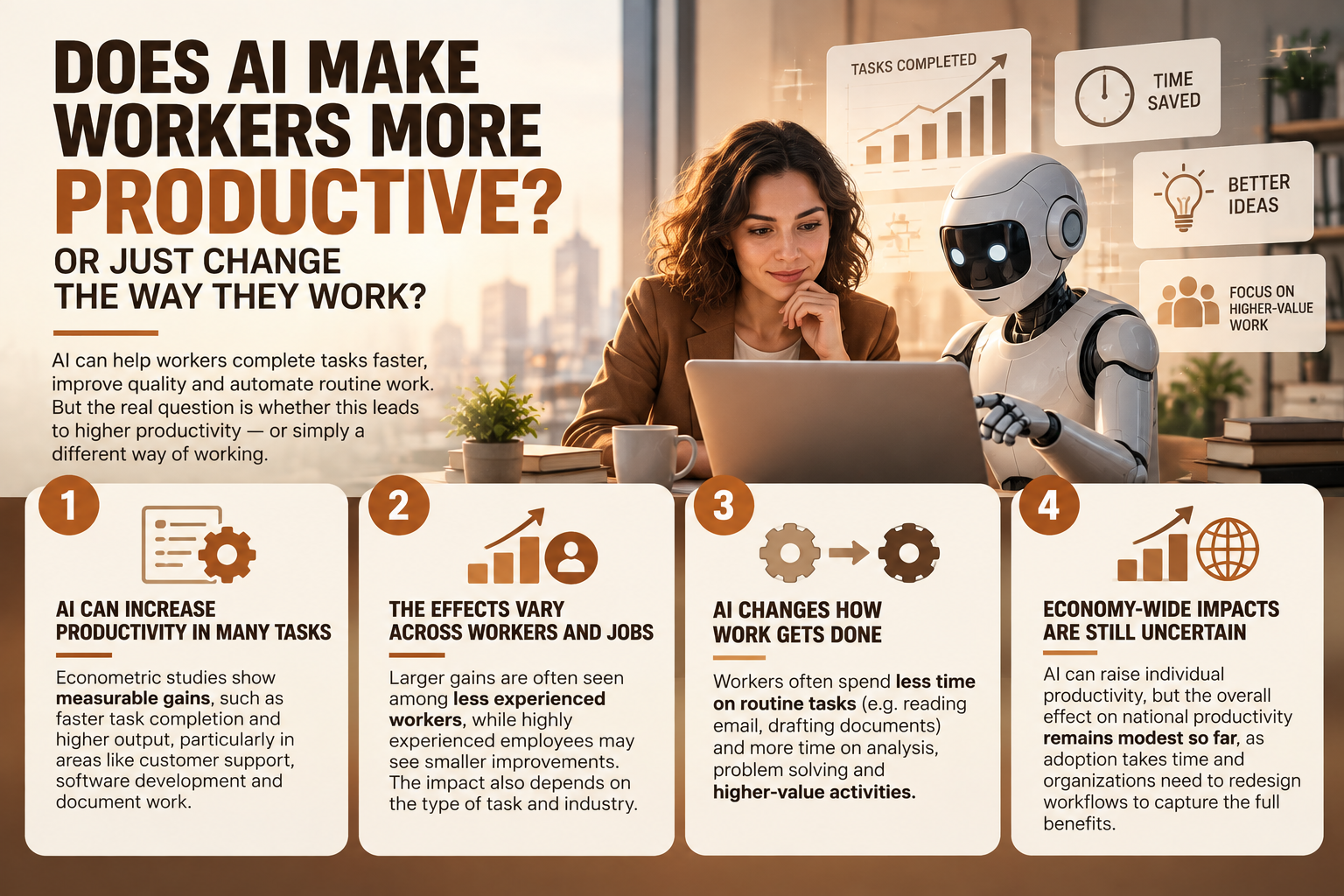
Generative AI can help workers complete some tasks faster, produce more output and reduce time spent on routine activities. But econometric evidence shows that productivity gains vary significantly across occupations, workers and organizations—and economy-wide productivity effects remain much harder to establish.
Generative AI has entered workplaces with an extraordinary promise: employees can write faster, analyze information more quickly, automate repetitive tasks and accomplish more without increasing working hours. Companies are consequently investing in AI assistants for customer support, software development, document preparation, research and administrative work. Yet productivity is an economic concept, not simply a measure of how impressive a technology appears or how frequently employees use it. The real test is whether AI allows workers to produce more—or better—output from the same amount of labor and other resources.
This distinction matters because AI can change work without necessarily increasing measurable productivity. An employee might generate more emails, presentations and reports while producing no additional economic value, or AI might save two hours that are subsequently absorbed by meetings and administrative tasks. Alternatively, employees could use the saved time for higher-value analysis, customer interaction or innovation, producing a genuine productivity improvement. Time saved by AI is therefore an input into productivity improvement, not automatically proof that productivity has increased.
Economists are beginning to answer this question using randomized experiments, staggered workplace adoption and other empirical methods rather than relying solely on surveys about whether employees feel more productive. The results are increasingly persuasive that generative AI can produce measurable gains in certain tasks and occupations, although the effects differ substantially between workers. Evidence from customer service, software development and knowledge work suggests improvements ranging from modest time savings to productivity increases above 20% in particular settings.
But another important fact remains: those improvements have not yet translated cleanly into aggregate national productivity statistics. The OECD reported in its 2025 productivity indicators that AI’s expected positive effects were not yet evident in aggregate productivity statistics, while the Federal Reserve said in July 2026 that AI adoption could be contributing to recent U.S. productivity gains but that the contribution appeared modest so far. AI can therefore produce measurable worker-level gains before economists can confidently identify a large economy-wide “AI productivity boom.”
The Strongest Evidence Shows That AI Can Raise Individual Productivity
One of the most influential real-world studies examined 5,179 customer-support agents using a generative AI conversational assistant. Researchers Erik Brynjolfsson, Danielle Li and Lindsey Raymond studied the staggered introduction of the technology and measured productivity through the number of customer issues successfully resolved per hour. Access to the AI system increased productivity by approximately 14% on average, providing evidence that AI assistance can generate measurable output improvements rather than merely changing employees’ perceptions of their work.
The average, however, concealed an even more interesting result. Productivity increased by approximately 34% for novice and lower-skilled workers, while the effects for highly experienced and highly skilled employees were comparatively small. The researchers found suggestive evidence that AI helped transmit the practices of stronger workers to less experienced employees, effectively allowing them to learn successful approaches more rapidly.
That finding changes how the economics of workplace AI should be understood. The technology may not simply automate tasks; it can potentially compress differences in accumulated knowledge between employees by making useful information and recommended responses available at the moment they are needed. A novice who previously needed months of experience to recognize recurring customer problems may receive something resembling that accumulated institutional knowledge through the AI system.
The productivity mechanism therefore resembles accelerated learning as much as automation. Experienced workers have already acquired many of the patterns, techniques and solutions contained in the AI’s recommendations, so the marginal value of those recommendations may be relatively limited. Less experienced workers have a larger knowledge gap for AI to fill, creating significantly greater potential gains. AI may be most economically valuable not when it replaces expertise, but when it makes expertise easier to distribute.
Evidence from software development points in a similar direction. A 2025 study combined randomized controlled trials involving 4,867 software developers at Microsoft, Accenture and another Fortune 100 company and estimated a 26.08% increase in completed tasks among developers given access to an AI coding assistant, although individual experiments were noisy. Less experienced developers again showed higher adoption and larger productivity improvements.
These results should not be generalized automatically to every occupation. Customer-support interactions and coding tasks provide relatively measurable outputs, whereas productivity in management, strategy, research or creative work can be considerably harder to quantify. The econometric evidence increasingly supports the proposition that AI can raise productivity, but it does not support the proposition that every worker receives the same productivity gain.
AI Changes How People Work Before It Changes the Organization
Another way to measure AI’s impact is to observe how employees allocate their time. A large randomized field experiment involving more than 6,000 workers across 56 firms gave some employees access to generative AI integrated into applications used for email, documents and meetings. Researchers could therefore examine not simply what employees said about AI but how their working patterns actually changed.
Workers who actively used the technology spent less time reading email and completed documents faster. Microsoft’s published analysis reports that users spent roughly half an hour less reading email per week and completed documents about 12% faster, while the broader study found substantial reductions in email time among workers who used the tool. These are concrete efficiency gains, although they do not necessarily imply an equivalent percentage increase in total worker output.
More revealingly, AI did not transform every component of work equally. The experiment found that access primarily affected behaviors employees could change individually, while activities requiring coordination with other people were much less responsive. Workers could use AI to change how they drafted a document or handled email, but the technology did not significantly reduce time spent in meetings.
This distinction reveals an important organizational constraint on AI productivity. Technology can optimize an individual task much faster than it can redesign the system of work surrounding that task. An employee might prepare a report in 30 minutes instead of two hours but still wait three days for managerial approval, attend the same meetings and navigate the same organizational processes.
That phenomenon resembles earlier general-purpose technologies, where technological capability arrived before organizations fully redesigned themselves around it. Firms frequently need new workflows, employee training, data infrastructure, performance measures and decision rights before technological efficiency becomes organizational productivity. The Federal Reserve similarly notes that it may take firms time to determine how best to integrate AI into production processes.
This is why asking whether AI saves time can produce a different answer from asking whether AI increases firm productivity. Saving 20% of the time required for one task does not increase company productivity by 20% if the task represents only a small part of the worker’s job or if the saved time is absorbed elsewhere. Economists therefore need to follow the productivity chain from task efficiency to employee output, organizational performance and eventually aggregate economic statistics.
Productivity Gains Depend on the Worker, Task and Organization
The emerging research strongly rejects the idea of a single universal “AI productivity effect.” OECD reviews of experimental evidence find that generative AI can increase efficiency in writing, summarizing, editing, translation and coding, with studies involving customer support, consulting and software development producing average productivity gains ranging from around 5% to more than 25%. But the OECD also emphasizes that outcomes depend on the task being performed and the experience of the user.
This variation makes economic sense. AI is especially useful when work contains information-intensive tasks that can be accelerated through drafting, summarization, classification, search or code generation. The productivity effect may be much smaller in occupations where physical activity, interpersonal trust, complex accountability or highly specialized expertise dominates the job.
Worker skill also interacts with AI in complicated ways. The customer-support and software-development studies suggest particularly large benefits for less experienced workers, implying that AI can partly substitute for experience in some tasks. But highly skilled workers may use AI differently, potentially applying it to more complex tasks where quality improvements are harder to capture through simple measures such as output per hour.
Quality introduces another complication. Producing ten reports instead of eight is not a productivity improvement if the additional reports contain errors that require human correction, create legal risk or lead to worse decisions. AI productivity must therefore be measured using both quantity and quality whenever output quality materially affects economic value.
How AI is implemented can matter as much as access itself. A 2026 field experiment involving 388 employees found uneven results when researchers changed the structure surrounding AI use: one behavioral protocol was associated with lower document quality and substantially lower document production, while another intervention showed some quality improvements at the upper end of the distribution, subject to important design limitations. Giving employees AI and redesigning work around AI are two different economic experiments.
This helps explain why identical AI technologies can produce different results across companies. One organization may integrate AI directly into reliable workflows, train employees and establish clear verification procedures, while another simply purchases licenses and tells employees to experiment. The software can be identical while the resulting productivity economics are completely different.
Worker-Level Gains Are Not Yet an Economy-Wide Productivity Revolution
The strongest productivity studies generally examine specific tasks, workers or companies. Macroeconomic productivity asks a much larger question: is an economy producing significantly more output from its labor and capital because of AI? Evidence that an employee completes a document faster is not automatically evidence that national labor productivity has increased by the same amount.
The OECD’s 2025 productivity compendium made this distinction particularly clear. It noted that AI, especially generative AI, was expected to influence future productivity positively under appropriate conditions, but its impact was not yet evident in productivity statistics. Multifactor productivity growth had stagnated or declined across many OECD countries in 2023 despite rapidly increasing attention to generative AI.
The U.S. picture is becoming more interesting. The Federal Reserve reported in July 2026 that business-sector labor productivity had grown at an average annual rate of 2.1% since late 2019, compared with 1.5% during the previous business cycle from late 2007 through 2019. The Fed attributed the stronger performance to several possible factors, including investment in labor-saving technologies and high-tech capital, increased business formation and, more recently, AI adoption—but described AI’s contribution as modest to date.
This does not contradict the workplace experiments. Adoption takes time, many firms have not reorganized around AI, and productivity gains concentrated in particular cognitive tasks initially represent only a fraction of total economic activity. A technology can produce strong experimental results long before it becomes sufficiently widespread to transform national productivity statistics.
Federal Reserve researchers describe a similar sequence for general-purpose technologies: capability improvements and declining costs are followed by investment and adoption, which in turn precede measurable productivity and labor-market effects. AI may therefore be somewhere within this diffusion process rather than at its final economic destination.
Employment effects are similarly unsettled. Federal Reserve researchers noted in March 2026 that AI could automate and replace some jobs, augment workers and create new occupations, but concluded that empirical research on adoption and employment remains at an early stage and that long-term conclusions remain difficult to formulate.
The relevant economic question is therefore not merely whether AI makes one worker faster. It is whether millions of workers adopt it, companies reorganize production around it, capital investment complements it and the resulting efficiency improvements survive when measured at the firm, industry and national levels. Microeconomic productivity gains are increasingly measurable; the magnitude of the macroeconomic productivity effect remains an open empirical question.
The available econometric evidence increasingly suggests that generative AI can produce genuine worker-level productivity improvements. Customer-support agents have resolved more issues per hour, software developers have completed more tasks and knowledge workers have completed some document-related activities faster. These are measurable outcomes rather than purely technological expectations.
But averages hide enormous differences. The largest improvements often appear among less experienced workers, while experienced employees may receive smaller gains in tasks where they already possess the knowledge AI provides. The productivity impact of AI depends on what workers do, what they already know and how effectively the technology complements their existing skills.
AI also changes the composition of work. Employees can spend less time drafting, searching or processing information and potentially devote more attention to judgment, customer relationships, problem solving and other activities. OECD workplace case studies have found job reorganization to be more prevalent than outright job displacement in the cases examined, with automation shifting work toward tasks where humans retain comparative advantages.
There are nevertheless potential costs. Workers have reported concerns involving greater work intensity, monitoring, skills and inequality, while organizations face questions about reliability and how saved time should actually be used. A technology that makes each task faster can simply result in workers receiving more tasks unless organizational design changes with the technology.
This is why the productivity debate should move beyond the question of whether employees have access to AI. Companies need to identify which tasks AI improves, measure output and quality, understand which workers benefit, redesign workflows and determine whether time savings translate into additional economic value. Simply counting AI licenses, prompts or generated documents says little about genuine productivity.
The evidence therefore points to a more nuanced conclusion: AI can make workers measurably more productive, but much of its early impact is also a reorganization of how work gets done. The largest economic gains are likely to emerge when firms convert faster individual tasks into better workflows, stronger human capabilities and genuinely higher-value output rather than simply asking employees to do the same work faster.