
Transfer Pricing Risks: When Intercompany Pricing Becomes a Governance Problem
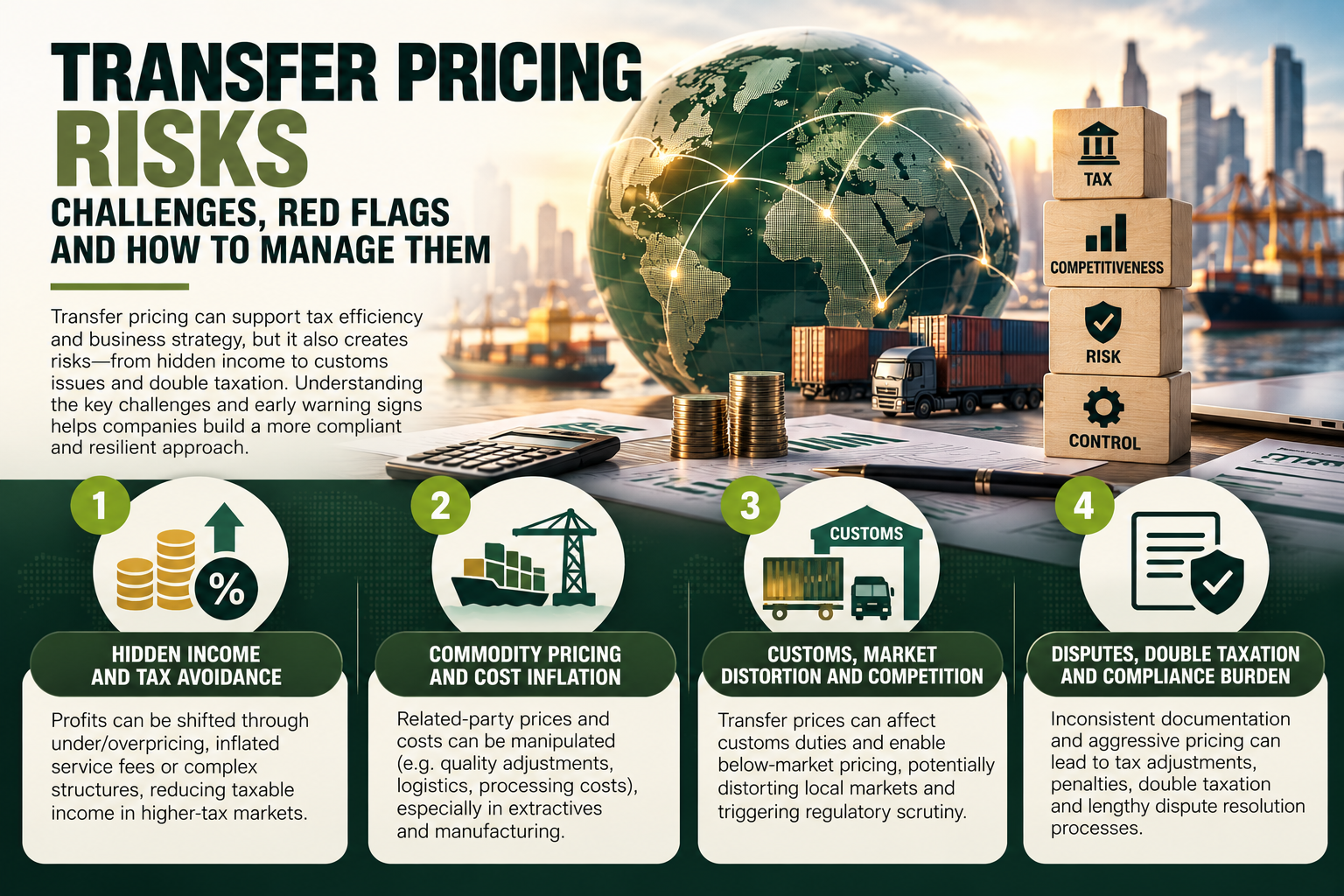
Transfer pricing is a legitimate and necessary part of multinational business, but poorly designed or deliberately manipulated related-party transactions can create significant tax, customs, governance and competition risks. Understanding the warning signs—from unexplained service charges to commodity pricing adjustments and persistent subsidiary losses—helps companies and authorities distinguish defensible intercompany pricing from arrangements that warrant deeper scrutiny.
Transfer pricing is a normal and necessary feature of multinational business. Companies operating through subsidiaries in multiple countries need prices for intercompany products, services, intellectual property, financing and other transactions. The central tax principle is that related-party cross-border transactions should generally be priced consistently with the arm’s-length principle, which the OECD describes as the international consensus for pricing such transactions.
The problem therefore is not the existence of transfer pricing. Problems arise when related-party arrangements do not reflect the underlying economic activity, when charges cannot be substantiated, or when internal prices are deliberately manipulated to produce outcomes that would be difficult to justify between independent parties. The important distinction is between legitimate transfer pricing and abusive or poorly controlled transfer pricing practices.
Those risks extend far beyond corporate income tax. Intercompany pricing can affect customs duties, resource revenues, subsidiary profitability, competition, cash flows and even corporate governance. A pricing mechanism that shifts $10 million of profit from one group entity to another simultaneously changes the financial position of both entities, even though the multinational’s consolidated operating profit may initially remain unchanged.
This makes transfer pricing a useful diagnostic tool for management, auditors, investors and tax authorities. Persistent losses, unusually large related-party charges, unexplained adjustments and entities earning significant profits without corresponding functions or assets do not automatically prove abuse—but they are legitimate signals for deeper examination.
The challenge is therefore to identify patterns rather than rely on isolated transactions. Four broad areas deserve particular attention: hidden or artificially shifted income, commodity and cost manipulation, customs and market distortions, and the compliance disputes that arise when the pricing model cannot withstand scrutiny.
Hidden Income and Aggressive Profit Shifting
One of the most serious transfer pricing risks appears when related-party transactions are used to obscure where economic income is actually generated. This can occur through underpriced sales, inflated procurement costs, poorly substantiated service charges, artificial rebates or other payments that reduce the reported profitability of one entity while increasing income elsewhere.
Management and tax authorities should be particularly attentive when a business reports substantial sales but persistently weak profitability while making large payments to related companies. That pattern does not prove manipulation because legitimate commercial factors can produce losses. The warning becomes stronger when weak local profitability coincides with large related-party payments that have limited evidence of corresponding economic benefit.
Management and consulting fees illustrate the issue. Multinational headquarters legitimately provide accounting, IT, legal, procurement, strategy and administrative services to subsidiaries, and appropriate intercompany charges can therefore be commercially justified. Problems arise when the recipient cannot demonstrate what services were actually received or why the charges provide economic value.
A strong control environment should therefore connect each material service charge to an agreement, methodology and evidence of performance. Reports, work products, correspondence, time records or other documentation can help establish what was delivered. An invoice establishes that a charge was made; it does not by itself establish that an economically valuable service was provided.
More sophisticated structures can involve royalties, financing arrangements, principal companies, regional hubs and cost recharges. None of these mechanisms is inherently abusive. The question is whether the resulting allocation of profit is consistent with the functions performed, assets used and risks assumed and controlled by the relevant entities.
The OECD’s transfer pricing framework is specifically intended to help prevent taxable profits from being artificially shifted away from the jurisdictions where the underlying economic activity takes place. Consequently, a low-tax company receiving substantial income while maintaining very limited personnel, assets or decision-making capability deserves closer functional and substance analysis.
A low tax rate is not itself evidence of abusive transfer pricing, just as a sophisticated legal structure is not evidence that the underlying pricing is arm’s length. The analysis has to return to economic substance and the actual controlled transactions.
Controls should therefore include functional analysis, benchmarking where appropriate, review of economic substance and consistency among intercompany agreements, transfer pricing documentation and actual operations. The more material the flow, the more important governance approval becomes.
Commodity Pricing and Cost Inflation Can Magnify the Risk
Transfer pricing becomes particularly sensitive in extractive industries because relatively small pricing differences can have substantial fiscal consequences. Oil, metals and minerals may be transferred between related producers, traders, refiners and marketing companies, creating multiple points where pricing adjustments affect the taxable income of individual entities.
Consider a producer selling a commodity to a related trading company. A benchmark price might be observable, but the actual transaction can legitimately differ because of quality, volume, transportation, insurance, delivery terms, currency and other economically relevant characteristics. The central question is not whether the transfer price differs from the benchmark—it is whether the difference can be economically explained and reliably measured.
OECD guidance specifically addresses commodity transactions and notes that quoted prices can provide a reference for applying the Comparable Uncontrolled Price method. It also recognizes that comparability may require adjustments for factors such as physical characteristics, quality, contractual volumes, delivery, transportation, insurance and foreign-currency terms.
This creates an obvious control point. A benchmark-minus arrangement may be commercially reasonable, but unusually large deductions deserve analysis. Quality discounts should correspond with reliable assay or technical evidence, while logistics deductions should correspond with realistic transportation and handling economics.
Commodity manipulation can occur inside the adjustments rather than in the headline benchmark price. A transaction can appear benchmark-based while excessive deductions for impurities, freight, processing or other items materially reduce the price received by the producing entity.
The same principle applies to costs. Related-party processing, transportation, technical and service expenses can reduce the taxable income of an operating company. Sudden increases in these costs, especially when they diverge significantly from independent benchmarks or technical realities, can warrant investigation.
Technical expertise therefore becomes essential. Transfer pricing teams examining mining, energy or industrial transactions may need engineers, commodity specialists and customs professionals in addition to accountants and tax lawyers. A technically implausible adjustment does not become economically credible merely because it appears in a transfer pricing model.
The OECD’s recent work on critical raw materials similarly notes the relevance of the CUP approach and quoted prices for commodity transactions while recognizing the need for adjustments reflecting the specific characteristics and terms of the transaction.
Effective controls can include independent assays, commodity benchmark testing, logistics comparisons, technical audits and verification that related traders perform genuine functions and assume economically meaningful risks. This makes the analysis much harder to manipulate through accounting entries alone.
Customs, Market Distortion and Related-Party Transactions Can Collide
Transfer pricing does not operate independently from other regulatory systems. The value assigned to goods crossing a border can affect both taxable profit and customs obligations, potentially creating competing incentives. A multinational therefore needs to understand the same transaction simultaneously from tax, customs, accounting and commercial perspectives.
Post-import transfer pricing adjustments make this interaction particularly important. A group may perform a year-end adjustment to bring an entity’s profitability into line with its transfer pricing policy, while customs authorities may have their own rules governing the value of imported goods and the treatment of later adjustments. Local requirements can differ substantially, so a tax-driven true-up should not automatically be assumed to produce the same result for customs purposes.
This makes consistency a major control objective. Tax and trade teams should understand the methodology used to establish intercompany prices, the circumstances that trigger adjustments and the documentary trail connecting contracts, invoices and accounting entries. A pricing policy that is defensible for income-tax purposes can still create operational problems if customs consequences are ignored.
Market behavior presents another dimension. A subsidiary might operate at very low margins because of genuine market-entry expenditure, recession, competition or other commercial circumstances. Persistent losses can nevertheless warrant closer examination when the entity continues expanding while another related entity consistently captures high returns.
Again, the pattern is a warning signal rather than proof. The correct question is whether independent parties in comparable circumstances would accept the allocation of functions, risks and returns. Transfer pricing analysis should explain the commercial reality rather than begin with the assumption that every loss-making subsidiary is being manipulated.
The stakes can become especially high where related-party arrangements intersect with weak corporate governance. An enterprise could potentially suffer economically from below-market sales, above-market procurement or poorly substantiated service arrangements involving connected parties. Such conduct can raise issues beyond transfer pricing, including conflicts of interest, fraud, procurement governance or other areas of law depending on the facts and jurisdiction.
Independent procurement benchmarking, conflict-of-interest declarations, beneficial-ownership checks and audit-committee oversight can therefore complement traditional transfer pricing controls. The most dangerous related-party transaction may not be the one with the most sophisticated tax structure—it may be the one that nobody independently reviewed.
Intermediaries deserve similar attention. Multiple entities between the operating company and ultimate service provider or customer are not inherently problematic, but management should understand what each intermediary actually does and how its remuneration was determined. High commissions paid to entities performing limited observable functions are a reasonable trigger for further review.
The objective is not to eliminate complex structures simply because they are complex. It is to ensure that economic reward remains connected to demonstrable economic activity and that management can explain why each material entity exists within the transaction chain.
Documentation, APAs and Dispute Readiness Are Critical Controls
The final challenge is what happens when tax authorities disagree with the multinational’s transfer pricing position. A significant adjustment can increase taxable income in one country without automatically reducing taxable income in another. The economic result can be double taxation of the same underlying income until the issue is resolved.
This is not merely theoretical. The OECD’s 2024 Mutual Agreement Procedure statistics reported an average completion time of about 30.9 months for transfer pricing MAP cases, illustrating how long cross-border disputes can remain unresolved. The OECD’s 2026 Manual on Effective Mutual Agreement Procedures was updated to provide practical guidance and best practices for resolving treaty-related tax disputes.
A prolonged transfer pricing dispute can create significant cash-flow and management burdens even when the taxpayer ultimately obtains relief. Tax may have to be paid or secured, penalties and interest may become relevant under domestic rules, advisers and employees spend substantial time on the dispute, and uncertainty can remain on financial statements.
Documentation is consequently a risk-management mechanism rather than a compliance formality. The functional analysis, agreements, benchmarking, calculations and actual conduct should tell a consistent economic story. Documentation prepared after an audit begins is far less useful than documentation supported by contemporaneous business evidence.
Master-file and local-file consistency is also important where those documentation requirements apply. A multinational should avoid describing an entity as strategically important in corporate materials while characterizing the same company as performing only routine functions for transfer pricing purposes unless the distinction can be economically explained.
Advance Pricing Arrangements can provide additional certainty for suitable material or recurring transactions, depending on the jurisdictions involved and their APA programs. The OECD notes that MAPs and APAs can improve tax certainty, including in circumstances involving multiple treaty relationships.
MAP provides another important mechanism where treaty conditions are satisfied. The OECD describes MAP as a process through which taxpayers can seek relief where actions by one or both contracting states result in taxation inconsistent with the relevant treaty, including situations involving double taxation.
But dispute resolution should be the final layer rather than the first line of defense. The strongest transfer pricing control is a business model whose contracts, pricing methodology, economic substance, accounting treatment and actual behavior remain consistent before an audit begins.
Transfer pricing creates risk because related companies do not negotiate with each other in exactly the same way as independent enterprises. Management can influence contractual terms, pricing formulas and internal allocations across entities under common control. That flexibility makes rigorous arm’s-length analysis and governance essential.
The warning signs are often recognizable. Persistent losses despite strong sales, unusually high royalties or service fees, one-directional year-end adjustments, unexplained commodity discounts, abnormal logistics costs, low-substance intermediaries and inconsistencies between transfer pricing and operational reality all deserve attention. But a red flag is evidence that a transaction should be investigated—not evidence that abuse has already been proven.
Commodity transactions demonstrate why this distinction matters. Differences from quoted prices may be entirely legitimate because quality, freight, delivery or other commercial characteristics differ. The risk emerges when adjustments are unusually large, inconsistent or unsupported by credible evidence.
The same logic applies to loss-making subsidiaries and low-tax entities. Both can exist for legitimate commercial reasons, but management should be able to explain the underlying economics and demonstrate that related-party remuneration corresponds with actual activity. Substance, documentation and consistency are ultimately more important than the appearance of the organizational chart.
For multinational companies, the strongest control environment combines transfer pricing expertise with finance, customs, legal, compliance and operational knowledge. Material related-party transactions should receive appropriate governance scrutiny, while technical and commercial evidence should support the assumptions embedded in the pricing model.
Ultimately, the biggest transfer pricing risk is not simply paying additional tax after an audit. It is operating a cross-border pricing system that management cannot clearly explain, document or defend when regulators begin asking why profits, costs and risks ended up where they did.