
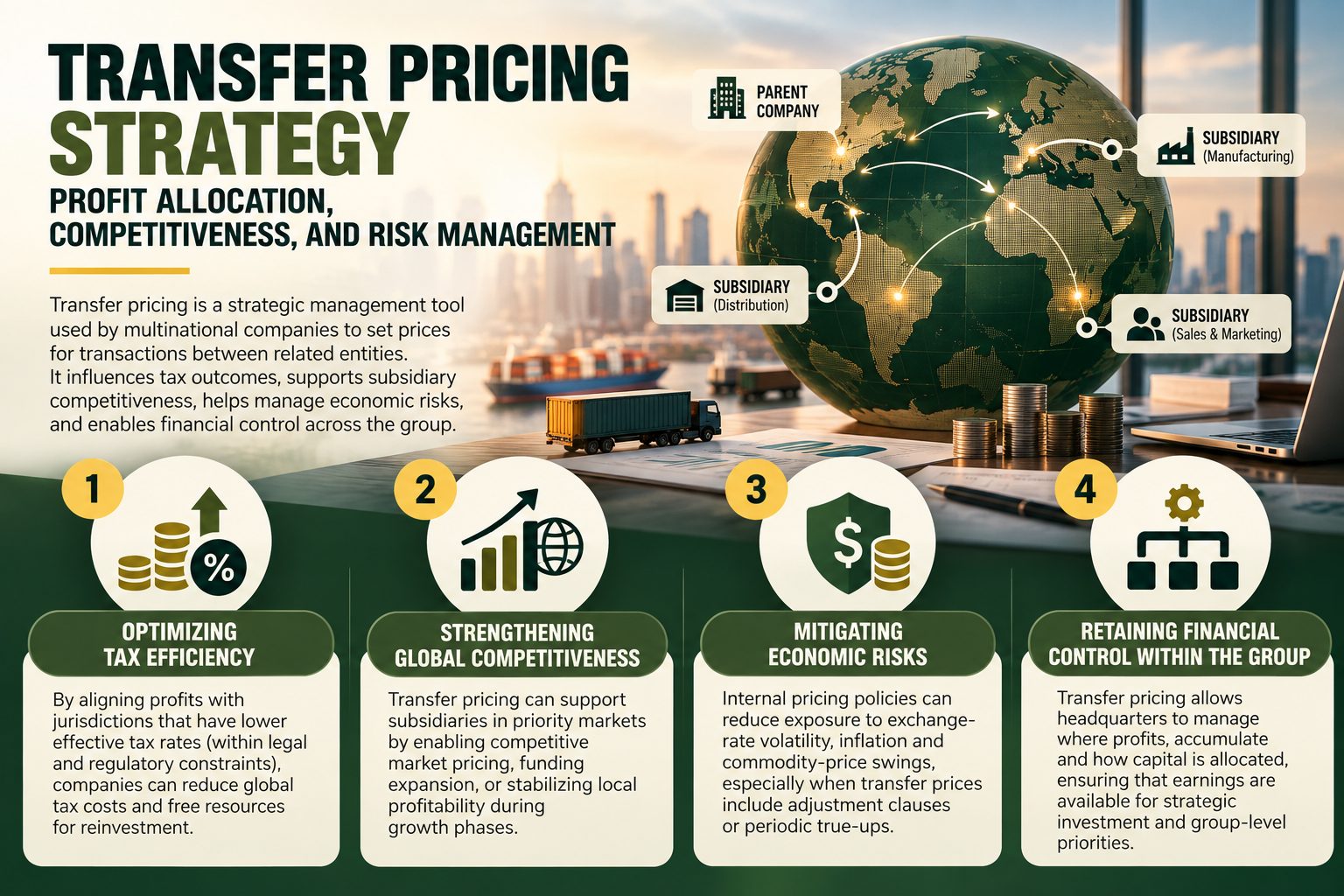
Transfer Pricing Strategy: Profit Allocation, Competitiveness, and Risk Management
Transfer pricing is more than a tax-compliance calculation. Intercompany prices influence where operating profit appears, how subsidiaries perform, who bears commercial risks and how multinational groups manage cross-border operations. The challenge is designing a commercially useful policy that remains consistent with the arm’s-length principle and economic substance.
Transfer pricing determines the prices and other conditions applied to transactions between related companies. These transactions can include products, services, intellectual property, financing, guarantees and other arrangements between entities belonging to the same multinational group. Because one entity’s expense is frequently another entity’s revenue, transfer pricing directly influences where operating profit appears within a multinational organization.
This makes transfer pricing strategically important. A change in the price charged by a manufacturing entity to a related distributor, for example, can change the profitability of both companies even though the consolidated group’s external revenue remains unchanged. Similar effects arise from royalties, management-service charges, intercompany financing and other controlled transactions.
But management discretion has an important boundary. The OECD describes the arm’s-length principle as the international consensus for pricing cross-border transactions between associated enterprises, with the objective of producing a principled allocation of profits and reducing disputes and double taxation.
Transfer pricing strategy should therefore not be understood simply as moving profits toward whichever entity or country management prefers. A defensible transfer pricing strategy connects intercompany remuneration to economic activity: functions performed, assets used, risks assumed and controlled, and the commercial relationships between the entities.
Within those constraints, however, transfer pricing remains an important management tool. Four dimensions are particularly significant: tax efficiency, market competitiveness, economic-risk allocation and group financial control.
Tax Efficiency Must Follow Economic Substance
Tax is the most visible aspect of transfer pricing because different entities within the same group can operate under substantially different tax systems. If one company earns more profit and another earns less, the group’s aggregate tax burden can change depending on the jurisdictions involved. This naturally makes intercompany pricing important to multinational tax planning.
However, lower tax cannot by itself justify allocating additional profit to a particular entity. Tax authorities generally examine whether the outcome is consistent with the functions performed, assets employed and risks borne by the parties. The OECD framework specifically seeks to prevent taxable profits from being artificially shifted away from jurisdictions where relevant economic activity takes place.
Consider a group containing a parent company, manufacturing subsidiary and local distributor. If the distributor performs relatively routine activities while the manufacturer controls significant production risks and owns important assets, the economic analysis may support different remuneration from a situation in which the distributor controls major market risks and performs valuable local functions.
Risk allocation is especially important. A contract might state that one subsidiary bears currency, inventory or development risk, but contractual language alone may not determine the transfer pricing outcome. OECD guidance emphasizes actual conduct and examines whether the entity assigned a risk controls that risk and has the financial capacity to assume it.
This creates a crucial distinction between tax optimization and artificial profit shifting. Legitimate transfer pricing planning operates within the economic structure of the group and applicable rules; simply assigning high profits to a low-tax entity without corresponding substance can create adjustments, penalties, interest and potentially double taxation.
The international environment has also changed substantially through the global minimum tax. OECD Pillar Two establishes a 15% minimum effective corporate tax framework for large multinational groups within its scope, reducing some of the traditional benefits associated with very low effective tax rates.
The strategic question is therefore no longer simply “Where is the tax rate lowest?” It is “Where does the economic activity justify the profit, and what is the after-tax result once the entire international tax framework is considered?”
Transfer Pricing Can Support Competitive Markets and Subsidiaries
Transfer pricing also influences how subsidiaries compete. A local distributor purchasing products from a related manufacturer has a cost base determined partly by its intercompany purchase price. That cost affects its gross margin and can influence its ability to compete against independent businesses in the local market.
This becomes especially relevant when a multinational enters a strategically important market. A local entity may initially face substantial marketing expenditure, customer-acquisition costs or other market-development investments. Management may want an intercompany model capable of recognizing the commercial circumstances faced by the subsidiary while remaining consistent with what independent parties would reasonably have agreed.
But there is an important limitation. Transfer pricing should reflect the commercial arrangement; it should not simply be adjusted until a subsidiary produces management’s preferred profit number. If an independent distributor would genuinely bear market-development risks and losses under comparable circumstances, the related entity may potentially do so as well, depending on the functional and comparability analysis.
Conversely, a subsidiary characterized as a routine or limited-risk distributor creates a different economic expectation. If headquarters claims that the subsidiary bears little economically significant risk but repeatedly leaves it with large losses whenever market conditions deteriorate, tax authorities may question whether actual conduct is consistent with the stated transfer pricing model.
The same principle applies when subsidiaries perform more valuable functions over time. A local business may begin as a straightforward sales operation but gradually develop customer relationships, marketing capabilities, technical expertise or other economically significant activities. Transfer pricing policies should evolve when the underlying business evolves.
This is one reason annual transfer pricing reviews matter. A policy designed when a subsidiary employed 20 people and performed routine distribution may no longer accurately represent a company employing hundreds of people and controlling major commercial decisions several years later.
The OECD’s Amount B work illustrates the broader effort to provide a simplified and streamlined approach for certain qualifying baseline marketing and distribution activities. It uses a pricing framework based on returns on sales for eligible distributors, subject to defined scope conditions.
Good transfer pricing therefore supports competitiveness by accurately reflecting the economic role of each entity—not by using intercompany prices as an unrestricted subsidy mechanism.
Transfer Pricing Strategy Can Allocate and Manage Economic Risk
Multinational businesses face currency movements, inflation, commodity-price volatility, credit risk, inventory exposure and changing financing costs. Intercompany contracts determine which legal entities are expected to bear many of these risks, making risk allocation a central component of transfer pricing strategy.
Foreign exchange provides a useful example. Suppose a manufacturer operates in dollars while its related distributor sells in euros. The group needs to determine who economically bears movements between those currencies and whether the pricing arrangement actually produces the risk allocation described in the intercompany agreement.
Simply writing that the distributor assumes foreign-exchange risk may not be sufficient. OECD guidance provides an example in which contractual allocation of currency risk can be contradicted by actual pricing behavior, reinforcing the principle that the economic conduct of the parties matters alongside the written contract.
Periodic adjustments or true-ups can also be part of transfer pricing systems, but they need a defensible basis. For example, a group might operate a policy designed to produce an arm’s-length return for a particular category of entity and later make an adjustment when actual results deviate from the policy. Such mechanisms require careful design because local tax, customs, VAT and accounting consequences can differ across jurisdictions.
Commodity businesses face another version of the same challenge. Large movements in energy, metals or agricultural prices can radically change margins between producers, processors and distributors. Transfer pricing needs to determine how economically significant risks and resulting returns are allocated rather than merely shifting volatility to whichever entity management wants to protect.
Financial transactions add further complexity. The OECD’s transfer pricing guidance covers intra-group loans, cash pooling, hedging, financial guarantees and captive insurance, emphasizing arm’s-length conditions for transactions that multinational groups can structure internally.
Risk cannot simply be transferred on paper. If an entity supposedly bears a significant risk but lacks the capability to make relevant decisions or the financial capacity to absorb the downside, the contractual allocation can face challenge under the OECD framework.
Transfer pricing and enterprise risk management should consequently interact. Treasury, tax, finance and operating management need a consistent understanding of which entity controls each material risk, how it is compensated and whether actual behavior matches the legal documentation.
Financial Control Requires Consistency Across the Entire Group
Transfer pricing also affects internal financial management because intercompany prices influence subsidiary revenue, costs, margins and reported profitability. Headquarters may therefore use transfer pricing information when assessing business units, allocating capital and understanding where economic returns arise across the value chain.
This creates a potential management problem. A subsidiary’s accounting profit is not necessarily a pure measure of local management performance because part of that profit may be determined by the group’s transfer pricing architecture. Evaluating managers solely on statutory entity profitability can therefore create distorted incentives.
Suppose a local distributor increases sales substantially but its intercompany purchase price also increases under the group’s pricing policy. The subsidiary’s reported margin may remain relatively stable despite strong commercial execution. Conversely, a transfer pricing adjustment could improve entity-level profit without any corresponding improvement in operating performance.
Management reporting should therefore distinguish between operational performance and transfer-pricing effects. Local executives can be evaluated using measures they genuinely control, while tax and finance teams separately ensure that the legal entities receive remuneration consistent with the applicable transfer pricing policy.
Consistency between documentation and operations is equally important. Intercompany agreements, invoices, transfer pricing documentation, management reporting and actual decision-making should describe the same economic arrangement. A sophisticated policy becomes vulnerable if contracts say one entity controls risk while internal records show that another entity actually makes all relevant decisions.
The challenge becomes greater as multinational structures grow. Hundreds or thousands of intercompany transactions may involve products, services, loans, intellectual property and cost allocations across dozens of jurisdictions. A transfer pricing strategy that cannot be implemented consistently is not an effective strategy, regardless of how elegant the theoretical model appears.
This is why governance matters. Tax teams need input from treasury, legal, finance and operational management, while significant changes in business models should trigger review of existing intercompany arrangements. Transfer pricing cannot operate effectively as an isolated year-end tax exercise.
Tax administrations also increasingly have access to more standardized information about multinational structures and transfer pricing. The OECD maintains country profiles covering domestic rules on arm’s-length pricing, methods, intangibles, services, documentation and dispute-resolution mechanisms, with the profiles updated through January 2026.
Financial control and tax defensibility therefore point in the same direction: intercompany pricing should follow a coherent economic model that is documented consistently and actually implemented in practice.
A strong transfer pricing strategy connects tax, finance and operating economics. It determines how related companies are compensated for the functions they perform, assets they use and economically significant risks they control, while also affecting subsidiary margins and the distribution of taxable income across jurisdictions.
Tax efficiency remains relevant, but it cannot be separated from substance. The OECD framework is explicitly designed around arm’s-length pricing and a principled allocation of profits, while current international tax reforms have further changed the economics of low-tax structures.
Competitiveness matters as well. Transfer pricing can materially affect the economics of a subsidiary operating in a difficult or strategically important market, but commercial support and local profitability need to remain consistent with the actual functions and risks of the entities involved.
Risk allocation provides the third dimension. Currency, financing, inventory and other risks can be allocated through intercompany arrangements, but contractual language needs to correspond with actual control and financial capacity. A group cannot make economic risk disappear simply by moving it from one contract to another.
Finally, transfer pricing affects internal management. Headquarters needs to understand how intercompany pricing changes subsidiary results so that tax outcomes are not confused with operational performance. The strongest transfer pricing systems align contracts, behavior, financial reporting and economic substance rather than optimizing each independently.
The strategic objective is therefore broader than minimizing tax or maximizing profit in a particular entity. Effective transfer pricing puts profit where the underlying economic activity supports it, protects the group’s ability to operate competitively and reduces the risk that today’s tax optimization becomes tomorrow’s tax dispute.