
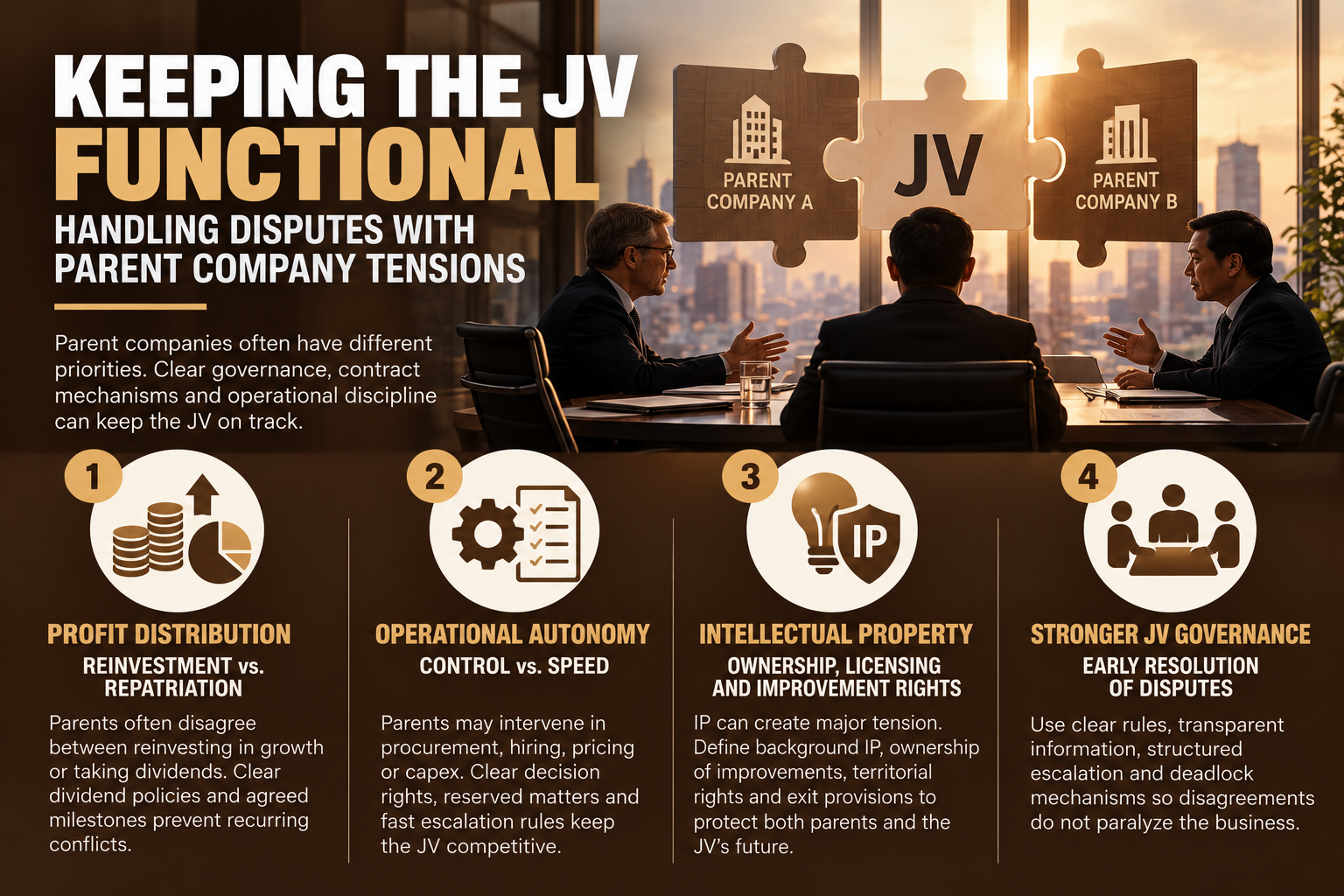
Parent Company Conflicts in Joint Ventures: Keeping the JV Functional
Joint ventures rarely fail because partners disagree. They fail when disagreements over cash, control, intellectual property and strategic priorities cannot be resolved without disrupting the business. Clear decision rights, objective financial rules and well-designed escalation mechanisms can keep parent-company tensions from becoming operational crises.
Conflict between a joint venture and its parent companies is not unusual. In fact, disagreement should be expected because the JV and its shareholders do not always have identical economic interests. The governance problem begins when ordinary disagreement prevents the JV from making decisions, investing, serving customers or executing its strategy.
Many JVs are established during a period of strong strategic alignment. Both parents want market entry, growth, technology sharing or access to complementary capabilities, making compromises relatively easy during negotiations. Several years later, however, market conditions, management teams and corporate priorities may be completely different.
One parent may need cash and push for dividends while the other wants aggressive reinvestment. One may want the JV to expand into a new market while the other worries that expansion will create a future competitor. The JV can consequently become trapped between what is economically rational for the business and what is strategically convenient for its shareholders.
The most useful way to understand this tension is to recognize that a JV is simultaneously an operating company and a contractual relationship between its parents. Management needs enough autonomy to run the company, while shareholders legitimately require control over decisions capable of materially affecting their capital, technology or reputation.
Successful JV governance does not attempt to eliminate these competing interests. Instead, it creates clear rules for cash, control, intellectual property and escalation before those interests collide.
Profit Distribution: Reinvestment vs. Repatriation
Dividend policy is one of the most predictable sources of parent-company conflict. Once the JV begins generating cash, management often wants to retain part of it for working capital, maintenance, capacity expansion and future growth. A parent company may instead want distributions to support its own cash flow or return targets.
Both positions can be economically rational. The problem occurs when the JV agreement does not establish how competing priorities should be resolved. Without an objective distribution framework, every dividend decision can become a negotiation over whose financial priorities matter more.
The disagreement becomes particularly damaging when investment decisions depend on the outcome. Management may need approval for a new production line, technology upgrade or capacity expansion but cannot determine how much cash will remain available. Capex is delayed while the parents negotiate distributions, and the JV can lose commercial opportunities even while reporting healthy profits.
A stronger approach is to connect dividends to objective financial gates. Distributions can depend on minimum liquidity, working-capital requirements, covenant compliance, approved capital expenditure and other measurable conditions. Once those conditions are satisfied, an agreed percentage of distributable cash can automatically become available to shareholders.
Milestones can provide another safeguard during the early years of the venture. Parents might agree that distributions remain limited until the factory reaches a specified utilization rate, customer-retention target or operating milestone. This converts a recurring shareholder argument into a rule established before the money is available to fight over.
The JV should also maintain an annually approved reinvestment priority list. Critical maintenance, safety expenditure, capacity expansion and strategic technology investment can be ranked before dividend negotiations begin. Parents then debate the capital plan as part of governance rather than reopening the entire question whenever cash accumulates.
Consider a manufacturing JV that generates strong earnings but needs another production line to satisfy customer demand. If its agreement requires minimum cash coverage before dividends can be distributed, management does not need to renegotiate the principle every year. The liquidity test protects the operating company while preserving shareholders’ right to receive excess cash once defined requirements are met.
Operational Autonomy: Parent Control vs. Management Speed
A second fault line concerns who actually runs the JV. Parent companies understandably want influence because their capital, technology, brands and reputations may be exposed. Yet excessive shareholder involvement can transform ordinary operational decisions into slow governance processes.
Procurement is a common example. A parent may want the JV to purchase components from its existing supply network, while management may identify cheaper or more reliable local suppliers. The situation becomes more sensitive when one parent is itself the proposed supplier because a normal purchasing decision becomes a related-party transaction with an inherent conflict of interest.
Hiring can create similar problems. Parents may want approval over senior appointments, expatriate assignments or compensation, particularly when employees are transferred from one shareholder. If approval requirements extend too far into ordinary recruitment, however, management can lose the flexibility required to build the organization.
Pricing presents another difficult boundary. Parents may legitimately want to protect a global brand or prevent the JV from disrupting prices in adjacent markets. But requiring shareholder approval for routine customer pricing can make the JV too slow to compete effectively.
The solution is a carefully designed delegation-of-authority matrix. Management should have explicit authority over routine decisions within the approved strategy and budget, while shareholder approval should be concentrated on genuinely material matters. Contract values, hiring authority, pricing flexibility and capex thresholds can all be defined numerically.
Major decisions can then be classified as reserved matters. These might include acquisitions, major borrowing, extraordinary capital expenditure, changes to strategy, material related-party transactions or amendments to important IP arrangements. Parents retain control where their fundamental interests are exposed without becoming shadow managers of daily operations.
Related-party procurement deserves especially strong safeguards. A JV can require benchmarking and board approval when purchasing from either parent while allowing management to select unrelated suppliers independently within an approved budget. This “procurement firewall” combines operational speed with protection against shareholder self-dealing.
Urgent decisions also need deadlines. An approval mechanism is ineffective if one parent can effectively veto a decision simply by refusing to respond. Escalation rules can require designated shareholder representatives to address urgent operating matters within 48–72 hours before the issue automatically moves to a higher governance level.
Intellectual Property: Who Owns the JV's Future?
Intellectual property is often more sensitive than cash because it determines what the JV—and potentially each parent—will be capable of doing in the future. A parent contributing proprietary technology wants to protect its existing IP, while the JV needs enough access to that technology to operate, improve products and remain competitive.
The first distinction should be between background IP and newly created IP. Background IP consists of technology, patents, software, processes, designs or know-how that a parent owned before contributing them to the venture. The JV normally receives defined usage rights without automatically acquiring ownership.
New IP creates a more difficult question. Engineers working inside the JV may improve manufacturing processes, adapt a parent’s technology to local conditions or develop entirely new products. The shareholders then need to determine whether those improvements belong to the JV, the contributing parent or both parties under some form of licensing arrangement.
“Improvement rights” should therefore be negotiated before improvements exist. The agreement can specify who owns modifications to licensed technology, whether the originating parent receives access to them and whether the JV can continue using those improvements after the relationship changes.
Territorial restrictions also matter. A parent may be comfortable allowing the JV to use technology inside one defined market but strongly oppose the venture exporting products into territories where the parent operates independently. Product scope, geography, sublicensing and customer restrictions should therefore be explicit.
Exit creates another potential conflict. If the JV depends entirely on technology licensed by one parent, termination of that license could make the business impossible to operate. A JV that loses access to essential IP when shareholder relations deteriorate may have little genuine independence regardless of what the ownership agreement says.
Continuity provisions can reduce this vulnerability. Depending on the commercial arrangement, licenses can include transition periods, continued-use rights under specified circumstances or predetermined mechanisms for handling IP following a shareholder exit. The appropriate solution depends on the technology, but the issue should be resolved contractually before relations deteriorate.
The central principle is that IP arrangements need to balance protection and functionality. Parents should not be forced to surrender strategic technology merely because they formed a JV, but the JV cannot operate sustainably if essential technology can be withdrawn whenever a shareholder dispute occurs.
Governance Must Resolve Conflict Before It Paralyzes the JV
Profit distribution, operational control and intellectual property look like separate problems, but they share the same structural cause: the JV and its parents have overlapping interests without having identical interests. Governance exists to manage that gap.
The first line of defense is precise decision rights. Management needs to know what it can decide independently, the board needs to understand which matters require approval and parents need clarity about which decisions remain shareholder matters. Ambiguous authority invites intervention precisely when speed matters most.
The second line is structured escalation. Operational disagreements should move through predetermined levels—from management to the JV board and, if necessary, to designated senior executives at the parent companies. Each stage should have deadlines so unresolved disputes cannot remain indefinitely inside the organization.
True deadlocks require additional mechanisms. Depending on the structure of the venture, agreements may provide mediation, expert determination, arbitration, buy-sell arrangements or ultimately termination provisions. The purpose of a deadlock mechanism is not to make separation easy; it is to make indefinite paralysis difficult.
Information rights are equally important. Parents are more likely to interfere operationally when they do not trust the information coming from the JV. Reliable budgets, forecasts, risk reporting, performance dashboards and board materials can reduce the perceived need for direct shareholder intervention.
Management also needs a clear institutional identity. Executives seconded from a parent can easily continue behaving as representatives of their original employer rather than managers of the JV. Roles, reporting lines and fiduciary responsibilities should make clear that JV management must operate the venture rather than function as competing extensions of the two parent organizations.
Finally, governance should be reviewed as the venture matures. Decision rights appropriate during construction or market entry may become unnecessarily restrictive once the JV develops experienced management and stable operations. Good JV governance evolves from intensive parental supervision toward greater operating autonomy as institutional capability increases.
Parent-company tension should not automatically be interpreted as evidence that a joint venture is failing. Different shareholders have different capital requirements, strategic objectives and risk tolerances. Disagreement is therefore an inherent feature of shared ownership rather than an exceptional event.
The danger appears when those disagreements enter daily operations. Dividend disputes can postpone investment, approval requirements can slow customer decisions and poorly designed IP arrangements can make technology a bargaining weapon. At that point, shareholder conflict begins destroying the value the JV was created to produce.
The strongest JVs reduce this risk through mechanisms established before conflict becomes serious. Objective dividend gates reduce annual arguments over cash, delegated authority protects operating speed, reserved matters preserve shareholder control and carefully drafted IP provisions clarify ownership before valuable technology is created.
Escalation and deadlock procedures provide the final protection. They acknowledge that some disputes cannot be solved at operating level and create a defined path toward resolution. Without those mechanisms, unresolved disagreements can remain inside the JV until customers, employees and financial performance begin suffering.
Ultimately, the goal is not perfect alignment between parent companies. Perfect alignment rarely survives changes in markets, leadership and corporate strategy. The more realistic objective is to build a venture that can continue functioning even when its shareholders temporarily want different things.
A successful JV therefore needs more than a compelling commercial strategy. It needs a governance architecture capable of absorbing disagreement without transferring that disagreement into the operating business. The real test of JV governance is not how well the partners work together when they agree—it is whether the company can still function when they do not.