
Joint Venture vs. Local Company: Where Conflict Usually Appears
Foreign joint ventures do not compete in a political vacuum. Tax incentives, rapid market-share gains, higher wages and imported supply chains can make a JV appear structurally advantaged over domestic competitors. Once commercial rivalry becomes a question of fairness, employment or local economic interests, ordinary competition can develop into regulatory and reputational risk.
Foreign joint ventures often enter markets with advantages that established domestic companies find difficult to replicate. They may bring international technology, access to capital, established brands, sophisticated management systems and global supplier relationships. Governments may reinforce those advantages through tax exemptions, customs relief, subsidized land or other incentives intended to attract foreign direct investment.
From the government’s perspective, these advantages can be justified by the economic benefits expected from the investment. New factories can create employment, transfer technology, increase exports and strengthen local supply chains. From the perspective of an established domestic competitor, however, exactly the same policy can look like the government is subsidizing a new rival.
That difference in perspective explains why joint venture conflict with local companies can become much more complicated than normal commercial competition. A domestic company that loses customers does not necessarily respond only by lowering prices or improving products. It may also appeal to industry associations, employees, journalists, regulators and politicians.
Once that happens, the competitive environment changes. The JV is no longer competing only for customers—it is competing for legitimacy. Tax incentives, market share, wages and sourcing decisions can all become evidence in a broader argument over whether foreign investment is strengthening the domestic economy or displacing domestic businesses.
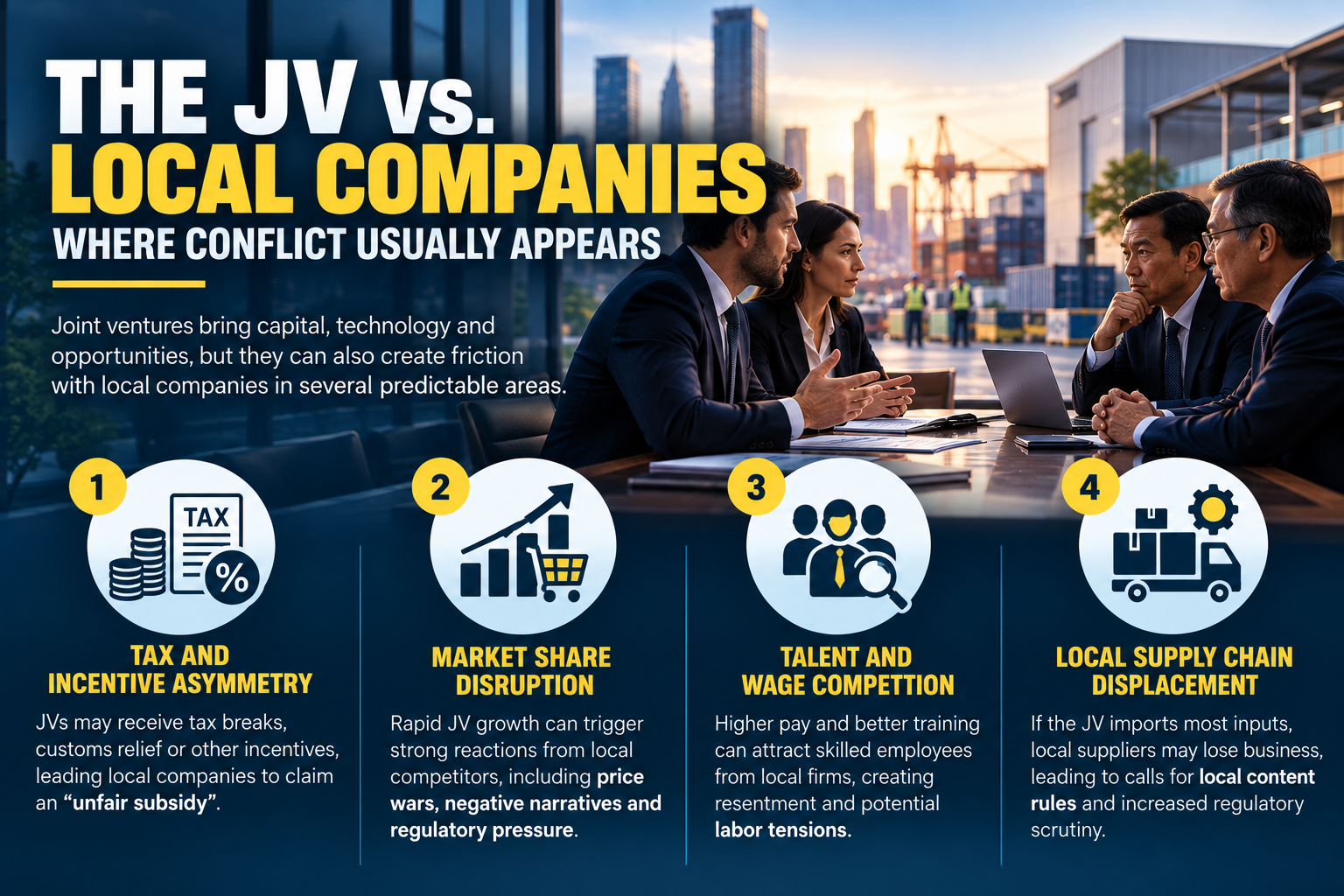
For JV management, these conflicts should therefore be treated simultaneously as commercial, regulatory and reputational risks. Four friction points deserve particular attention: tax and incentive asymmetry, market-share disruption, competition for talent and displacement of local suppliers.
Tax Incentives Can Make the JV Look Structurally Favored
Governments frequently use financial incentives to attract foreign investment. Corporate tax holidays, customs exemptions, subsidized industrial land, investment grants and preferential financing can materially improve project economics. These measures may be economically rational when governments are attempting to attract technology, capital or employment that otherwise would not enter the country.
The political problem appears when domestic competitors do not receive equivalent benefits. A local manufacturer paying the normal corporate tax rate may find itself competing against a JV receiving several years of reduced taxation and duty-free equipment imports. Even when the JV’s real competitive advantage comes from technology or productivity, the government incentive becomes the easiest advantage for competitors to attack.
The sensitivity can be especially high in industries with thin margins. In manufacturing, logistics or consumer products, a relatively small difference in costs can materially affect pricing and market share. Domestic companies can therefore frame foreign-investment incentives as an “unfair subsidy” that allows the JV to price below competitors.
The resulting risk extends beyond reputation. Industry associations may lobby governments to narrow incentive eligibility, tax authorities may scrutinize whether the JV continues to satisfy investment conditions and policymakers can face pressure to terminate preferential arrangements earlier than originally anticipated.
Management should therefore avoid building a business model whose competitiveness disappears when incentives disappear. Tax benefits should accelerate the investment case, not become the investment case. Productivity, technology, product quality and customer service need to become the sustainable sources of competitive advantage.
One useful management tool is a post-incentive cost curve. The JV can regularly model its profitability assuming that tax holidays, customs relief or subsidies end earlier than expected. If the business becomes uncompetitive under that scenario, management has identified a structural weakness before regulators or competitors expose it.
Rapid Market-Share Gains Can Turn Competitors Into Political Opponents
A successful JV can disrupt an established market remarkably quickly. Superior technology, international brands, better access to financing or more efficient production may allow the venture to capture customers faster than domestic competitors expected. Commercially, this is evidence that the investment strategy is working.
But the speed of expansion matters. When a JV takes marginal customers from a large domestic competitor, the reaction may remain commercial. When it captures anchor customers essential to the competitor’s utilization, cash flow or distribution network, the domestic company may begin treating the JV as an existential rather than ordinary competitive threat.
Price wars are one possible response. Local competitors may temporarily sacrifice margins to prevent the JV from establishing market share, while distributors can face pressure over which products they carry. Negative narratives concerning foreign ownership, employment or product quality may also emerge as the competitive dispute expands beyond price and service.
Industry associations provide another channel. Domestic companies often have established relationships with ministries, regulators and local authorities developed over decades. They can use those organizations to advocate for stricter industry standards, additional inspections or regulatory changes that affect the economics of the new entrant.
This is the point at which commercial competition can become political competition. A JV may be completely compliant and still face greater scrutiny because domestic competitors have successfully reframed their commercial losses as an industrial-policy problem.
The appropriate response is not political retaliation. The JV needs exceptionally strong compliance documentation, transparent commercial practices and credible relationships with industry stakeholders. The faster a foreign JV grows, the stronger its institutional legitimacy needs to become.
Commercial strategy matters as well. Competing primarily through aggressive price reductions can reinforce claims that the JV is using foreign capital or government incentives to destroy domestic competitors. Competing through quality, reliability, technology and customer service can make the economic contribution of the venture easier to defend.
Higher Wages Can Turn Talent Competition Into a Labor Issue
People represent another predictable source of conflict. Foreign-backed JVs may offer higher salaries, international training, modern facilities and clearer career-development opportunities than established domestic employers. For employees, those improvements can be highly attractive.
For local companies, the same process can look like systematic talent extraction. A JV that recruits experienced engineers, managers or technicians from competitors can increase wage pressure throughout a relatively small labor market. The JV may therefore affect competitors’ cost structures even when it never takes one of their customers.
This problem is particularly acute when specialized skills are scarce. A company can replace a general administrative employee relatively quickly, but losing experienced engineers, technicians or production managers can constrain operations for months. Domestic companies may consequently accuse the foreign venture of “poaching” employees or destabilizing the local labor market.
The issue can also extend to trade unions. If the JV pays substantially higher wages, its compensation structure may become a benchmark during negotiations at other companies. Domestic employers can then face demands they believe their own economics cannot support.
For the JV, this creates both external and internal risks. Externally, the company can face reputational criticism and greater scrutiny of employment practices. Internally, recruiting large numbers of people rapidly can produce inconsistent training, cultural problems, high turnover or safety weaknesses if organizational systems do not expand at the same speed.
The strongest response is to increase the supply of talent rather than merely compete for the existing supply. Apprenticeships, technical academies, university partnerships and professional certification programs allow the JV to demonstrate that it is building capabilities within the local economy.
Transparent compensation structures are equally important. Pay differences should be explainable through responsibilities, qualifications and performance rather than opaque individual negotiations. A JV that becomes known for developing people is politically easier to defend than one perceived merely as buying talent away from domestic employers.
Imported Supply Chains Can Create the Strongest Local Backlash
Conflict between a JV and local companies does not necessarily indicate improper conduct by either side. Foreign investors are expected to compete, while domestic companies naturally seek to protect their commercial interests. The governance challenge emerges when competitive pressures extend beyond the marketplace and begin to shape the broader business environment.
Supply-chain decisions can produce perhaps the most direct conflict between a JV and domestic business interests. Foreign investors frequently enter new markets with existing global suppliers because those suppliers already meet the group’s technical, quality and safety requirements. Operationally, importing familiar components can be the lowest-risk way to launch production.
Economically, however, this can limit the local benefits of foreign investment. If a JV imports machinery, components, packaging, professional services and raw materials, domestic suppliers may see relatively little new revenue despite substantial investment being announced locally. A foreign factory can create local employment while still generating much of its supply-chain value outside the host country.
Domestic supplier associations then have a clear incentive to lobby for localization. Governments may respond through local-content targets, procurement preferences, supplier-registration requirements or changes in customs treatment. Pressure can become stronger when imported inputs contribute to foreign-currency shortages or trade deficits.
Forced localization creates its own risks. A supplier that satisfies a local-content requirement may not immediately meet the quality, scale or reliability standards of an established international supplier. Switching too rapidly can therefore generate production interruptions, warranty costs or even product-safety problems.
The JV consequently needs a phased localization strategy rather than a binary choice between global and domestic sourcing. Local suppliers can be assessed against quality, cost, capacity and reliability standards, with development programs used where gaps can realistically be closed. Localization should be treated as capability development, not simply as a purchasing quota.
This approach can also improve the economics of the JV. Local sourcing can shorten lead times, reduce transportation costs and lower foreign-exchange exposure once suppliers reach the required standard. What initially appears to be a political concession can therefore become an operational advantage.
The broader objective is to demonstrate that the JV creates an economic ecosystem rather than an isolated foreign-owned operation. Local suppliers are not merely a compliance issue; they can become part of the venture’s long-term social and political license to operate.
Conflict between a JV and local companies does not necessarily indicate improper conduct by either side. Foreign investors are expected to compete, while domestic companies naturally seek to protect their commercial interests. The governance challenge emerges when competitive pressures extend beyond the marketplace and begin to shape the broader business environment.
The four principal friction points are closely connected. Tax incentives can intensify accusations of unfair competition, rapid market-share gains can strengthen lobbying against the foreign entrant, higher salaries can generate labor-market resentment and imported supply chains can create political pressure for localization. A JV experiencing several of these simultaneously can quickly become a visible target.
Management should therefore monitor more than revenue and market share. The venture should understand how much of its workforce is locally developed, how much procurement is localized, how dependent profitability remains on incentives and how competitors and industry associations perceive its expansion. These indicators provide an early-warning system for risks that conventional financial reporting may miss.
The objective is not to weaken the JV so domestic competitors can survive. A foreign investor should compete—but it should ensure that its competitive advantage can be explained through productivity, technology, quality and value creation rather than appearing dependent primarily on government privilege. That distinction matters enormously when political pressure increases.
The most resilient JVs therefore pursue two objectives simultaneously: commercial competitiveness and local legitimacy. They develop employees, strengthen suppliers, maintain transparent compliance and gradually reduce dependence on special incentives while continuing to compete effectively.
Ultimately, a JV does not operate only inside a product market. It operates inside a broader economic and political ecosystem containing competitors, employees, suppliers, regulators and communities. Winning market share may establish the business, but maintaining legitimacy helps protect the conditions under which that business can continue to operate.