
The JV vs. Government: Why This Relationship Becomes Difficult
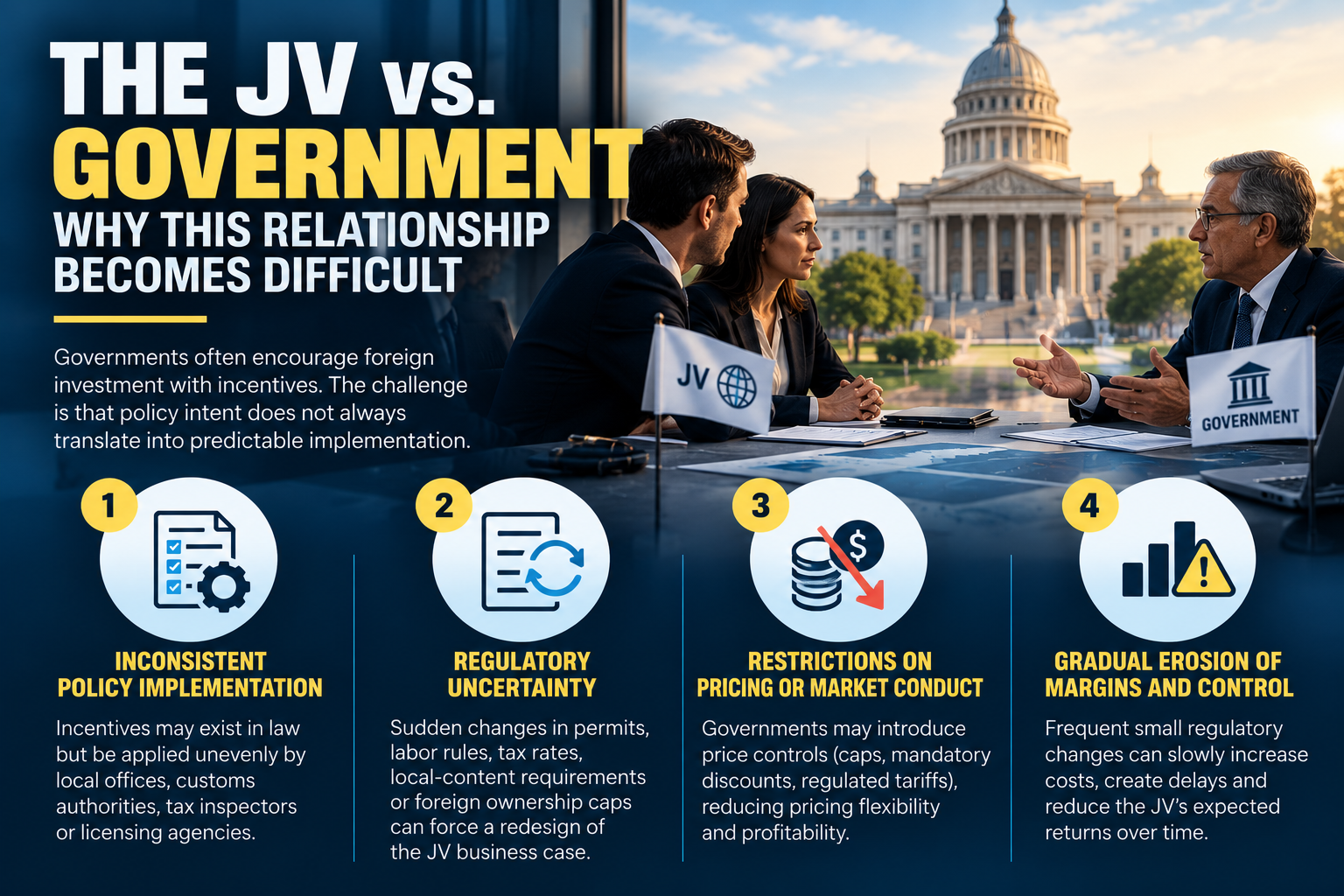
Governments often encourage foreign joint ventures through tax incentives, investment protections and simplified market-entry rules. Yet the greater challenge frequently begins after investment: inconsistent implementation, changing regulations and restrictions on pricing can gradually undermine the original JV business case.
One of the most frustrating problems for international JVs is the difference between formal policy and practical implementation. A national investment law may provide attractive incentives, yet the agencies responsible for customs, taxation, licensing or local permits may interpret those incentives differently. An incentive has limited economic value if the investor cannot reliably obtain it in practice.
Consider customs relief offered for equipment imported into a new manufacturing facility. The investment authority may approve the exemption, but customs officials can still dispute whether particular components qualify. Equipment can then remain at a port while the JV pays storage charges and waits for clarification.
Tax incentives can produce similar problems. A company may receive an investment agreement promising a reduced tax rate, only to encounter later disputes over eligible income, deductible expenses or the starting date of the incentive period. Even if the investor eventually prevails, years of uncertainty can affect cash flow and management resources.
Regional differences add another layer of complexity. National authorities may strongly support foreign investment while provincial or municipal governments apply environmental permits, labor requirements or construction rules differently. For the JV, the economically relevant regulation is not simply what appears in national legislation—it is what the authorities actually enforce.
This makes implementation risk difficult to model. A conventional financial model may assume a 10% tax rate because that is what the investment agreement provides, but it rarely assigns a probability to delayed refunds, disputed exemptions or administrative reinterpretation. The actual cost of regulation can therefore be substantially higher than the headline statutory rate suggests.
Strong JV planning should consequently distinguish between legal entitlement and implementation certainty. Before relying on an incentive, investors should examine how the rule has actually been administered, whether other investors have successfully used it and which government bodies control implementation.
Inconsistent Policy Implementation: The Law Says Yes, the Administration Says Maybe
One of the most frustrating problems for international JVs is the difference between formal policy and practical implementation. A national investment law may provide attractive incentives, yet the agencies responsible for customs, taxation, licensing or local permits may interpret those incentives differently. An incentive has limited economic value if the investor cannot reliably obtain it in practice.
Consider customs relief offered for equipment imported into a new manufacturing facility. The investment authority may approve the exemption, but customs officials can still dispute whether particular components qualify. Equipment can then remain at a port while the JV pays storage charges and waits for clarification.
Tax incentives can produce similar problems. A company may receive an investment agreement promising a reduced tax rate, only to encounter later disputes over eligible income, deductible expenses or the starting date of the incentive period. Even if the investor eventually prevails, years of uncertainty can affect cash flow and management resources.
Regional differences add another layer of complexity. National authorities may strongly support foreign investment while provincial or municipal governments apply environmental permits, labor requirements or construction rules differently. For the JV, the economically relevant regulation is not simply what appears in national legislation—it is what the authorities actually enforce.
This makes implementation risk difficult to model. A conventional financial model may assume a 10% tax rate because that is what the investment agreement provides, but it rarely assigns a probability to delayed refunds, disputed exemptions or administrative reinterpretation. The actual cost of regulation can therefore be substantially higher than the headline statutory rate suggests.
Strong JV planning should consequently distinguish between legal entitlement and implementation certainty. Before relying on an incentive, investors should examine how the rule has actually been administered, whether other investors have successfully used it and which government bodies control implementation.
Regulatory Uncertainty Can Rewrite the JV Business Case
The second major challenge is regulatory change itself. Joint ventures frequently commit capital on the basis of assumptions about tax rates, foreign ownership, labor costs, environmental obligations, import requirements and local-content rules. If those assumptions change materially, the economics of the entire investment can change with them.
Foreign ownership restrictions provide a straightforward example. An investor may enter a market because regulations permit majority foreign ownership, giving it effective control over technology, strategy and capital allocation. If future rules require greater domestic ownership, the foreign partner may need to restructure the venture or accept less control than originally anticipated.
Local-content rules can have an equally important financial effect. A manufacturing JV may initially import specialized components because domestic suppliers cannot meet its quality or volume requirements. A new requirement to source a larger percentage locally can increase costs, require supplier-development programs and potentially affect product quality or production schedules.
Tax and labor regulations can alter the model more gradually. Higher payroll costs, mandatory benefits, withholding taxes, environmental charges or changes to depreciation rules may individually appear manageable. When several regulatory changes accumulate, however, a project originally expected to generate an attractive return can become economically marginal.
This is why regulatory risk should not be analyzed only as a legal issue. Every significant regulatory assumption should connect directly to the financial model. Management should understand what happens to EBITDA, cash flow, project IRR and debt-service capacity if important rules change.
Scenario analysis is particularly useful. Instead of assuming that today’s regulation will continue indefinitely, the JV can model adverse cases involving higher taxes, tighter ownership restrictions, additional local-content requirements or delayed licensing. The objective is not to predict the next regulation; it is to determine whether the investment remains viable when regulation changes.
Price Controls Can Turn Market Growth Into Margin Compression
The third challenge arises when governments intervene directly or indirectly in pricing. This is particularly relevant in sectors considered socially or economically important, including energy, utilities, healthcare, pharmaceuticals, transportation, telecommunications and certain consumer products.
A JV may enter a country expecting market-based pricing and build its investment model accordingly. Later, the government may introduce price ceilings, regulated tariffs, mandatory discounts or approval requirements for price increases. Revenue can then become politically constrained while wages, imported inputs, financing costs and other expenses continue rising commercially.
The problem is particularly severe during inflation or currency depreciation. Imagine that a JV imports a substantial share of its inputs in dollars but sells its product in local currency under a regulated price. If the currency depreciates sharply while regulators refuse corresponding price increases, gross margins can contract rapidly even if sales volumes remain strong.
Direct price ceilings are only one form of intervention. Governments can influence economics through reimbursement rates, procurement rules, mandatory rebates or informal pressure on strategically important suppliers. The legal structure differs, but the economic consequence can be similar: management loses part of its ability to pass increasing costs to customers.
Price regulation can also weaken the normal relationship between demand and investment. If regulated returns become insufficient, the JV may rationally postpone capacity expansion or reduce discretionary investment even while customer demand remains strong. A policy designed to make a product cheaper can therefore alter the commercial incentive to supply additional capacity.
For the investor, the important question is not simply whether prices are regulated today. Management should examine how prices are determined, who approves changes, how frequently adjustments occur and whether the mechanism recognizes inflation, exchange rates and input costs.
These factors should be incorporated into sensitivity analysis before capital is committed. A business that remains profitable only if management retains complete pricing flexibility may be poorly suited to a market where pricing is politically sensitive.
Managing Government Risk Before It Becomes a JV Crisis
Regulatory risk cannot be eliminated, particularly in long-duration investments. But investors can reduce their exposure by treating government relationships and regulatory assumptions as core elements of JV design rather than issues for the legal department to handle after incorporation.
The first protection is rigorous due diligence. Investors should examine not only current legislation but also regulatory history, administrative practice and differences between national and regional enforcement. How a government implemented yesterday’s rules can sometimes reveal more than what today’s investment law promises.
The JV agreement should also anticipate regulatory change. Partners can define responsibility for obtaining licenses, dealing with authorities, funding compliance costs and responding to changes that materially alter the investment economics. Deadlock and exit mechanisms become particularly important when regulatory changes affect the partners differently.
Investment agreements and applicable investment treaties may provide additional protections depending on the jurisdiction and structure. Stabilization provisions, change-in-law mechanisms, dispute-resolution clauses and other contractual protections can help allocate regulatory risk, although their availability and enforceability vary substantially by country.
Government relations should also remain institutional rather than dependent on one politically connected individual. Personal relationships can help an investment navigate administrative systems, but they create another form of key-person risk. A sustainable government strategy depends on transparent relationships with institutions, not privileged access to individual officials.
Finally, management should maintain a regulatory-risk dashboard connected to the JV’s economics. Proposed tax changes, licensing developments, local-content rules and pricing interventions should be translated into potential financial effects rather than summarized only as legal developments.
The central principle is simple: regulatory developments should reach the financial model before they reach the income statement. That gives partners time to renegotiate contracts, adjust sourcing, modify financing or reconsider additional investment before the impact becomes irreversible.
The relationship between a JV and government is inherently complex because both sides operate on different time horizons and respond to different incentives. Governments want investment but must also respond to voters, fiscal constraints, domestic industries and changing policy objectives. Investors want access to attractive markets but need sufficient predictability to justify committing capital for many years.
That does not make government intervention inherently hostile to foreign investment. Taxation, labor standards, environmental rules and competition regulation serve legitimate public-policy objectives, while price regulation can be used to pursue affordability or other policy goals. The investor’s challenge is not to expect regulation to disappear but to understand how regulatory change affects the economics and control structure of the venture.
For many JVs, the greatest danger is therefore not one dramatic government action. It is the cumulative effect of delayed permits, inconsistent tax treatment, new local-content requirements, additional compliance costs and restrictions on pricing. Each change may appear manageable individually while collectively destroying much of the return anticipated when the investment was approved.
Successful JV governance requires regulatory risk to be monitored alongside financial, operational and partner risks. Boards and investors should continuously ask whether the assumptions supporting the original investment case remain valid and how much value would disappear if important regulatory conditions changed.
A government incentive can help launch a joint venture, but regulatory predictability determines whether that venture remains attractive over the long term. The strongest JVs are therefore not those that assume government policy will remain unchanged; they are those structured to remain economically resilient when it does not.