
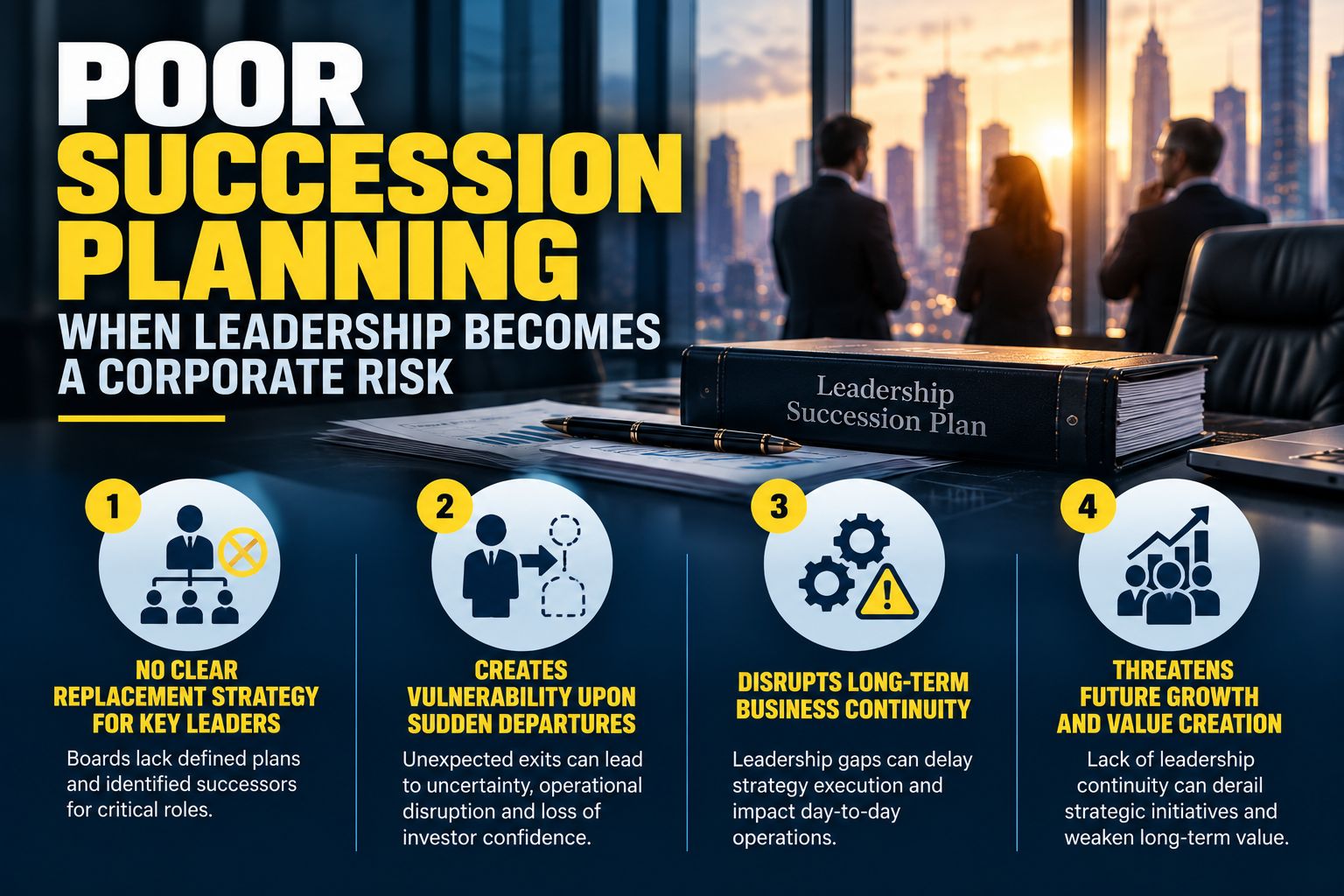
Poor Succession Planning: When Leadership Becomes a Corporate Risk
Leadership transitions are inevitable, but leadership crises are not. Poor succession planning leaves companies vulnerable when CEOs or other critical executives depart unexpectedly, potentially disrupting strategy, investor confidence and daily operations. Effective boards treat succession as a continuous risk-management process rather than a decision to make after a vacancy appears.
Every organization eventually replaces its leaders. CEOs retire, executives accept positions elsewhere, founders step aside and sometimes illness, dismissal, misconduct or other unexpected events force an immediate transition. The departure itself is usually not the governance failure—the failure is being unprepared when it happens.
A well-governed company should therefore know what happens if a critical executive becomes unavailable tomorrow. The board should understand which responsibilities require immediate reassignment, which internal executives could assume temporary leadership and whether credible long-term successors are being developed. These questions should be addressed while existing leadership is still functioning normally.
Yet succession planning can receive less board attention than financial results, acquisitions or immediate strategic problems. When leadership appears stable, replacing senior executives seems distant and hypothetical. That creates a dangerous paradox: the easiest time to plan succession is when succession does not appear necessary.
Poor succession planning turns an ordinary corporate transition into a potentially significant governance risk. A sudden departure can create strategic uncertainty, disrupt relationships with employees and customers, unsettle investors and expose how dependent the organization has become on a small number of individuals.
No Replacement Strategy Creates Key-Person Risk
Some companies become deeply identified with a founder or long-serving CEO. The executive may control important customer relationships, understand critical technology, dominate capital-allocation decisions and embody the company’s public identity. Strong leadership can create enormous value, but excessive dependence on one individual creates key-person risk.
This dependency is easy to underestimate while the executive remains in place. Decisions continue to be made, investors receive guidance and relationships remain stable, creating the appearance of institutional strength. The weakness becomes visible only when the organization has to operate without the person around whom those systems developed.
A board should therefore distinguish between a talented leader and an irreplaceable leader. If a company cannot function effectively without one executive, the governance system has allowed individual capability to substitute for institutional resilience. That is a vulnerability regardless of how successful the executive has been.
Succession planning should extend beyond the CEO. Chief financial officers, chief operating officers, technology leaders, business-unit heads and other specialized executives may control knowledge or relationships that are difficult to replace quickly. The more concentrated that knowledge becomes, the greater the operational consequences of an unexpected departure.
Boards should consequently maintain both emergency and long-term succession plans. The emergency plan answers, “Who takes control tomorrow?” The long-term plan answers the more difficult question: “Who should lead the company through its next strategic phase?”
Sudden Departures Can Turn Leadership Gaps Into Corporate Crises
Unexpected departures test governance structures immediately. If a CEO suddenly resigns, the board may have only hours to establish interim authority, communicate with employees and investors, satisfy disclosure requirements and reassure important customers or lenders. There is little time to begin designing a succession process from scratch.
Without an established plan, the company can enter a leadership vacuum. Senior executives may compete for authority, strategic projects can be delayed and employees may become uncertain about future priorities. A leadership vacancy can therefore spread into operational instability even when the underlying business remains financially healthy.
Markets can also interpret an unexpected departure as information about the company’s condition. Investors may question whether undisclosed operational, financial or governance problems contributed to the change, particularly when explanations are vague. Poor communication can consequently magnify uncertainty beyond the actual importance of the departure.
An emergency succession plan reduces this risk by establishing temporary authority in advance. The board should know who can serve as interim CEO, who assumes that executive’s existing responsibilities and how decision-making authority changes during the transition. Critical external stakeholders should also have clearly identified points of contact.
The same preparation applies below the CEO level. If a CFO leaves immediately before financial reporting, or a technology executive departs during a major systems implementation, the disruption can be substantial. Succession planning is therefore part of business continuity, not merely executive recruitment.
Preparation does not eliminate disruption, but it changes the organization’s response from improvisation to execution. That difference can be crucial during the first days of a leadership transition, when uncertainty is highest and stakeholders are looking for evidence that the board remains in control.
Poor Succession Planning Can Disrupt Long-Term Strategy
The consequences of weak succession planning extend beyond the immediate vacancy. Corporate strategies frequently require years to execute, meaning leadership transitions can occur halfway through acquisitions, restructurings, international expansions, digital transformations or major capital-investment programs.
A poorly managed transition can interrupt those strategies. A newly appointed CEO may lack sufficient understanding of previous decisions, while internal executives may disagree about which initiatives should continue. If the departing leader held substantial undocumented institutional knowledge, even understanding why earlier decisions were made can become difficult.
This creates an important governance challenge. Boards should plan succession around the future needs of the company rather than simply search for a replica of the current CEO. A leader who was ideal for rapid expansion may not be the right executive for a mature company requiring operational discipline, just as an effective restructuring specialist may not be suited to the next growth phase.
Internal talent development therefore becomes part of succession planning. High-potential executives can be given responsibility for major business units, exposed to board discussions and rotated through functions that broaden their experience. This gives directors an opportunity to observe potential successors before a leadership vacancy exists.
External candidates remain important because internal succession is not always appropriate. A company undergoing strategic transformation may deliberately require capabilities that do not exist inside the organization. The objective is not to guarantee an internal promotion but to create credible options before the decision becomes urgent.
Succession should also preserve institutional knowledge without preventing strategic change. Companies need mechanisms for transferring critical relationships, operational information and strategic context from departing executives while still allowing new leadership to challenge established assumptions.
Boards Must Treat Succession as a Continuous Process
CEO succession is fundamentally a board responsibility. Management can identify and develop talent, but directors need an independent view of what capabilities the organization will require and whether internal candidates genuinely possess them. A board that discusses succession only when the CEO announces a departure has started too late.
Effective succession planning should therefore appear regularly on the board agenda. Directors can review potential internal successors, assess development gaps and examine how leadership requirements could change under different strategic scenarios. These discussions should continue even when the current CEO is performing exceptionally well.
Emergency planning should run in parallel. The company needs a practical protocol for death, illness, resignation, dismissal or other sudden unavailability of a critical executive. Interim authority, disclosure responsibilities, communications and board decision-making procedures should be understood before they are required.
Boards should also examine whether the incumbent CEO has become an obstacle to succession. Powerful executives may naturally prefer certain successors, resist discussions about their eventual departure or retain responsibilities that prevent other leaders from developing. Succession planning cannot be effective if the person being succeeded effectively controls the entire succession process.
Compensation and retention policies also matter. Potential successors may leave if they see no credible path to advancement, particularly when a long-serving CEO provides little indication of eventual transition. Boards should understand whether key executives are being developed and retained rather than assuming they will remain available indefinitely.
Finally, succession plans need to be tested against different scenarios. The appropriate successor after an orderly retirement may differ from the person needed during a liquidity crisis, regulatory investigation or major operational disruption. Strong succession planning creates options; weak succession planning creates dependence.
Poor succession planning transforms predictable leadership change into unnecessary corporate risk. Every CEO and senior executive will eventually leave, even when the timing cannot be predicted. Boards therefore have little justification for treating succession as an unexpected event.
The strongest succession systems combine emergency preparedness with long-term leadership development. They identify temporary replacements, cultivate internal candidates, maintain access to external talent and ensure that strategic knowledge does not reside entirely with one individual. This allows leadership to change without forcing the organization itself into crisis.
Investors should pay attention to this issue as part of corporate governance analysis. An unusually dominant CEO, repeated departures of potential successors, limited executive depth or an unclear transition process can indicate greater key-person dependence. None automatically means a company has poor governance, but together they can reveal vulnerability that conventional financial ratios will not capture.
For boards, the most useful test is straightforward: if the CEO could not come to work tomorrow, who would run the company—and would everyone know what to do? If directors cannot answer that question immediately, succession is not merely an HR issue; it is an unresolved governance risk.
Long-term corporate resilience ultimately depends on institutions being stronger than individuals. Great leaders create value, but great governance ensures that the company can continue creating value after those leaders are gone.