
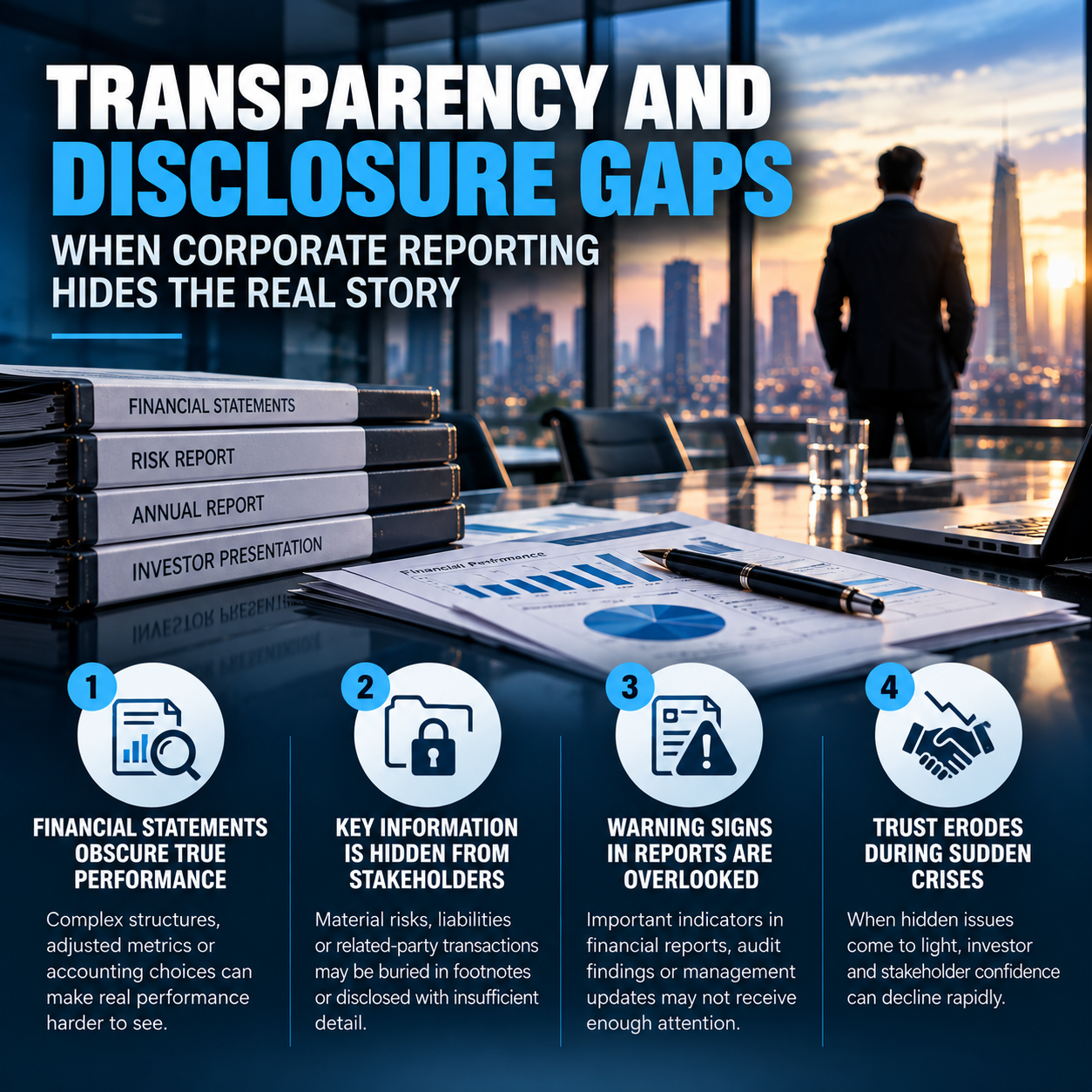
Transparency and Disclosure Gaps: When Corporate Reporting Hides the Real Story
Corporate transparency is more than publishing financial statements on time. When reporting obscures underlying performance, material information reaches stakeholders too late, or management emphasizes favorable metrics while minimizing emerging problems, disclosure itself becomes a governance risk.
Public companies produce enormous amounts of information. Annual reports, financial statements, earnings presentations, regulatory filings and investor calls can collectively run to thousands of pages. Yet a company can disclose large quantities of information without providing genuine transparency.
Transparency requires stakeholders to receive material information that is accurate, understandable, timely and sufficiently complete to evaluate the company’s financial condition and major risks. Disclosure can technically satisfy reporting requirements while still making the underlying economics unnecessarily difficult to understand. Complexity can therefore become almost as problematic as outright omission.
This distinction becomes particularly important when a company’s performance begins to deteriorate. Investors need to understand declining cash generation, rising leverage, weakening margins or increasing contingent liabilities before those problems become existential. When important information remains buried in footnotes or disguised by unusually favorable presentation, the market may continue operating with an incomplete picture.
Transparency and disclosure gaps become a corporate governance problem when information asymmetry prevents shareholders, creditors or boards from understanding the risks they are actually carrying. By the time reality becomes impossible to conceal, the resulting loss of trust can be more damaging than the original financial problem.
Financial Statements Can Be Accurate but Still Obscure Performance
Financial reporting is necessarily complicated. Modern corporations operate across countries, currencies and business segments while using acquisitions, derivatives, leases, pensions and complex financing structures. Accounting standards therefore require judgments that cannot always be reduced to a single objectively correct number.
The problem begins when that flexibility consistently makes performance appear stronger or risk appear smaller. Management might emphasize adjusted earnings that exclude recurring costs, highlight EBITDA while debt and capital expenditure continue rising, or focus attention on revenue growth despite deteriorating cash generation. The individual figures may be technically valid while the overall presentation creates an incomplete impression of economic performance.
Non-GAAP and alternative performance measures illustrate the issue. These metrics can be extremely useful when they remove genuinely unusual items and help investors understand recurring operations. They become less informative when companies repeatedly exclude costs that are supposedly “one-time” but appear year after year.
Cash flow provides another important test. Reported earnings can rise while operating cash flow deteriorates because of working-capital movements, aggressive revenue recognition or other accounting effects. Investors therefore need to reconcile income-statement profitability with actual cash generation rather than assuming the two measures will move together.
Balance sheets can contain similar warning signs. Increasing receivables, growing inventories, unusual related-party balances or rapidly expanding intangible assets may all deserve explanation when they grow significantly faster than the underlying business. None automatically proves improper reporting, but unexplained divergence between accounting performance and economic reality should trigger questions rather than reassurance.
The board and audit committee therefore need to consider not merely whether the financial statements comply with accounting standards. They should also ask whether a reasonable investor can understand what is actually driving the company’s performance.
Key Information Can Be Disclosed Without Being Visible
Material information does not always disappear completely. Sometimes it is technically disclosed but located where few stakeholders are likely to recognize its significance. A critical liability buried deep inside a lengthy filing can satisfy a disclosure requirement while providing little practical transparency.
Complex organizational structures can make the problem worse. Subsidiaries, joint ventures, special-purpose entities and related-party arrangements may distribute economic risks across multiple legal entities. Without clear explanations, stakeholders can struggle to determine which risks ultimately remain with the parent company.
Related-party transactions deserve particular attention because they can create conflicts between controlling shareholders, executives and outside investors. Transactions involving management, family members, major shareholders or affiliated entities may be legitimate, but transparency becomes especially important whenever the parties negotiating a transaction are not economically independent.
Risk disclosures can suffer from a different problem: excessive generality. A company may produce pages describing cybersecurity, supply-chain, regulatory and economic risks while saying little about which risks are increasing or have already begun to affect operations. Standardized language can then function more as legal protection than useful information.
Boards should therefore consider the accessibility of disclosure as well as its completeness. Material information should be sufficiently prominent for investors to understand its significance without reconstructing the company’s economics from dozens of disconnected footnotes.
If stakeholders need forensic accounting skills to discover a major corporate vulnerability, disclosure may exist while meaningful transparency does not.
Poor Disclosure Turns Financial Problems Into Trust Crises
Information gaps become most damaging when unexpected events force previously underestimated risks into public view. A sudden liquidity crisis, accounting restatement, cyberattack, covenant problem or regulatory investigation can cause investors to reconsider not only the immediate event but everything management previously told them.
This creates a second-order problem. The market is no longer asking only, “How expensive is this crisis?” Investors begin asking, “What else don’t we know?” Once that question becomes widespread, uncertainty itself can acquire financial value.
Creditors may demand higher interest rates or tighter contractual protections. Shareholders may apply lower valuation multiples because they no longer trust management guidance. Suppliers can reduce payment terms, employees may reconsider their future with the organization and customers can become reluctant to enter long-term relationships.
This explains why relatively manageable operational problems can become much larger governance crises. A company with transparent reporting can acknowledge a problem, quantify its likely consequences and explain its response. A company already suffering from credibility problems must first convince stakeholders that its new explanation is reliable.
Delayed disclosure can make this dynamic significantly worse. Management naturally has incentives to avoid unnecessarily alarming markets while facts remain uncertain, and companies should not publish unsupported speculation. But there is an important difference between verifying facts before disclosure and repeatedly delaying material information because the message is unfavorable.
Trust therefore behaves somewhat like corporate capital. It accumulates slowly through consistent reporting and credible communication but can disappear rapidly when stakeholders conclude that previous disclosures did not reflect the company’s actual condition.
Boards Must Govern the Quality of Corporate Transparency
Transparency cannot be delegated entirely to the finance department. Senior executives, the audit committee, internal auditors, external auditors and the full board all influence whether stakeholders receive a reliable picture of corporate performance.
The audit committee has a particularly important role because it sits between management and the external assurance process. Directors should understand significant accounting judgments, changes in estimates, unusual transactions and disagreements with auditors rather than treating audited financial statements as sufficient evidence that reporting risk has disappeared.
Boards should also compare financial reporting with internal management information. If executives monitor cash flow, customer churn or operational incidents internally because those measures are crucial to running the company, directors should consider whether external investors receive enough information to understand the same economic drivers.
Consistency matters across reporting channels. Annual reports, sustainability reports, investor presentations and executive interviews should not tell materially different versions of the company’s condition. Selective transparency—emphasizing favorable information in prominent communications while relegating unfavorable information to technical filings—can undermine credibility even when individual disclosures remain legally compliant.
Whistleblower systems provide another safeguard. Employees may observe reporting problems, control failures or questionable transactions long before outside investors can identify them. Boards therefore need mechanisms through which serious concerns can reach independent directors without being filtered by the executives potentially implicated in those concerns.
The objective is not maximum disclosure of every piece of corporate information. Businesses legitimately possess commercially sensitive information, and excessive disclosure can overwhelm rather than inform stakeholders. The objective is decision-useful transparency: giving stakeholders the material information necessary to understand performance, risk and financial condition without obscuring the underlying economics.
Transparency and disclosure gaps rarely create the underlying business problem by themselves. They make existing problems harder to identify, easier to postpone and more damaging when finally revealed. A weak investment, deteriorating margin or increasing debt burden may be manageable when recognized early but considerably more dangerous when hidden behind incomplete reporting.
This is why corporate transparency should be treated as a governance mechanism rather than simply a compliance requirement. Effective disclosure reduces information asymmetry between management, boards, shareholders and creditors. It allows those stakeholders to evaluate corporate decisions before weaknesses become crises.
For investors, warning signs can include repeated reliance on adjusted metrics, unexplained differences between earnings and cash flow, rapidly changing accounting estimates, opaque related-party transactions, vague risk disclosures and unexpected revisions to previously reported information. No individual signal proves misconduct, but clusters of unexplained anomalies deserve closer examination.
For boards, the critical test is not simply whether information has technically been disclosed. Directors should ask whether stakeholders could reasonably understand the company’s true financial condition from the information provided. Compliance answers the question “Did we disclose it?” while transparency asks the more important question: “Could investors understand it?”
When the answer to the second question is no, disclosure becomes a governance weakness. And when a sudden crisis eventually exposes what routine reporting failed to communicate, the company may discover that restoring lost trust is considerably more difficult than correcting the original financial problem.