
Inadequate Risk Oversight: When Boards Ignore Warning Signs
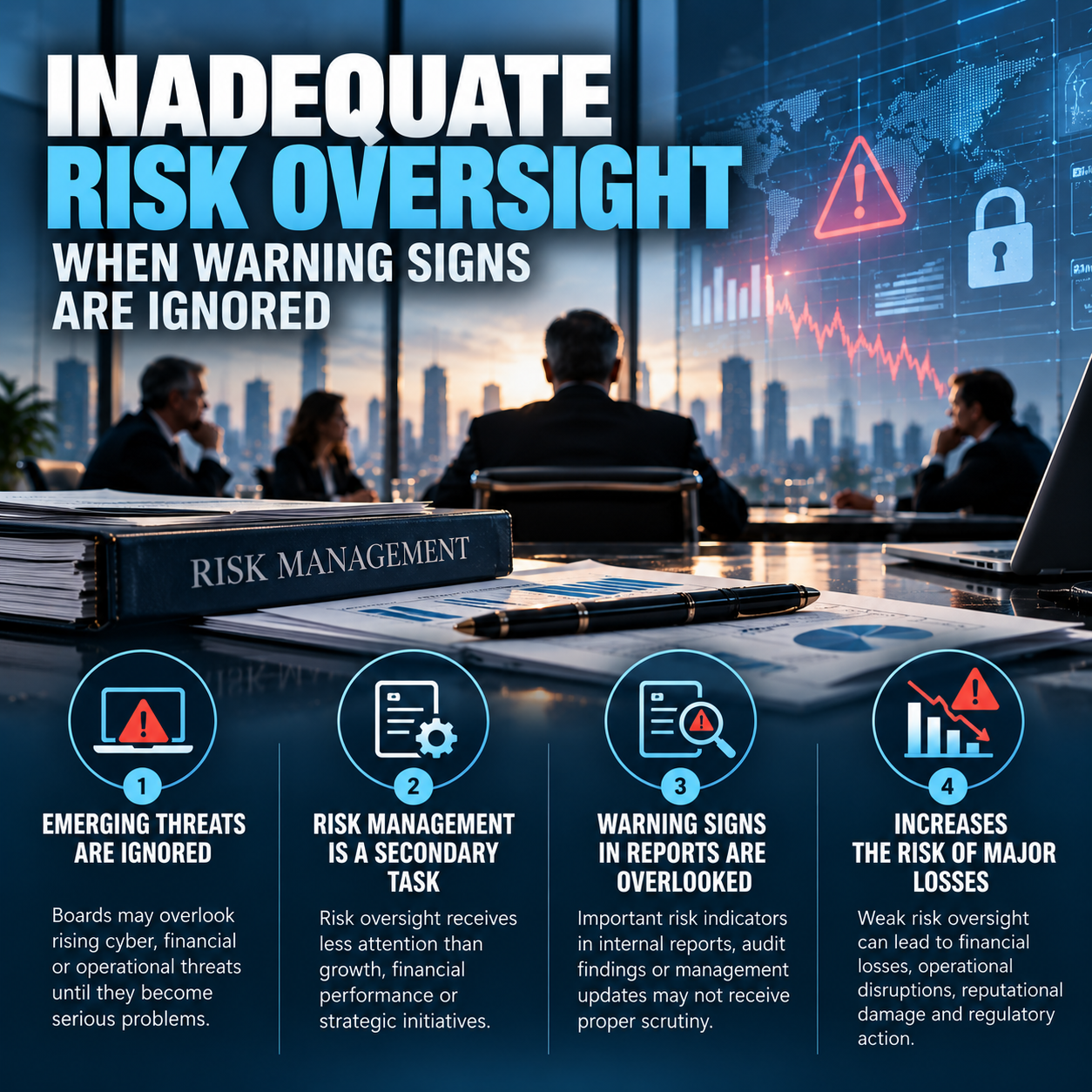
Boards do not need to predict every corporate crisis, but they need systems capable of identifying material risks before those risks become existential. Inadequate risk oversight emerges when cyber threats, financial vulnerabilities and internal warning signs receive insufficient attention, leaving directors reacting to crises they should have been monitoring.
Every company takes risks. Expanding into a new market, launching a product, acquiring a competitor, borrowing money or implementing new technology all involve uncertainty. Good corporate governance does not eliminate risk; it ensures that the company understands which risks it is taking, how large they are and whether they remain consistent with its strategy and capacity to absorb losses.
This is where the board of directors becomes critical. Management handles risks operationally, but the board is responsible for overseeing whether appropriate systems, controls and reporting structures exist. When that oversight becomes superficial, important threats can remain unresolved even when information about them is already circulating inside the organization.
The problem has become more complicated as corporate risks have expanded beyond conventional financial exposures. Cybersecurity, artificial intelligence, supply-chain concentration, geopolitical disruptions, regulatory changes and third-party technology dependencies can all produce material financial consequences. A board that focuses primarily on quarterly earnings while treating risk management as a secondary compliance exercise may understand yesterday’s performance better than tomorrow’s vulnerabilities.
This is the essence of inadequate risk oversight. The failure is not necessarily that directors receive no information about emerging threats. Frequently, the more important problem is that warning signs appear in reports, audits and management presentations but never receive sufficient attention or escalation.
Emerging Risks Are Easy to Ignore Until They Become Crises
Cybersecurity provides a clear example of how the nature of board oversight has changed. A cyberattack is no longer simply an IT department problem because a serious incident can interrupt operations, expose confidential information, generate regulatory consequences and damage relationships with customers. The technical vulnerability can therefore become an enterprise-level financial and governance problem.
Yet boards do not need to become cybersecurity engineering teams. Their responsibility is to understand the company’s material exposure, determine whether management has adequate resources and controls, and challenge whether the organization could respond effectively to a serious incident. Directors do not need to know how to configure a firewall, but they should understand what happens to the business if the firewall fails.
Financial risks create similar challenges. Rising leverage, deteriorating liquidity, concentrated customers, refinancing requirements or exposure to volatile interest rates may appear manageable individually. When several vulnerabilities develop simultaneously, however, the company’s capacity to withstand an economic shock can deteriorate much faster than headline earnings suggest.
Emerging threats are particularly difficult because historical data may provide incomplete guidance. A risk that has never caused a major loss at the company can still become material, while rapidly changing technology or regulation may create exposures that traditional risk models were not designed to capture. Boards therefore need to consider not only what has gone wrong historically but also what could plausibly go wrong next.
This requires structured scenario analysis rather than intuition alone. Directors should understand how severe but credible events could affect liquidity, operations, customers and capital requirements. Without that forward-looking perspective, risk oversight can become little more than a review of problems that have already occurred.
When Risk Management Becomes a Secondary Task
One of the most dangerous governance mistakes is treating risk management as administrative overhead. Revenue growth, acquisitions and strategic expansion naturally attract management attention because their benefits are visible and measurable. Effective risk management often receives less recognition because its greatest successes are disasters that never happen.
This asymmetry can distort organizational priorities. A business unit generating rapid growth may receive additional capital even while risk functions warn that controls, staffing or infrastructure are struggling to keep pace. When revenue receives immediate rewards but risk management receives attention only after something goes wrong, the organization creates an incentive to underestimate danger.
The position of the risk function inside the organization therefore matters. A chief risk officer or equivalent executive needs sufficient authority to challenge business leaders and escalate material concerns when necessary. If risk professionals depend entirely on the executives whose activities they monitor, uncomfortable findings may struggle to reach the board.
Resources matter as well. A company cannot credibly describe cybersecurity, compliance or operational resilience as strategic priorities while consistently underfunding the teams responsible for them. Boards should therefore compare statements about risk appetite with actual spending, staffing and organizational authority.
Risk management also needs to be integrated into strategic decisions rather than added after those decisions have effectively been made. Acquisitions, geographic expansion, outsourcing arrangements and major technology projects should be evaluated not only for expected returns but also for the risks they introduce. Risk oversight works best before capital is committed, not after the downside has appeared.
A mature risk culture therefore does not ask the risk department to approve management’s decisions retrospectively. It incorporates risk analysis into the decision itself, forcing management and directors to examine both expected returns and credible failure scenarios.
Warning Signs Are Often Visible Before the Crisis
Major corporate failures can appear sudden from outside the organization. Internally, however, problems frequently develop over months or years through smaller warning signs: repeated control deficiencies, missed deadlines, unusual employee turnover, customer complaints, deteriorating cash conversion, cybersecurity incidents or unresolved internal-audit findings.
The board’s information architecture determines whether these signals receive attention. Directors can receive hundreds of pages before each meeting, creating the appearance of comprehensive oversight while actually making important information harder to identify. More information does not automatically produce better oversight; boards need information that identifies changes, exceptions and emerging concentrations of risk.
Risk dashboards can help when they focus on meaningful indicators rather than generating another layer of reporting. Directors should be able to see which exposures are increasing, which controls have failed, which remediation actions are overdue and which risks are approaching established tolerance levels. Trends and exceptions often matter more than isolated numbers.
Repeated findings deserve particular attention. A weakness identified by internal audit once may reflect an ordinary control problem, but a material weakness that remains unresolved across several reporting periods can indicate a deeper organizational issue. Boards should ask why remediation has been delayed, who is accountable and what happens if the weakness contributes to a real incident.
Directors should also be cautious when management repeatedly describes significant problems as temporary, immaterial or already under control. Those explanations may be correct, but effective oversight requires independent challenge rather than automatic acceptance of management’s interpretation. A board’s value is greatest when it asks questions that operating executives would prefer not to answer.
Escalation procedures are therefore essential. Employees, internal auditors, compliance officers and risk executives need credible channels for raising serious concerns beyond ordinary management structures. Without those channels, the board may discover that the information required to understand a crisis existed internally but never reached the people responsible for oversight.
Strong Risk Oversight Requires Challenge, Ownership and Follow-Through
Effective risk oversight begins with clear responsibility. The full board should understand the company’s most significant enterprise risks, while appropriate committees can provide deeper supervision of areas such as financial reporting, cybersecurity, compliance or compensation. Delegating detailed work to committees, however, should not mean that the rest of the board stops understanding material exposures.
Boards also need explicit risk appetite and tolerance frameworks. Management should know how much financial, operational and strategic risk the company is prepared to accept in pursuit of its objectives. Without those boundaries, directors may discover only after a crisis that management’s understanding of acceptable risk was very different from their own.
Stress testing should complement conventional risk reporting. Boards can ask what happens if revenue falls sharply, credit becomes unavailable, a major supplier fails, a critical system is unavailable for several days or sensitive information is compromised. The purpose is not to predict the next crisis precisely; it is to determine whether the organization can survive plausible forms of severe stress.
Accountability then needs to continue after the board meeting. Identifying a risk without assigning responsibility, deadlines and remediation requirements does little to reduce the exposure. Material findings should remain visible until they are resolved rather than disappearing from subsequent reports as attention shifts toward newer issues.
Finally, boards need enough expertise to understand the risks they oversee. That does not require every director to become a specialist in cybersecurity, derivatives, artificial intelligence or regulation. It does require a board collectively capable of recognizing when its own knowledge is insufficient and obtaining independent expertise when necessary.
Effective risk oversight is ultimately a process of disciplined skepticism. Directors should support management’s strategy while continuously asking what assumptions could be wrong, what information might be missing and whether the organization could absorb the consequences if an important risk materializes.
Inadequate risk oversight rarely begins with a catastrophic event. It usually begins much earlier, when an emerging threat receives insufficient attention, a control weakness remains unresolved or risk management becomes subordinate to more immediate commercial objectives.
The board’s responsibility is not to prevent every loss. Business necessarily involves uncertainty, and excessive risk aversion can destroy value just as surely as reckless expansion. The governance objective is to ensure that significant risks are identified, understood, challenged and consciously accepted rather than discovered accidentally after they become crises.
For investors, risk oversight should therefore be considered alongside financial performance when evaluating governance quality. Board expertise, risk committees, cybersecurity governance, internal-audit reporting, whistleblower mechanisms and the independence of control functions can reveal how seriously an organization treats threats that do not yet appear in its earnings.
For directors, the critical question is straightforward: if a major corporate problem is developing today, would the board receive the warning early enough, understand its significance and have the authority to force action? If the answer is uncertain, the governance system itself may represent a material risk.
A company can recover from many operational mistakes when they are identified early. What becomes far more difficult to defend is a crisis preceded by repeated warnings that were available but ignored. Strong boards do not merely receive risk reports—they challenge them, escalate them and make sure somebody acts on what they reveal.