
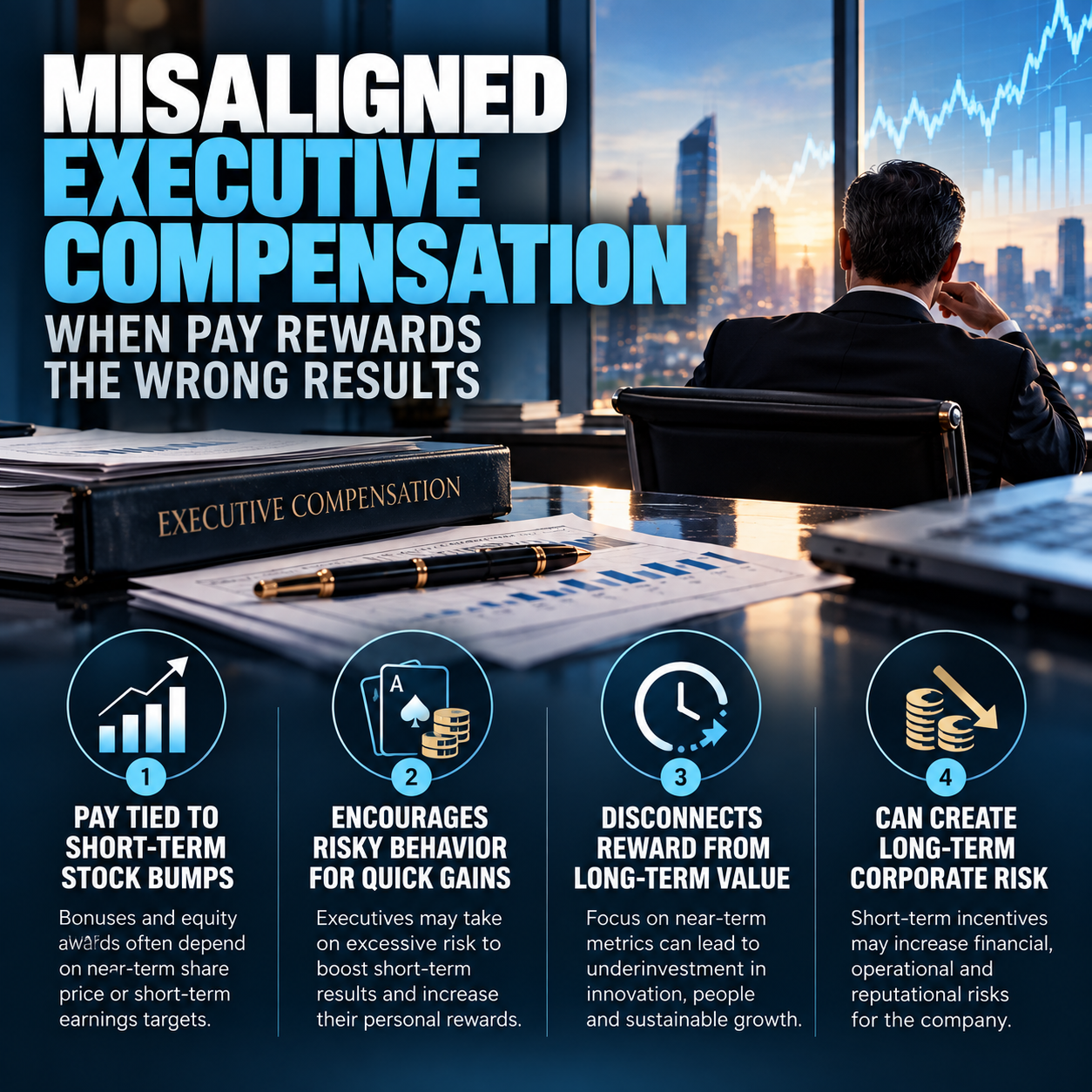
Misaligned Executive Compensation: When Pay Rewards the Wrong Results
Executive compensation should align management with long-term shareholders, but poorly designed incentives can produce the opposite result. When bonuses and equity awards depend excessively on short-term share prices or easily manipulated performance targets, executives may be rewarded for taking risks that increase today’s valuation while weakening tomorrow’s business.
Executive compensation is supposed to solve one of corporate governance’s oldest problems. Shareholders own the company, but professional executives control its daily operations and make decisions about capital allocation, acquisitions, investment, financing and strategy. Compensation packages attempt to align those executives’ financial interests with the interests of the company’s owners.
The theory appears straightforward: reward management when shareholders prosper. In practice, however, defining “prosper” can be surprisingly difficult. A higher stock price next quarter is not necessarily evidence that a company has created sustainable economic value.
This is where misaligned executive compensation becomes a corporate governance problem. If executives can receive enormous rewards from temporary share-price increases, aggressive earnings targets or short measurement periods, management may rationally prioritize the metrics determining its compensation. The incentive system can then encourage decisions that look successful today while transferring risk into the future.
The central governance question is therefore not whether executives are paid too much or too little. It is whether the structure of their compensation rewards the same outcomes that long-term shareholders actually want. The amount attracts attention, but the incentive structure determines behavior.
Short-Term Stock Performance Can Distort Executive Decisions
Equity compensation exists for a legitimate reason. Giving executives shares, restricted stock or options can make them owners alongside outside shareholders, theoretically encouraging management to increase the value of the company. Problems arise when the measurement period is significantly shorter than the economic consequences of the decisions being rewarded.
Consider an executive whose compensation depends heavily on reaching earnings-per-share targets over the next year. Management can potentially improve EPS through genuine operational improvements, but it can also influence the number through cost reductions, share repurchases, acquisition accounting or reductions in discretionary investment. Those alternatives can produce very different long-term economic outcomes despite generating similar short-term financial metrics.
Research and development provides a simple example. Cutting R&D can increase current earnings because the company immediately spends less money, potentially helping management achieve an annual profit target. But if those investments would have generated valuable products three or five years later, shareholders may eventually bear a much larger economic cost.
Capital expenditure can create the same conflict. Maintenance, production capacity, technology infrastructure and employee development require spending today while their benefits may emerge years later. An incentive system dominated by near-term financial targets can unintentionally make necessary long-term investment personally unattractive to executives.
Share prices add another complication because they reflect expectations rather than only current operating performance. Management can sometimes support short-term market sentiment through aggressive guidance, financial engineering or strategies that maximize immediate cash distributions. A rising share price is valuable to shareholders, but how that increase was produced matters enormously to whether it can persist.
Misaligned Compensation Can Encourage Excessive Risk
Compensation can also create asymmetric incentives. If an executive receives substantial upside when an aggressive strategy succeeds but does not personally absorb an equivalent share of the losses when it fails, the economically rational response may be to accept more risk than diversified long-term shareholders would prefer.
Stock options illustrate the problem particularly clearly. Options can become extremely valuable when a company’s share price rises significantly, while their value generally cannot fall below zero. This convex payoff can make strategies with large potential upside attractive even when they also introduce substantial downside risk for shareholders.
The problem becomes more serious when bonuses depend on narrow performance thresholds. Imagine that management receives a major award for reaching a specific revenue or earnings target but receives little additional compensation for narrowly missing it. As the measurement date approaches, executives may have unusually strong incentives to accelerate revenue, postpone costs or pursue transactions that increase the probability of crossing the threshold.
Acquisitions can also interact with executive incentives. Buying another company can immediately increase the size of the organization, revenue and assets under management, even when the acquisition ultimately destroys shareholder value. If compensation increases with organizational size or short-term earnings rather than long-term returns on invested capital, management can be rewarded for expansion rather than value creation.
Leverage creates another potential distortion. Additional debt can finance acquisitions, dividends or share repurchases that increase near-term shareholder returns and sometimes executive compensation. Yet the associated financial risk may remain on the balance sheet for years after the executives responsible for the original decision have received their awards.
The governance failure is therefore not simply “executives taking risks.” Businesses must take risks to create value. The problem occurs when executives receive the upside from a risk before shareholders know its full long-term cost.
Compensation Committees Must Measure Long-Term Value
The board’s compensation committee is responsible for preventing this incentive mismatch. Its task should extend beyond benchmarking the CEO’s salary against executives at comparable companies. The more important challenge is designing a compensation architecture that rewards durable economic performance without encouraging manipulation or excessive risk-taking.
Longer vesting periods are one mechanism. If substantial equity awards cannot be monetized for several years, executives remain exposed to the consequences of decisions made during the performance period. A strategy that produces a temporary stock-price increase followed by major losses becomes considerably less attractive when management’s wealth remains tied to the company.
Multiple performance measures can provide another safeguard. Revenue growth alone may reward unprofitable expansion, while EPS alone can be influenced by capital structure and share repurchases. Measures incorporating profitability, cash generation, return on invested capital and strategically relevant non-financial objectives can provide a broader assessment of performance.
The specific metrics should reflect the economics of the company. A mature industrial business, rapidly expanding software company and regulated bank have fundamentally different capital requirements and risk profiles. Applying the same compensation formula across them would ignore the underlying sources of long-term value.
Clawback provisions provide additional protection when compensation was awarded on results that later prove inaccurate or were generated through misconduct. Deferred compensation can similarly keep management economically exposed to risks that emerge after the original bonus calculation. Neither mechanism eliminates incentive problems, but both can reduce the gap between when executives are rewarded and when shareholders discover the actual outcome.
Compensation committees also need genuine independence. If directors responsible for determining CEO pay are socially, professionally or economically dependent on the executive whose compensation they approve, even a sophisticated incentive plan can become ineffective. Executive-pay governance ultimately depends on board governance.
Long-Term Alignment Requires More Than Stock Options
A common misconception is that paying executives in shares automatically aligns their interests with shareholders. Equity ownership certainly can improve alignment, but only if the design recognizes differences between temporary market valuation and sustainable corporate value. Timing, vesting, performance conditions and the executive’s ability to sell all matter.
Meaningful executive share ownership can help because managers then participate in both gains and losses over longer periods. Ownership requirements can prevent executives from immediately selling every vested award, while post-vesting holding requirements can extend their economic exposure beyond the formal performance period.
Boards should also examine what executives are incentivized not to do. A CEO rewarded almost entirely for expanding earnings may have weak incentives to invest in resilience, compliance, cybersecurity, maintenance or organizational culture because these expenditures impose visible current costs while preventing losses that may never become observable. Good incentive design recognizes the economic value of avoiding catastrophic outcomes.
Investors can evaluate these structures through proxy statements and remuneration reports. The useful questions extend beyond total compensation: what percentage is fixed versus variable, which performance measures determine awards, how long does equity vest, what happens after poor performance and can compensation be recovered following misconduct or financial restatements?
No compensation structure can perfectly measure managerial contribution. Stock prices reflect economic conditions, interest rates and industry cycles beyond any CEO’s control, while accounting metrics contain their own limitations. Effective compensation therefore requires judgment rather than reliance on a single supposedly objective number.
Misaligned executive compensation becomes dangerous when executives can maximize their personal rewards without creating equivalent long-term economic value for shareholders. Short measurement periods, narrow financial targets and asymmetric equity incentives can turn an otherwise sensible pay-for-performance philosophy into a source of corporate risk.
The solution is not eliminating performance-based compensation. Executives should have meaningful incentives to improve profitability, allocate capital efficiently and increase shareholder value. The governance challenge is ensuring that rewards are realized over a timeframe long enough to distinguish sustainable performance from temporary financial improvement.
Boards therefore need to evaluate compensation as part of the company’s risk architecture. Vesting periods, performance metrics, ownership requirements, clawbacks and deferred compensation should be designed together rather than treated as independent administrative features. The resulting structure should make it difficult for executives to become wealthy from strategies whose hidden costs appear only after they leave.
Shareholders should similarly look beyond the headline number reported as CEO compensation. A $20 million package strongly connected to durable value creation may create better incentives than a $5 million package dominated by poorly designed short-term targets. The governance problem is not simply how much management gets paid—it is what management must do to get paid.
When executives become richer because the company becomes sustainably stronger, compensation is performing its intended function. When executives can become richer by temporarily making the company look stronger, the incentive system itself has become a corporate governance risk.