
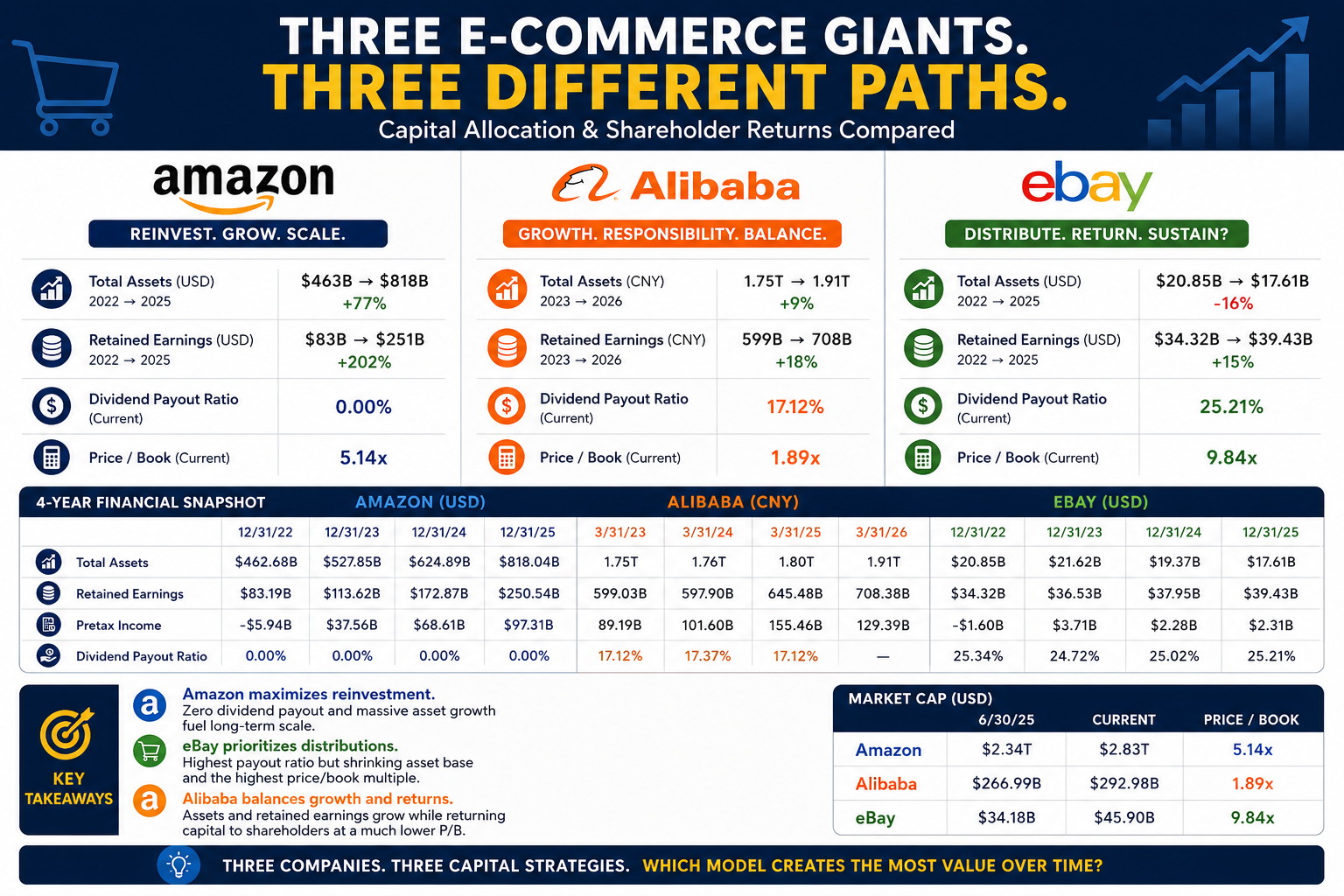
Three e-commerce giants. Three very different approaches to capital allocation.
Amazon, Alibaba and eBay represent three distinct capital-allocation models. We compare their assets, retained earnings, dividends and valuation to examine what each strategy means for long-term investors.
Amazon: The Reinvestment Model
Amazon provides the clearest example of a growth-first capital-allocation strategy. Total assets increased from approximately $463 billion in 2022 to $818 billion in 2025. Over the same period, retained earnings increased from roughly $83 billion to $251 billion. Amazon’s reported balance sheet therefore expanded dramatically in only three years. That expansion matters because Amazon continues to deploy enormous amounts of capital into infrastructure rather than treating its existing businesses primarily as sources of distributable cash.
Its capital requirements extend far beyond the traditional Amazon.com retail marketplace. The company operates a global fulfillment and logistics network, Amazon Web Services infrastructure, advertising technology, devices, entertainment operations and an increasingly capital-intensive artificial-intelligence ecosystem. This makes Amazon fundamentally different from a mature marketplace business designed principally to maximize near-term distributions.
Amazon also pays no regular dividend. Earnings and cash generated by the business therefore remain available for reinvestment rather than being systematically distributed to shareholders. The underlying capital-allocation philosophy is straightforward: generate cash, retain capital, reinvest it, and attempt to create larger future cash flows.
That strategy can create substantial value when incremental investment produces attractive returns. But reinvestment itself does not guarantee value creation. The crucial question for investors is whether each additional dollar retained by Amazon can continue producing sufficiently high returns as the company’s capital base becomes larger. Amazon’s expanding balance sheet consequently represents both its opportunity and its challenge. A company deploying hundreds of billions of dollars needs increasingly large opportunities to move its overall economics.
eBay: Capital Returns Against a Contracting Asset Base
eBay presents a very different picture. Its total assets declined from approximately $20.9 billion in 2022 to $17.6 billion in 2025. Unlike Amazon, eBay is not rapidly expanding the balance sheet supporting its marketplace. At the same time, retained earnings have grown from roughly $34.3 billion in 2022 to $39.4 billion in 2025. The company has also continued returning cash to shareholders through dividends and substantial share repurchases. In 2025 alone, eBay reported approximately $531 million of cash dividends and about $2.5 billion of share repurchases.
That distinction is important. Looking exclusively at dividend payout ratios understates eBay’s shareholder-return strategy because buybacks represent another major channel through which capital is returned. The economic model is therefore considerably more mature than Amazon’s. Instead of continually expanding the asset base, eBay can use cash generated by its established marketplace to repurchase shares, pay dividends and selectively reinvest in the platform. There is nothing inherently inferior about this model. A shrinking asset base can be entirely rational when a business is asset-light and management lacks reinvestment opportunities capable of generating attractive returns.
The relevant question is whether eBay is deliberately becoming a more efficient, cash-generative marketplace or whether its smaller balance sheet reflects limited opportunities for attractive organic expansion. Valuation adds another dimension. At the point-in-time valuations used in this comparison, eBay traded at a substantially higher price-to-book multiple than Amazon and Alibaba. That may initially appear counterintuitive given its contracting asset base.
However, price-to-book ratios require caution when comparing these businesses. Digital marketplaces can generate significant economic value from brands, networks, customer relationships and technology that accounting book value does not fully capture. Large share repurchases can also reduce reported equity and mechanically increase price-to-book ratios. The multiple therefore deserves investigation rather than a simplistic conclusion that one company is necessarily cheaper or more expensive.
Alibaba: A Hybrid Capital-Allocation Strategy
Alibaba sits between the two extremes. Its asset base has continued to expand while retained capital has also increased. At the same time, Alibaba has moved toward returning more capital to shareholders through dividends and share repurchases. This produces a hybrid model. Alibaba is not following Amazon’s pure reinvestment approach, but neither does its capital allocation resemble a mature marketplace focused predominantly on distributions.
That reflects the breadth of Alibaba’s operations. Beyond its core Chinese commerce businesses, the group has exposure to cloud computing, international digital commerce, logistics and other technology-driven businesses. The company therefore has significant opportunities requiring investment while simultaneously possessing the financial capacity to return capital.
For investors, this creates a different analytical question from Amazon. With Amazon, the central issue is whether massive reinvestment can continue generating sufficiently attractive returns. With Alibaba, the question is how management balances reinvestment against shareholder distributions and whether capital can be shifted toward the businesses offering the highest prospective returns.
There is another complication: comparing Alibaba’s balance sheet directly with Amazon and eBay requires care because Alibaba reports in Chinese yuan and operates under a different corporate, regulatory and economic environment. The absolute asset figures are therefore less informative than the direction of travel. Alibaba has maintained a large capital base while simultaneously becoming more willing to distribute capital to shareholders. That combination potentially allows investors to participate in continued business expansion without relying entirely on future growth to generate returns.
Could eBay Eventually Become an Acquisition Target?
eBay’s smaller scale creates a longer-term strategic question: could the company eventually become part of a larger platform? The question becomes relevant if eBay’s relative position in global e-commerce continues to weaken while larger competitors accumulate greater technological, logistics and financial resources. Amazon might appear to be an obvious industrial candidate. Combining the two platforms could theoretically produce marketplace, advertising, payments and technology synergies. In practice, however, such a transaction would likely attract intense competition scrutiny. Amazon acquiring a major U.S. online marketplace competitor would create obvious questions for antitrust authorities.
Alibaba presents a different theoretical combination. Acquiring or combining with eBay could provide Alibaba with an established Western marketplace presence and potentially accelerate its international expansion. eBay’s existing customer base, seller network and brand recognition would be difficult to reproduce organically.
But this scenario presents another set of obstacles. A major Chinese technology group acquiring a prominent U.S. marketplace could face significant national-security, regulatory and geopolitical scrutiny. Neither scenario should therefore be treated as an acquisition prediction. The more useful investment question is not “Who will buy eBay?” It is “Can eBay create enough value independently that consolidation never becomes strategically necessary?” That shifts attention back toward operating performance, competitive positioning and capital allocation rather than takeover speculation.