
When a Diluted Brand Dilutes Market Value: Ferrari contra Lamborghini
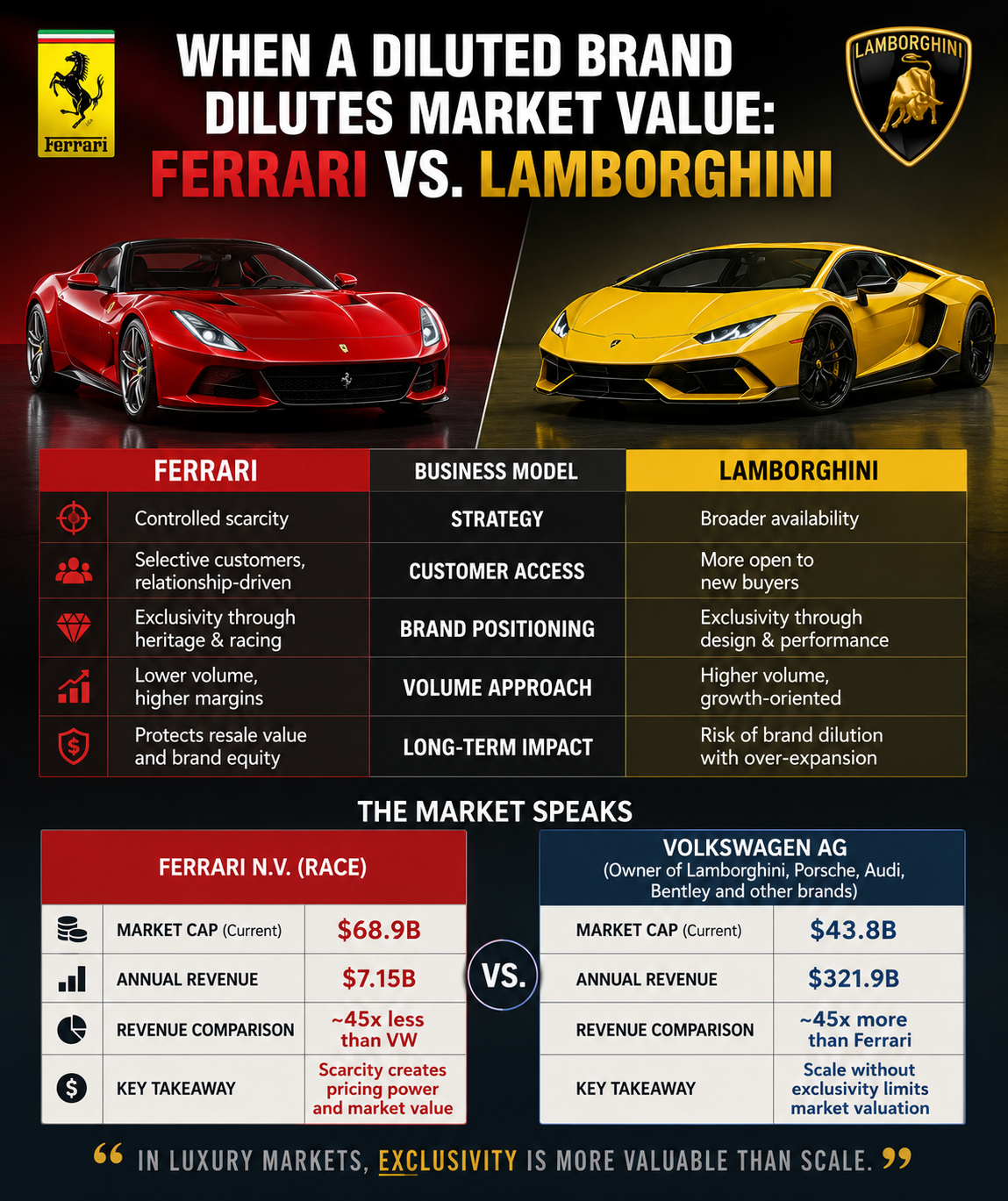
Ferrari and Lamborghini both sell exceptional supercars, but their approaches to exclusivity differ. Ferrari’s controlled scarcity illustrates how disciplined supply, customer relationships and brand protection can translate into extraordinary market value.
Ferrari: Scarcity as a Business Strategy
Ferrari has spent decades cultivating the perception that owning one of its cars means joining an exclusive ecosystem rather than simply purchasing an expensive vehicle. Production is managed carefully relative to demand, while access to certain limited and highly desirable models can depend on a customer’s existing relationship with the company. This transforms scarcity from a production constraint into an important part of Ferrari’s commercial strategy.
The system can also influence customer behavior long after the initial purchase. Buyers seeking access to particularly desirable future models have an incentive to remain active within the Ferrari ecosystem and maintain their relationship with dealers and the brand. As a result, Ferrari can potentially generate value not only from individual transactions but also from the lifetime relationship between the company and its most committed customers.
Scarcity contributes directly to pricing power as well. When demand persistently exceeds available supply, a manufacturer faces less pressure to compete through discounts or aggressive incentives. Ferrari can instead focus on higher prices, personalization, limited editions and product mix, allowing revenue and profitability to grow without requiring production volumes to increase at the same rate.
This is one reason Ferrari should not be analyzed simply as another automobile manufacturer. Traditional mass-market automakers generally seek enormous scale because their economics depend heavily on spreading development and manufacturing costs across millions of vehicles. Ferrari operates closer to the economics of a luxury company, where exclusivity, desirability and pricing power can matter more than unit volume alone.
Lamborghini: Exclusivity With a Broader Growth Strategy
Lamborghini also sells exclusivity, extraordinary performance and a globally recognized luxury identity. Its vehicles remain inaccessible to the overwhelming majority of consumers, and production is tiny compared with mainstream automotive manufacturers. However, Lamborghini has pursued growth more aggressively, particularly by broadening its product portfolio and attracting customers beyond the traditional two-seat supercar market.
The Urus SUV illustrates this strategy particularly well. Lamborghini was able to extend its brand into a significantly larger luxury-vehicle category while preserving the performance and visual characteristics associated with the company. The move expanded Lamborghini’s addressable market and helped the company reach customers who might never have purchased a traditional Lamborghini supercar.
That approach can produce substantial financial benefits because higher production volumes allow the company to monetize its brand across a larger customer base. The strategic risk, however, is familiar across the luxury industry: accessibility must expand without making the brand feel ordinary. A luxury company can increase revenue by selling more products, but excessive availability can eventually weaken the scarcity that helped justify premium prices in the first place.
This does not mean Lamborghini has ceased to be exclusive, nor does it mean growth automatically destroys luxury positioning. The more precise distinction is that Ferrari has historically placed unusually strong emphasis on managing scarcity and customer access as strategic assets. Lamborghini demonstrates a somewhat different model in which exclusivity coexists with a greater willingness to expand the customer base and product range.
Ferrari vs Volkswagen: Why Revenue Does Not Equal Market Value
The contrast becomes particularly interesting when Ferrari is compared not only with Lamborghini but with Lamborghini’s ultimate parent, Volkswagen Group. Volkswagen operates an enormous automotive portfolio that includes brands such as Volkswagen, Audi, Porsche, Bentley and Lamborghini. Its consolidated revenue is consequently many times larger than Ferrari’s revenue.
Yet equity markets can assign Ferrari a valuation comparable with, or even above, much larger automotive groups depending on prevailing share prices and exchange rates. Because market capitalizations fluctuate continuously, any exact comparison should be dated rather than treated as a permanent relationship. Nevertheless, the broader valuation contrast demonstrates an important principle: investors do not value companies simply according to how much revenue they generate.
Revenue measures the amount of business passing through a company, but it says little by itself about the economic quality of that revenue. Investors also consider margins, capital requirements, growth expectations, competitive advantages, pricing power and the durability of future cash flows. A smaller company with exceptional economics can therefore command a higher valuation than a much larger company operating in a more competitive and capital-intensive market.
Ferrari’s economics help explain why the comparison can be so striking. Its customers are buying engineering and performance, but they are also paying for heritage, identity, scarcity and membership in an unusually exclusive brand ecosystem. Those intangible characteristics can support economics that differ substantially from those of a conventional high-volume automotive manufacturer.
The lesson is therefore not that Ferrari is automatically a better investment than Volkswagen, nor that Lamborghini’s strategy is unsuccessful. The more useful conclusion is that scale and value are not synonymous. A company can dominate revenue while another captures greater economic value from every product, customer relationship and unit of brand scarcity.
The Real Asset Is Controlled Desirability
Ferrari demonstrates how scarcity can become an economic asset when it is supported by genuine demand. Simply restricting supply does not create a valuable luxury brand; consumers must already want the product strongly enough for scarcity to reinforce desirability. Ferrari’s advantage comes from combining limited availability with decades of motorsport heritage, distinctive products and a customer base willing to pay substantial premiums.
This distinction is critical because artificial scarcity without underlying brand strength rarely produces durable pricing power. If customers can easily substitute another product, restricting supply simply sends them elsewhere. Ferrari can exercise unusually tight control because its strongest customers often want a Ferrari specifically, rather than merely an expensive sports car with comparable technical specifications.
There is also a broader strategic lesson for companies outside the automotive industry. Businesses frequently assume that growth means reaching more customers, increasing production and maximizing short-term revenue. In premium markets, however, deliberately refusing some potential revenue can sometimes protect the conditions that allow much greater margins and customer lifetime value.
The danger begins when management treats brand recognition as an unlimited resource. Expanding production, introducing increasingly accessible products or licensing a prestigious name too broadly can generate immediate revenue while gradually reducing exclusivity. Once consumers stop perceiving a brand as scarce or culturally distinctive, rebuilding that positioning can be far harder than increasing production in the first place.
Ferrari and Lamborghini demonstrate two legitimate but different approaches to luxury growth. Lamborghini has successfully expanded its customer base and product portfolio while maintaining its position as one of the world’s most recognizable performance brands. Ferrari has placed greater emphasis on controlled supply, selective access and maintaining a long-term relationship between customers and the brand.
The financial comparison with Volkswagen illustrates why this distinction matters. An enormous corporation can generate vastly more revenue while the market assigns extraordinary value to a much smaller company with stronger margins, scarcity and perceived pricing power. Market capitalization reflects expectations about future economics, not simply the number of products a company sells today.
For executives and investors, the broader lesson extends well beyond supercars. Brand value is maximized not necessarily by reaching every possible customer, but by understanding what makes customers willing to pay a premium and protecting that advantage from dilution. Growth creates value when it strengthens those economics; growth that undermines exclusivity can eventually destroy the very advantage it was intended to monetize.
Ferrari’s strategy therefore illustrates a counterintuitive principle of luxury economics: sometimes the most valuable sale is the one a company is disciplined enough not to make. Controlled scarcity limits short-term volume, but when supported by exceptional demand, it can strengthen pricing power, customer loyalty and long-term brand equity. That is why the Ferrari-versus-Lamborghini comparison is ultimately less about cars and more about the economics of protecting scarcity.