
EBITDA vs EBIT: The Economics of Real Investment Projects
EBITDA and EBIT measure profitability differently, but for infrastructure, energy, real estate and manufacturing investments, the real issue is cash flow. Depreciation lowers EBIT while potentially creating valuable tax shields, making the relationship between EBITDA, CAPEX and free cash flow essential for evaluating project economics.
The debate between EBITDA and EBIT is often presented as an accounting discussion. For real investment projects, however, it is fundamentally a cash-flow and capital-allocation discussion. The distinction becomes particularly important when analyzing infrastructure, energy, real estate, utilities and manufacturing assets that require substantial upfront investment.
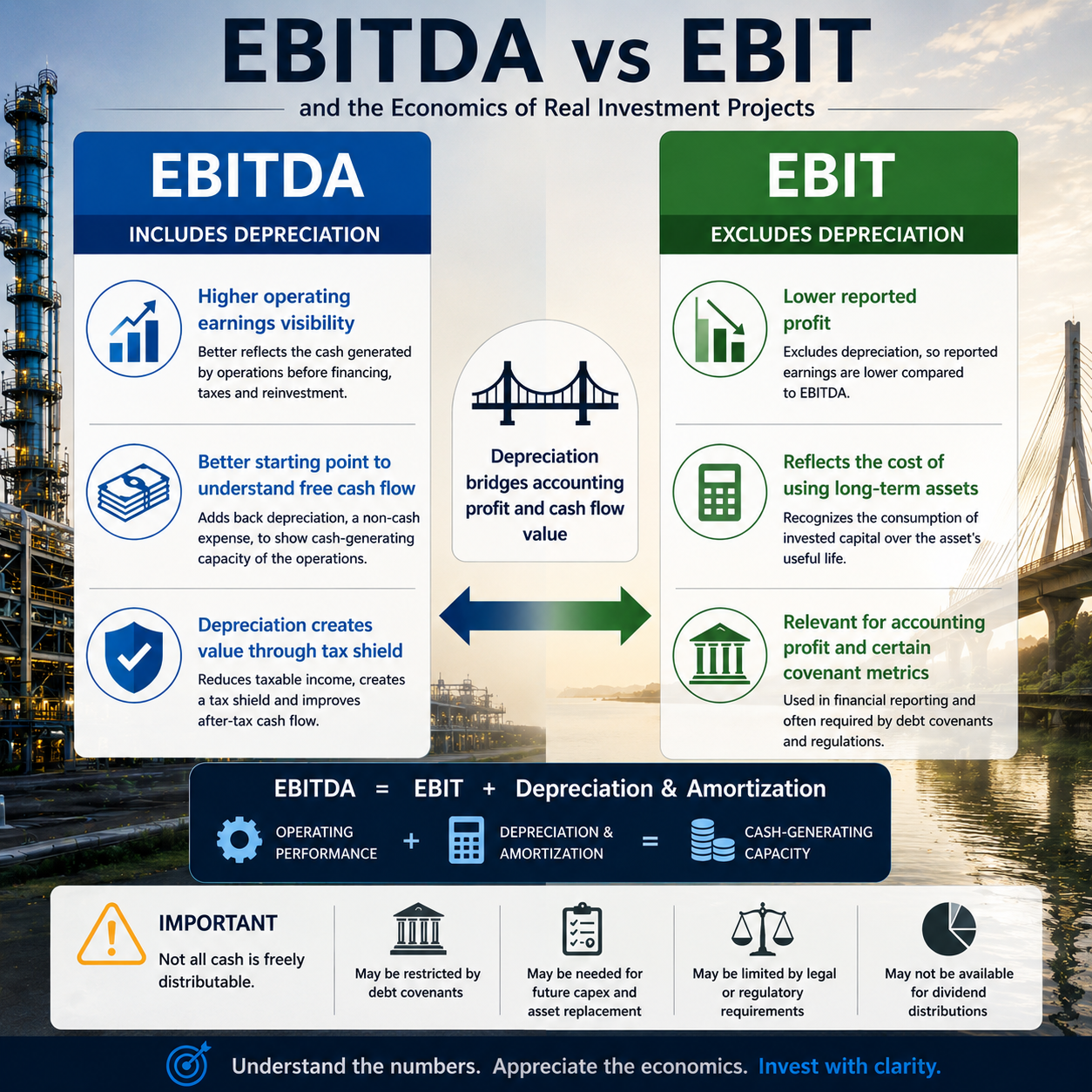
EBIT treats depreciation as an operating expense and therefore reduces reported operating profit. EBITDA adds depreciation and amortization back, recognizing that these accounting charges do not normally represent current-period cash payments. Neither metric, however, tells investors exactly how much cash an asset ultimately generates or how much of that cash can actually be distributed.
Understanding the difference requires looking beyond the income statement. Depreciation affects taxes, capital expenditures consume actual cash, debt service can restrict distributions, and assets eventually require maintenance or replacement. The economics of a real investment project therefore sit somewhere between EBITDA, EBIT and free cash flow rather than being captured perfectly by any single metric.
EBITDA vs EBIT: Why Depreciation Changes the Picture
Consider a project generating $100 million of revenue and $60 million of cash operating expenses. Its EBITDA is $40 million before considering depreciation, financing and taxes. If annual depreciation is $20 million, EBIT falls to $20 million even though the depreciation charge itself did not require another $20 million cash payment during that period.
This is why EBITDA can provide a useful starting point for assessing an asset’s operating cash-generating capacity. It removes a non-cash accounting allocation associated with investments generally made in previous periods. For capital-intensive projects with large depreciable asset bases, the difference between EBITDA and EBIT can consequently be substantial.
But this is also where EBITDA can become misleading if used without context. The fact that depreciation is non-cash today does not mean the underlying assets are economically free. A power plant, factory, logistics facility or hotel will normally require maintenance expenditures and may eventually require significant replacement capital to continue generating revenue.
EBIT therefore captures something economically relevant that EBITDA deliberately excludes: the consumption of the asset base over time. The accounting depreciation schedule may not perfectly match economic deterioration, but completely ignoring asset consumption can substantially overstate the sustainable economics of a capital-intensive business.
Depreciation Tax Shields and Project Value
Depreciation becomes particularly important because it can reduce taxable income even though it is not itself a current cash expenditure. Suppose the same project produces $40 million of EBITDA and records $20 million of depreciation. Taxable operating profit before financing effects may therefore be only $20 million rather than $40 million, subject to the applicable tax rules.
At a hypothetical 25% tax rate, $20 million of allowable depreciation could create a $5 million depreciation tax shield. That represents cash that would otherwise have been paid in taxes and can therefore increase the project’s after-tax cash flow. The precise benefit depends on jurisdiction, depreciation schedules, taxable income, loss utilization and other tax rules.
This mechanism helps explain why depreciation should not simply be dismissed as an accounting convention. It reduces reported EBIT, but the associated tax deduction can simultaneously create genuine economic value. Accelerated depreciation can make this effect particularly significant during the earlier years of certain investment projects because tax deductions are received sooner.
Timing matters because a dollar of tax savings today is generally worth more than the same nominal dollar received many years later. Depreciation schedules can therefore affect project net present value even when the total amount depreciated over the asset’s life remains unchanged. For investment analysis, the timing of tax deductions can be nearly as important as their absolute amount.
Why EBITDA Still Is Not Free Cash Flow
The weakness of EBITDA is visible when investors begin treating it as though it were cash available to shareholders. EBITDA ignores taxes, interest, working-capital requirements and capital expenditures, all of which can absorb substantial amounts of actual cash. A project reporting strong EBITDA can therefore generate weak or even negative free cash flow.
Capital expenditures are particularly important. Depreciation relates primarily to accounting recognition of existing investment, whereas CAPEX represents actual cash being spent on assets. If a project generates $40 million of EBITDA but requires $25 million of recurring capital expenditure to maintain its productive capacity, the headline EBITDA figure provides an incomplete picture of its economics.
The distinction between maintenance CAPEX and growth CAPEX is also critical. Maintenance CAPEX is required to preserve existing earning capacity, while growth CAPEX is intended to increase future capacity or profitability. Combining the two can make a healthy expansion program appear economically similar to an asset that simply requires enormous expenditure to prevent deterioration.
Debt adds another layer. Infrastructure and real estate investments are frequently financed with substantial leverage, meaning cash generated by the underlying asset may first need to cover interest, scheduled principal repayments and required reserve accounts. EBITDA can look attractive while the amount of cash actually available for equity distributions remains considerably smaller.
From EBITDA to Real Project Economics
A more useful approach is to treat EBITDA as the beginning of the analysis rather than its conclusion. Investors can move from operating earnings toward actual project cash flow by incorporating taxes, working-capital movements and capital expenditures. Financing cash flows can then be considered separately depending on whether the objective is to value the underlying asset or the equity invested in it.
A simplified operating relationship can be expressed as:
EBITDA – cash taxes – change in working capital – CAPEX = approximate unlevered free cash flow
Depreciation affects this calculation indirectly because it influences taxable income and therefore cash taxes. This is the crucial connection between the income statement and project cash flow: depreciation itself is non-cash, but its tax consequences can be very real.
EBIT provides a different perspective because it recognizes the accounting cost associated with using long-lived assets. It can therefore be useful when comparing operating profitability across periods or assessing returns relative to the capital invested in a business. But EBIT should not be mistaken for cash flow either, because depreciation expense and actual capital expenditure can differ dramatically in both timing and magnitude.
For long-duration projects, the strongest analysis therefore uses EBITDA, EBIT and free cash flow together. EBITDA helps reveal operating cash-generation potential, EBIT introduces the economic consumption of depreciable assets, and free cash flow incorporates the actual cash requirements necessary to maintain and operate the investment.
For real investment projects, the EBITDA-versus-EBIT debate becomes misleading when one metric is presented as universally superior. EBITDA is useful because depreciation does not represent a current cash outflow, while EBIT is useful because physical assets are consumed and eventually require maintenance or replacement. Each metric captures a different part of the underlying economics.
Depreciation also has an important dual role. It reduces reported operating profit while potentially reducing taxable income and generating a valuable tax shield. The resulting tax savings can increase free cash flow and project value, particularly when depreciation deductions occur relatively early in an investment’s life.
However, depreciation tax shields should never be confused with permanently available distributable cash. Future CAPEX, debt service, reserve requirements, working capital and legal or regulatory restrictions can absorb cash that appears available when looking only at EBITDA. Sustainable distributions depend on the complete cash-flow structure of the project.
For long-term investors, the objective should therefore be to move beyond the question of EBITDA versus EBIT. The more important question is how accounting earnings translate into after-tax cash flows after considering the capital required to preserve the asset’s earning capacity. Ultimately, it is those cash flows—and the price paid to acquire them—that determine the economics of a real investment project.