
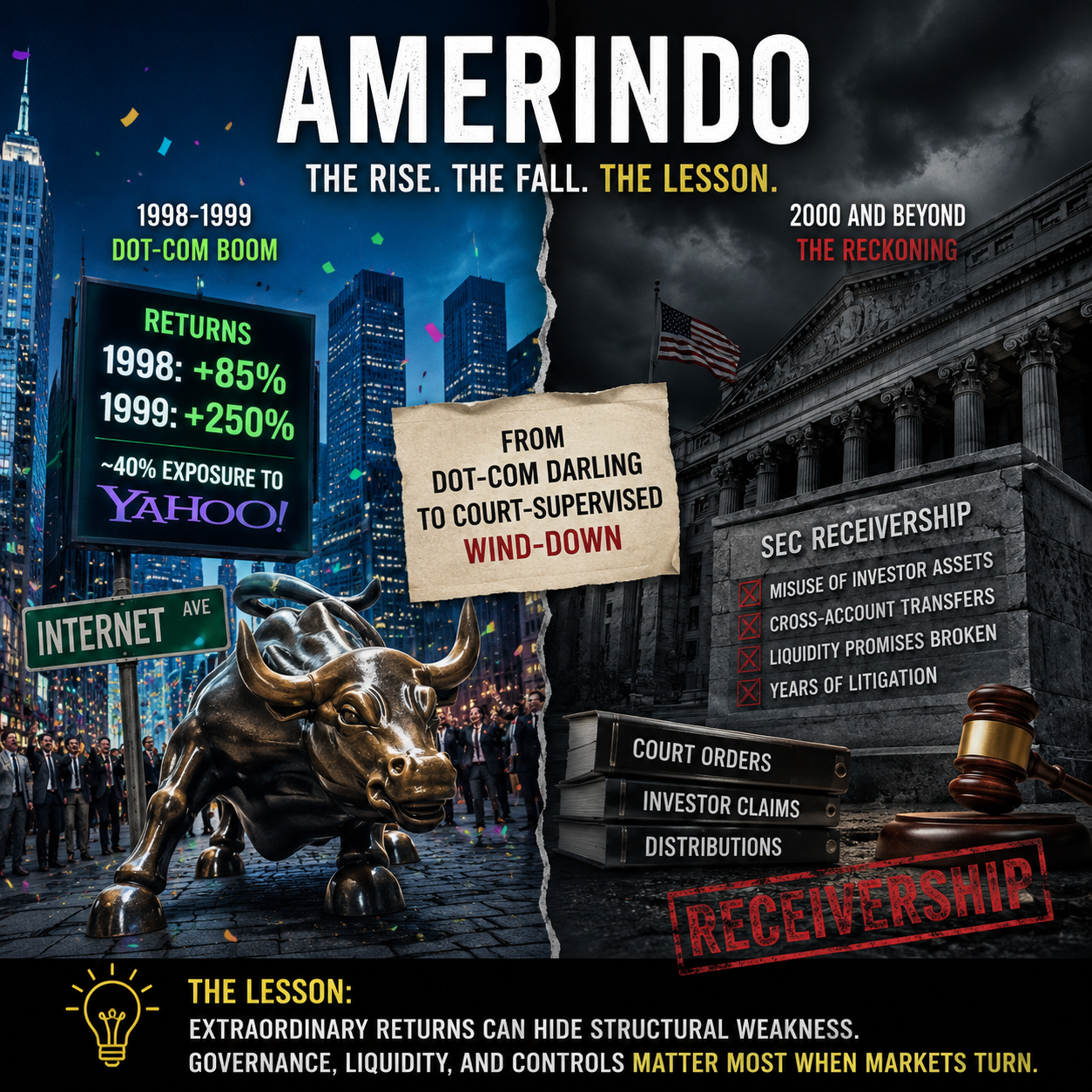
From Dot-Com Darlings to Court-Supervised Wind-Down: The Amerindo Technology Growth Fund Story
The Amerindo Technology Growth Fund emerged from the technology boom as an aggressive investor in some of the era’s most prominent growth companies. Its subsequent trajectory—from extraordinary market performance to legal disputes, regulatory intervention, and a court-supervised wind-down—offers a case study in investment strategy, governance, liquidity, and investor protection.
Amerindo looked like the kind of investment firm nobody wanted to question: reported returns of 85% in 1998 and 250% in 1999, combined with a highly concentrated bet on Yahoo!, appeared to validate its managers’ technology-focused strategy. During the Dot-com boom, extraordinary performance carried its own authority. Questions about concentration, liquidity, governance, and control could easily seem secondary while markets continued to rise.
But when the technology cycle turned, Amerindo’s story changed dramatically. What began as a story about investment performance eventually became one involving regulatory intervention, criminal proceedings, receivership, investor claims, and a court-supervised wind-down lasting many years.
When Performance Overshadows Risk
Amerindo built its identity around emerging technology and growth investing. Its strategy fit the late-1990s environment of rapidly rising technology valuations, active IPO markets, and enthusiasm for internet companies. Concentration amplified the results when those investments performed well.
Exceptional performance, however, does not answer fundamental institutional questions. Who controls investor assets? How concentrated is the portfolio? How independently are transactions reviewed? Where will liquidity come from if investors want their money back?
These questions become especially important when success gives investment managers greater freedom from scrutiny. Strong returns can demonstrate that an investment strategy has worked; they do not demonstrate that the organization supporting it has equally strong governance.
When Investment Risk Becomes Governance Risk
The post-2000 bear market placed the Amerindo structure under pressure. The SEC subsequently alleged misuse and movement of investor assets among accounts and deviations from the investment purposes described for certain Amerindo vehicles. The broader platform also included Guaranteed Fixed Rate Deposit Accounts, where the SEC alleged a mismatch between promises made to investors and how funds were actually deployed.
This illustrates an important distinction. Investment losses are an ordinary part of investing. Governance problems arise when market losses expose weaknesses in cash controls, custody, liquidity management, disclosure, or oversight.
Liquidity is particularly important. A portfolio can tolerate volatility if its structure gives it sufficient time to recover. But when investors expect liquidity that the underlying assets cannot provide, falling markets can turn a performance problem into a cash problem—and a cash problem into a governance crisis.
From Fund Management to Court Supervision
The SEC pursued an enforcement action alleging violations of federal securities and investment-adviser laws, while subsequent federal criminal proceedings resulted in convictions following a jury trial in 2008. Amerindo entities, including the Amerindo Technology Growth Fund, ultimately entered a receivership process.
At that stage, the focus changed completely. Investment decisions gave way to identifying assets, validating investor claims, determining distributions, and resolving competing legal interests.
The process also demonstrates how long fund failures can take to resolve. By 2017, three interim distributions totaled approximately $54.4 million. Later proceedings considered inflation adjustments, while disputes concerning residual funds and penalties continued into 2024. A fund can therefore fail relatively quickly while its legal and financial resolution continues for many years.
What Amerindo Teaches Investors and Fund Managers
Amerindo’s history remains relevant to private equity, venture capital, and other private investment structures because the underlying questions have not disappeared.
Illiquid assets still need funding structures appropriate to their duration. Concentrated portfolios require meaningful risk oversight. Cash movements require independent controls. Valuations need credible processes. And governance needs to remain effective even when a successful manager has produced exceptional returns. Practical safeguards include independent custody, dual controls, liquidity stress testing, clear investor records, and governance capable of constraining even highly successful managers.
The central lesson is therefore broader than Amerindo. Markets test more than investment strategies—they test the structures supporting them. Strong performance can conceal weaknesses because the consequences of those weaknesses may not become visible until conditions deteriorate.
The best time to ask difficult questions about concentration, liquidity, cash controls, and governance is not after performance collapses. It is precisely when exceptional performance makes those questions seem unnecessary.