
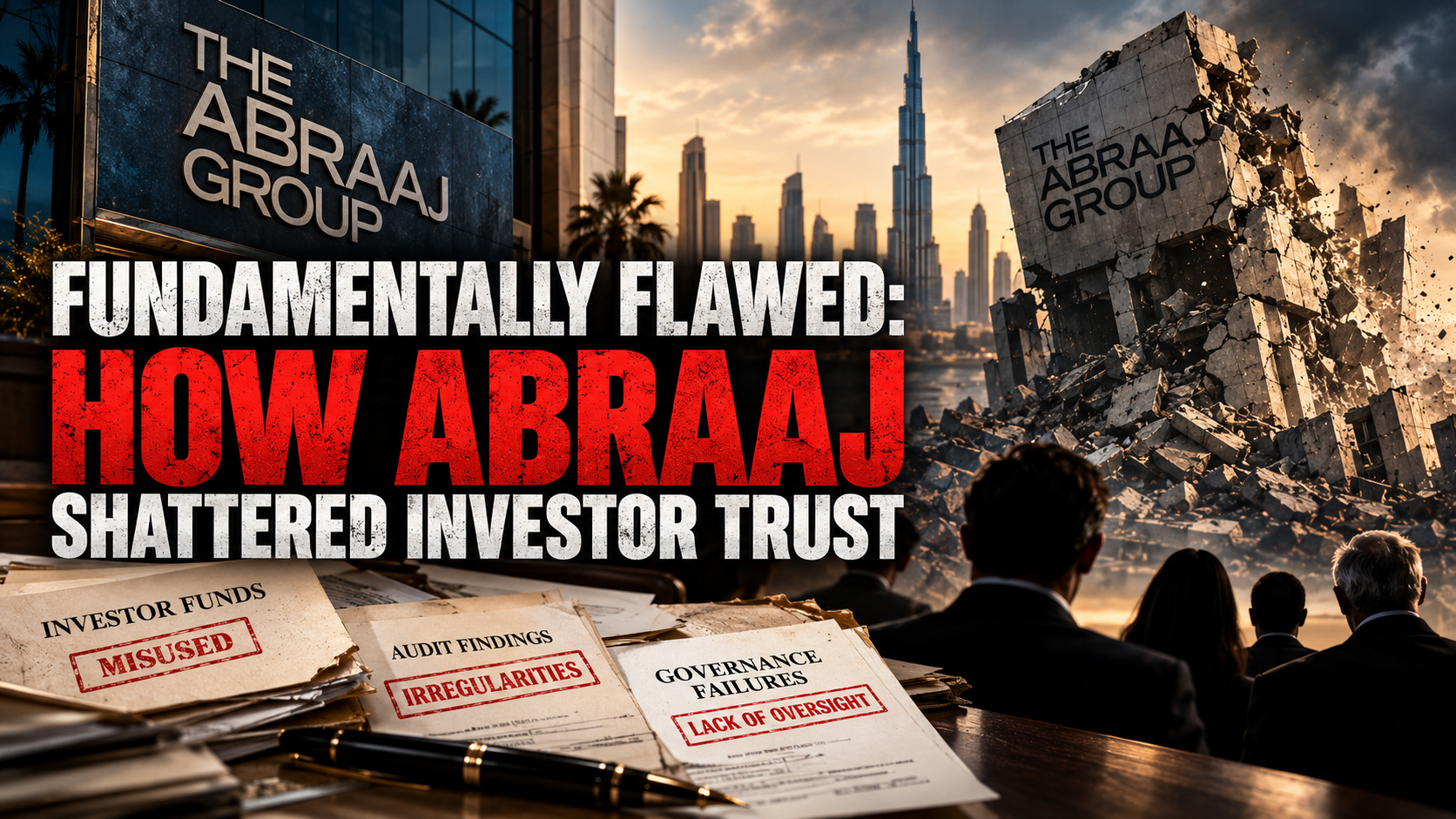
Abraaj Fund Collapse: How Governance Failures Shattered Investor Trust
Abraaj grew into one of the most prominent emerging-market private equity firms before collapsing amid liquidity problems, misuse of investor funds and serious governance failures. Its downfall demonstrates why reputation, impact investing credentials and prestigious institutional investors cannot substitute for independent controls over investor capital.
For years, the Abraaj Group represented one of the most compelling stories in emerging-market private equity. Founded in Dubai in 2002 by Arif Naqvi, the firm expanded across Africa, Asia, Latin America, the Middle East and other growth markets, eventually managing more than $13 billion. Its proposition was attractive: investors could pursue financial returns while directing capital toward healthcare, infrastructure, energy and other sectors capable of producing measurable social impact.
Abraaj’s credibility was reinforced by the institutions willing to invest alongside it. Its limited partners included prominent development and institutional investors, helping transform the company from a regional investment manager into an internationally recognized emerging-markets platform. For outside investors, the presence of sophisticated institutions appeared to provide an additional layer of validation.
That reputation eventually proved insufficient. Behind the firm’s rapid expansion were serious liquidity problems, questionable movement of investor capital and governance structures that regulators later concluded had failed to protect investors. Abraaj’s collapse became more than the failure of a private-equity manager; it became a warning about what can happen when organizational complexity grows faster than financial controls.
The Abraaj case is therefore particularly useful for investors because the warning signs were not confined to investment performance. The deeper problems involved cash management, governance, transparency and institutional oversight. Those weaknesses eventually destroyed something far more difficult to replace than investment capital: investor trust.
Abraaj’s Growth Story Concealed a Liquidity Problem
Abraaj expanded during an unusually favorable period for alternative investments. Following the global financial crisis, low interest rates encouraged institutional investors to search for higher returns outside traditional developed markets, while emerging-market private equity offered exposure to demographic growth, infrastructure development and expanding consumer economies. Abraaj positioned itself directly at the intersection of those trends.
The firm also became closely associated with impact investing. Healthcare was especially important to that strategy, and the Abraaj Growth Markets Health Fund was created to invest in healthcare businesses across emerging economies. The combination of commercial returns and development objectives attracted sophisticated institutional and charitable investors.
But the organizational structure supporting Abraaj’s expansion became increasingly vulnerable to liquidity pressure. Your source material describes borrowing against anticipated commitments, bridge financing and movement of capital across entities as the firm’s financial position deteriorated. It also identifies more than $1 billion of debt associated with financing firm operations, although that particular figure should be separately verified before being presented as a definitive regulatory finding.
Liquidity itself is not evidence of misconduct, and subscription facilities, bridge loans and other forms of leverage are common throughout private equity. The critical question is whether borrowing is properly disclosed, appropriately structured and supported by reliable cash flows. At Abraaj, regulators eventually concluded that the liquidity problem crossed a much more serious boundary.
Investor Capital Became the Breaking Point
The crisis became public after investors began questioning why capital committed to the Abraaj Growth Markets Health Fund had not been deployed as expected. The SEC subsequently alleged that Naqvi and Abraaj Investment Management had misappropriated money from the Health Fund, commingled it with corporate funds and used money for purposes unrelated to the fund. The regulator also alleged that investors received false or misleading information intended to conceal how their money had been used.
The DFSA’s investigation revealed problems extending beyond a single fund. In 2019, the regulator found that Abraaj Investment Management had misused investor money to cover operating expenses and growing cash shortfalls while misleading investors about its cash-management practices. It also found that the company borrowed money immediately before reporting dates to temporarily create the bank balances investors expected to see.
Those findings fundamentally change how the Abraaj collapse should be understood. This was not simply an investment manager making unsuccessful investments or experiencing a temporary mismatch between incoming and outgoing cash. Regulators found deliberate actions designed to conceal the underlying financial condition from the people whose money Abraaj was supposed to manage.
The scale was substantial. The DFSA later found that Naqvi had been centrally involved in concealing an approximately $400 million shortfall across two Abraaj funds, including through temporary borrowing used to produce bank confirmations and financial statements. The regulator also found that the financial year-end of one fund had been changed to avoid disclosing an approximately $201 million shortfall.
That is the point at which a liquidity problem becomes a governance crisis. Investors can tolerate poor investment performance because risk is inherent to private equity. What they cannot price normally is uncertainty about whether reported cash exists, whether capital remains inside the vehicle for which it was committed and whether financial information can be trusted.
Governance Failed Before the Investment Strategy Did
Abraaj’s collapse demonstrates why governance can matter as much as investment selection in private markets. Your source material identifies concentrated decision-making around Naqvi, insufficient independent oversight and serious weaknesses in financial records and internal controls.
Founder-led investment firms are not inherently problematic. Strong founders can create investment cultures, develop specialist networks and identify opportunities that larger institutions overlook. The danger emerges when commercial influence, investment authority, cash control and organizational power become concentrated without sufficiently independent mechanisms capable of challenging management.
The DFSA’s findings illustrate that problem at Abraaj. It concluded that Naqvi personally proposed, authorized or executed actions that misled investors, directed investor money toward the group’s working-capital requirements and other commitments, and participated in efforts to conceal financial shortfalls. The Financial Markets Tribunal subsequently upheld the DFSA’s findings against him.
The consequences extended beyond Abraaj’s management. In 2022, the DFSA also fined KPMG LLP $1.5 million and a former audit partner $500,000 over failings associated with the audit of Abraaj Capital Limited. The case therefore raised questions not only about internal governance but also about the effectiveness of external safeguards surrounding a sophisticated investment organization.
Abraaj shows why institutional investors cannot outsource their judgment entirely to auditors, regulators or other prestigious limited partners. The presence of sophisticated names can create comfort, but it does not independently verify cash movements, governance quality or operational controls. Reputation is useful information; it is not a substitute for due diligence.
The Collapse Became a Due-Diligence Case Study
Once confidence disappeared, Abraaj’s business model became extremely difficult to sustain. Investors demanded greater visibility over fund assets, fundraising plans unraveled and the organization entered provisional liquidation proceedings in the Cayman Islands in 2018. The investment platform that had taken years to construct fragmented rapidly.
Regulatory consequences followed. In July 2019, the DFSA imposed penalties totaling approximately $315 million on Abraaj Investment Management Limited and Abraaj Capital Limited for misconduct that included deceiving investors, misusing investor money and carrying out unauthorized financial activities. The regulator imposed $299.3 million on AIML and approximately $15.3 million on ACLD.
Naqvi later received a separate DFSA penalty of approximately $135.6 million and restrictions preventing him from performing functions in or from the Dubai International Financial Centre. After he challenged the regulator’s findings, the Financial Markets Tribunal upheld them in December 2022, making the DFSA findings final.
U.S. enforcement added another dimension. The SEC charged Naqvi and Abraaj Investment Management in 2019, while subsequent SEC proceedings involved other former Abraaj executives. In 2022, for example, the SEC announced settled fraud charges against former managing partner Sivendran Vettivetpillai relating to conduct that helped Abraaj misappropriate client cash and conceal its financial condition from Health Fund investors.
For limited partners, however, the lasting lesson extends beyond enforcement. Abraaj demonstrates that financial due diligence examining returns, valuations and portfolio companies must be complemented by operational due diligence examining who controls cash, who authorizes transfers, who independently verifies balances and what happens when management faces a liquidity crisis.
What Investors Should Learn From Abraaj
Fund segregation is the most obvious lesson. Investor capital committed to a specific vehicle should remain subject to clearly defined controls, and movements between funds, management companies and affiliated entities deserve exceptional scrutiny. Your original analysis correctly emphasizes ring-fencing, independent oversight and operational due diligence as central safeguards.
Investors should also understand the manager itself rather than examining only its funds. A portfolio can appear healthy while the management company experiences liquidity pressure from salaries, expansion costs, debt service and unsuccessful fundraising. If the GP becomes financially distressed, incentives can change rapidly even when individual portfolio companies continue performing.
Independent verification becomes especially important when reported information looks unusually favorable during periods of financial stress. Bank balances, capital calls, distributions, NAV calculations, related-party transactions and inter-fund movements should be capable of verification through institutions that are not economically dependent on the investment manager. Abraaj demonstrated the danger of allowing internal explanations to substitute for independently verifiable evidence.
Finally, investors should resist the prestige cascade that can occur when respected institutions have already committed capital. The Gates Foundation, development-finance institutions or other sophisticated LPs participating in a fund may provide useful signals, but their involvement does not guarantee that every governance risk has been identified. Every institutional investor ultimately remains responsible for its own diligence.
Abraaj’s rise was built partly on an exceptionally powerful narrative. It combined emerging-market growth, private-equity returns, institutional credibility and social impact at a moment when global investors were searching for exactly that combination. At its peak, that story helped Abraaj become one of the most prominent private-capital managers associated with emerging markets.
Its collapse demonstrates that a compelling investment thesis cannot compensate indefinitely for weak financial controls. Once questions emerged about where investor cash was held and how it had been used, the issue was no longer simply fund performance. The credibility of the manager itself became the central investment risk.
That is why the Abraaj case remains relevant well beyond emerging markets or impact investing. Private funds depend on an unusually high degree of trust because LPs surrender day-to-day control over their capital for years and operate with less liquidity and transparency than public-market investors. Strong governance, independent verification and clear segregation of capital are therefore structural requirements rather than administrative formalities.
The fundamental flaw at Abraaj was ultimately not its ambition to build a global emerging-markets investment platform. It was the failure to build controls capable of constraining that ambition when financial pressure increased. Returns attract capital, but governance determines whether investors can trust the institution holding it.