
High ROE, High Debt: Is Lockheed Martin’s Return “Too Good”?
Lockheed Martin’s extraordinary return on equity looks compelling, but its highly leveraged capital structure explains much of the headline number. Comparing Lockheed with Dassault Aviation and Saab shows why investors should examine margins, debt and equity alongside ROE.
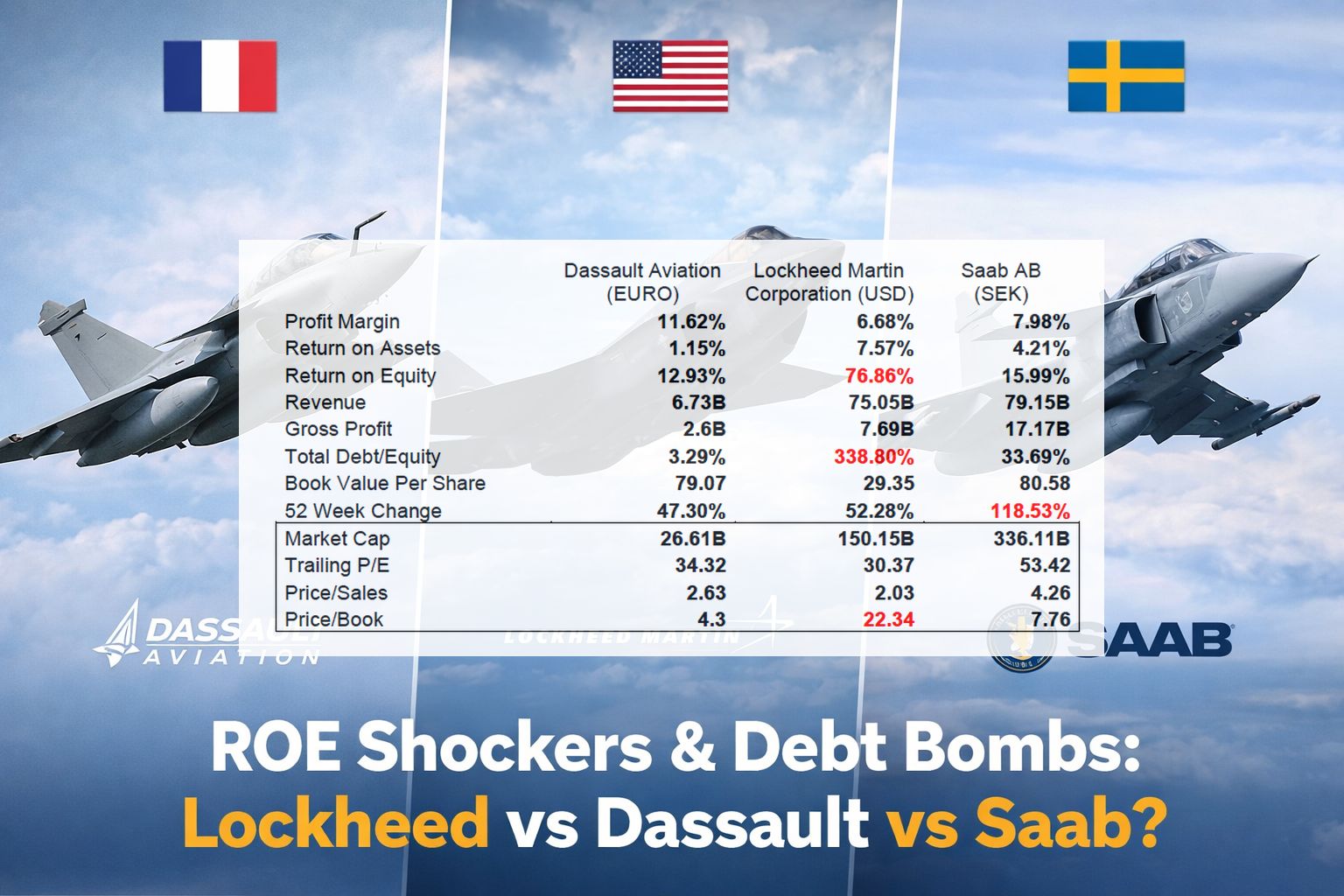
Lockheed Martin’s profitability numbers initially look extraordinary. Based on its 2025 net earnings and average shareholder equity, return on equity was approximately 77%, a level that would be exceptional in almost any industry. Lockheed generated $5.0 billion of net earnings on a year-end equity base of only $6.7 billion.
But ROE does not measure profitability in isolation. It measures profit relative to shareholder equity, meaning a company with a deliberately small equity base can report extremely high ROE even without extraordinary profit margins. Lockheed’s balance sheet therefore provides essential context for understanding what that 77% figure actually represents.
At the end of 2025, Lockheed reported approximately $21.7 billion of total debt against $6.7 billion of total equity. Debt was consequently more than three times reported equity, making leverage an important contributor to Lockheed’s unusually high ROE.
The interesting comparison is with two European defense companies, Dassault Aviation and Saab. All three benefit from elevated global defense spending, but their profitability, balance sheets and market expectations look substantially different.
Lockheed Martin: Why Leverage Magnifies ROE
The basic mathematics behind Lockheed’s ROE is straightforward. Return on equity compares net income with the equity capital recorded on the balance sheet, so reducing the denominator can dramatically increase the resulting percentage. A company earning $5 billion against $20 billion of equity would produce a much less spectacular ROE than the same company earning $5 billion against $7 billion.
Lockheed’s capital structure has been influenced by years of returning substantial amounts of capital to shareholders through dividends and share repurchases. Buybacks reduce outstanding shares but can also reduce reported shareholder equity, particularly when a company distributes large amounts of accumulated capital. The resulting smaller equity denominator can push ROE significantly higher.
That does not make Lockheed’s profitability artificial. The company generated $75.0 billion of sales, $5.0 billion of net earnings, $8.6 billion of operating cash flow and $6.9 billion of free cash flow in 2025, while finishing the year with a record $194 billion backlog. Those are substantial underlying cash flows rather than merely an accounting effect.
But it does mean that investors should not interpret a 77% ROE as evidence that Lockheed’s underlying business generates dramatically better economics than every lower-ROE competitor. Part of the number reflects operating performance, while another important part reflects how the company finances itself and how much accounting equity remains on its balance sheet.
Dassault Aviation: Strong Margins and a Different Balance Sheet
Dassault Aviation presents a very different financial profile. The company generated €7.4 billion of sales and €1.06 billion of adjusted net income in 2025, producing an adjusted net margin of 14.3%. Dassault also finished the year with approximately €9.4 billion of available cash.
That margin comparison is revealing. Lockheed’s 2025 net earnings represented roughly 6.7% of sales, while Dassault’s adjusted net margin was more than twice that level. The accounting definitions are not perfectly identical, so the comparison should not be treated as completely like-for-like, but Dassault clearly generates substantial profitability without relying on the same highly leveraged equity structure.
Dassault also possesses an unusually large backlog relative to its annual revenue. Its year-end 2025 backlog reached €46.6 billion, including 220 Rafale aircraft and 73 Falcon business jets. That provides substantial revenue visibility while its large cash position creates a very different financial-risk profile from Lockheed’s.
This illustrates why ROE should never be analyzed alone. Lockheed can simultaneously produce a dramatically higher ROE while Dassault produces a higher reported net margin and maintains substantial liquidity. The metrics are measuring different dimensions of financial performance rather than identifying a single superior business.
Saab: Growth and an Expanding Defense Backlog
Saab represents a third model. Rather than standing out primarily through Lockheed-style ROE or Dassault’s cash-rich balance sheet, Saab’s recent financial story has been dominated by rapid growth and extraordinary order intake. In 2025, order bookings increased 74% to SEK 168.5 billion and the year-end backlog reached approximately SEK 274.5 billion.
Its operating performance also strengthened. Saab reported approximately SEK 79 billion of 2025 sales and a 9.8% operating margin, while management increased its medium-term organic growth target to approximately 22% CAGR for 2023–2027. The company therefore entered 2026 with substantial contracted demand and a major production-capacity expansion underway.
The Gripen program illustrates those tailwinds. Colombia ordered 17 Gripen E/F fighters worth €3.1 billion, while Thailand ordered another four aircraft. Saab also secured major orders elsewhere in its portfolio, including GlobalEye aircraft for France and continued strong demand across missile and ground-combat systems.
Rapid growth, however, creates a different investment problem: valuation expectations can rise faster than earnings. A company benefiting from European rearmament can deliver excellent operational results while its stock still disappoints if investors have already capitalized years of expected growth into today’s share price. Current P/E and share-performance figures should therefore always be dated when making this comparison.
ROE Can Be Decomposed: The DuPont Perspective
The Lockheed comparison demonstrates why professional financial analysis often decomposes ROE rather than stopping at the headline percentage. Under the DuPont framework, return on equity is driven broadly by profitability, asset efficiency and financial leverage.
A company can therefore increase ROE through several different mechanisms. It can earn more profit from every dollar of revenue, generate more revenue from its asset base, or operate with more assets relative to shareholder equity. The first two primarily reflect operating economics; the third introduces capital structure directly into the calculation.
Lockheed’s approximately 77% ROE contains a substantial leverage component because its equity base is unusually small relative to both assets and debt. Dassault’s profitability is more visible through its strong margin and liquidity position, while Saab’s current financial story is more closely associated with expanding revenue and backlog.
This is why describing Lockheed’s ROE as simply “better” would be misleading. High ROE produced partly through leverage is economically different from high ROE produced primarily through exceptional margins or asset efficiency. Investors need to identify the source before deciding what the number actually says about business quality.
Lockheed Martin’s extraordinary ROE should neither be dismissed as an accounting trick nor accepted at face value as proof of exceptional profitability. The company generates enormous cash flows, operates with a record backlog and remains one of the world’s largest defense contractors. Its 2025 free cash flow of approximately $6.9 billion confirms that substantial economic earnings sit behind the headline return.
But Lockheed also operates with a remarkably small shareholder-equity base relative to its debt. With $21.7 billion of debt and only $6.7 billion of equity at year-end 2025, financial leverage materially amplifies the return calculated against shareholders’ accounting capital.
Dassault and Saab demonstrate why the comparison becomes more useful when multiple metrics are considered simultaneously. Dassault combines a 14.3% adjusted net margin with substantial available cash, while Saab combines improving profitability with a record order backlog and unusually rapid growth.
The broader lesson is simple: ROE tells investors how much profit a company generates relative to equity, but it does not explain why the equity base is so small. For Lockheed Martin, leverage and capital returns are central to that explanation. Anyone evaluating the company’s profitability should therefore examine ROE alongside margins, free cash flow, debt and invested-capital returns rather than treating 77% as a standalone measure of business performance.