
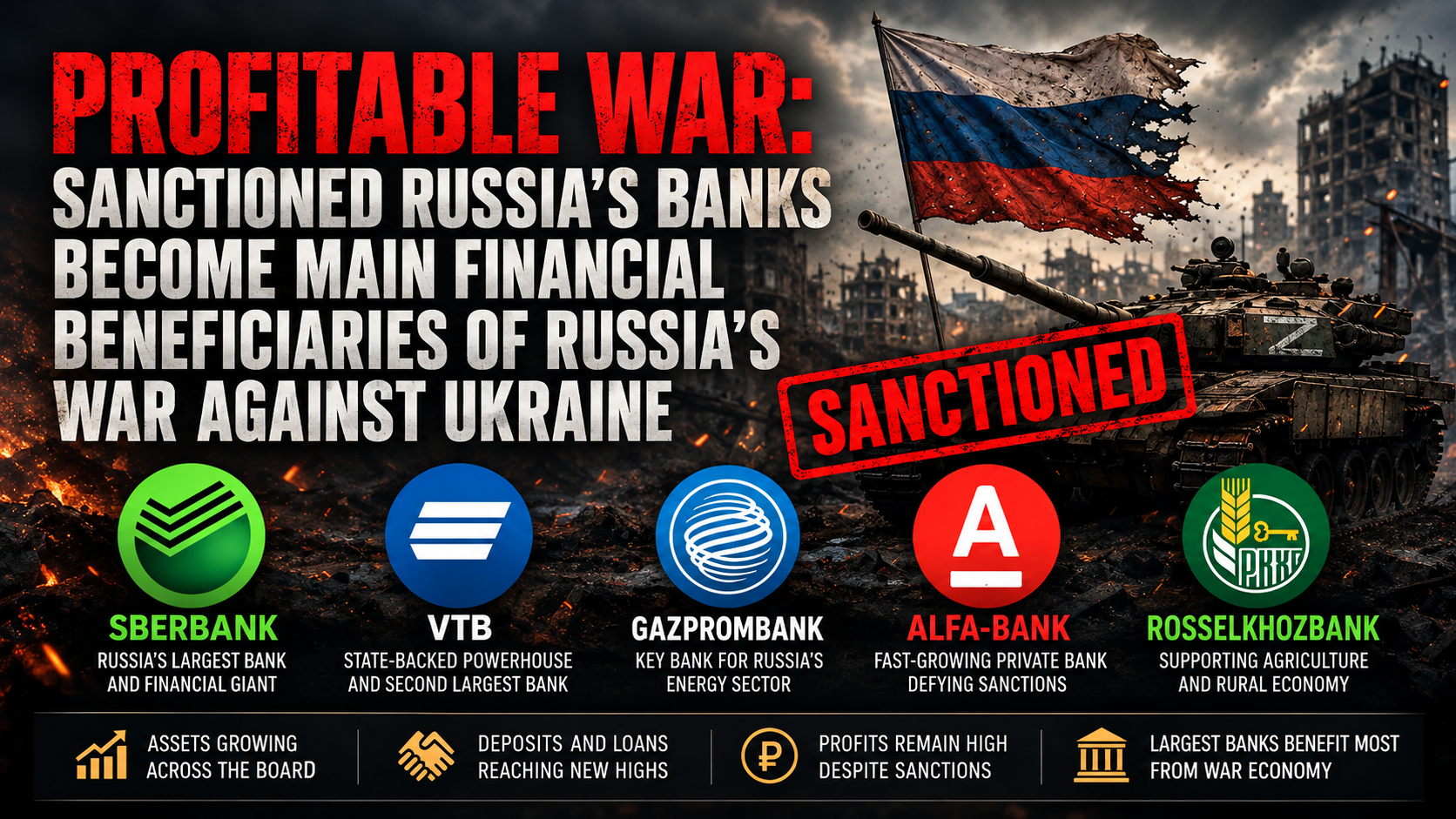
Profitable War: Sanctioned Russia’s Banks Become Main Financial Beneficiaries of Russia’s War Against Ukraine
Western sanctions cut major Russian banks off from important parts of the global financial system, but they did not destroy Russia’s domestic banking sector. Instead, wartime spending, high interest rates and expanding state-directed lending helped major banks generate substantial profits and become increasingly important to Russia’s war economy.
After Russia launched its full-scale invasion of Ukraine in February 2022, Western governments placed unprecedented restrictions on the country’s financial system. Major Russian banks faced asset freezes, restrictions on access to Western capital and payment systems, correspondent-banking prohibitions and, for numerous institutions, exclusion from SWIFT or broader transaction bans. The objective was to increase the economic cost of the war and constrain Russia’s ability to use the international financial system to finance its economy and military-industrial base.
The measures were substantial. The United States imposed full blocking sanctions on VTB in February 2022 and subsequently fully blocked Sberbank and Alfa-Bank, while the EU progressively restricted transactions with Russian financial institutions. Gazprombank retained more international access initially because of its role in energy payments, but the U.S. eventually designated it in November 2024 as Western governments continued tightening financial restrictions.
Yet an apparent contradiction emerged inside Russia. Despite losing access to significant parts of the Western financial system, Russian banks did not experience the systemic collapse that some observers expected in the early stages of the war. Instead, the domestic banking sector adapted, consolidated and ultimately generated record profits.
Russia's Banks Became Pillars of the Wartime Economy
Russia’s banking sector earned approximately RUB 4 trillion in 2024, an all-time record, before generating roughly RUB 3.5 trillion in 2025. The Bank of Russia reported that corporate lending continued expanding in 2025, increasing 11.8% after much stronger growth during the previous year. Large state-owned companies implementing major investment projects were among the drivers of that lending expansion.
Several forces help explain the apparent paradox. Russia dramatically increased government spending associated with defense and the broader wartime economy, creating demand throughout industries connected directly and indirectly with state expenditure. Banks remained central to financing companies operating within this increasingly state-directed economic structure.
High Russian interest rates also changed banking economics. The Bank of Russia’s policy rate reached 21%, creating severe pressure for borrowers but also contributing to strong net interest income across parts of the banking system. Russian banks therefore operated in an unusual environment where sanctions constrained international activity while domestic monetary and fiscal conditions could simultaneously support substantial nominal earnings.
The result was not a banking system functioning normally despite sanctions. It was a banking system adapting to a fundamentally different economic structure—one increasingly oriented toward domestic financing, government priorities and trade with countries outside the Western sanctions coalition.
Sberbank and VTB: State-Controlled Winners
Sberbank provides the clearest example of the sector’s resilience. Russia’s largest bank generated record profits after the initial sanctions shock and continued expanding its balance sheet. By September 2026, management was forecasting that 2026 earnings would exceed the approximately RUB 1.7 trillion earned in 2025, potentially establishing another record.
Those profits also matter directly to the Russian state because the government controls Sberbank. After the bank generated record earnings in 2023, it approved approximately RUB 752 billion of dividends, with roughly half flowing to the Russian government as controlling shareholder. Banking profitability can therefore translate directly into fiscal revenue for the state.
VTB followed a different but similarly revealing path. Western sanctions severely restricted its traditional international operations, forcing the bank to restructure how it handles cross-border business. Rather than disappearing from international trade finance entirely, VTB increasingly redirected its operations toward countries maintaining economic relations with Russia.
By 2025, VTB was targeting as much as 30% of Russia’s trade with so-called “friendly” countries by 2026. The strategy relied partly on subsidiaries and branches outside the Western financial system, including operations in China and India. This demonstrates an important limitation of sanctions: restricting access to Western finance can substantially increase transaction costs without necessarily eliminating a bank’s ability to develop alternative channels.
Sanctions Changed Russian Banking Rather Than Destroying It
This does not mean Western financial sanctions were ineffective. The U.S. measures against Sberbank and VTB were specifically designed to cut their access to the U.S. financial system and dollar-based transactions, while EU measures progressively removed Russian institutions from SWIFT and later imposed broader transaction prohibitions. Those restrictions materially reduced the ability of Russian banks to operate through the financial infrastructure they had used before 2022.
The international consequences are visible in Russia’s efforts to construct alternatives. Russian institutions increased their reliance on the domestic SPFS financial messaging system, non-Western currencies, alternative correspondent relationships and financial intermediaries in third countries. The U.S. and EU subsequently expanded sanctions toward foreign financial institutions and intermediaries helping Russia circumvent existing restrictions.
The distinction is critical. Sanctions can successfully isolate a bank internationally without making that bank unprofitable domestically. A bank that loses Western correspondent relationships may simultaneously gain deposits, domestic customers and lending opportunities as foreign competitors leave the country and economic activity becomes concentrated within domestic institutions.
Russia’s wartime transformation reinforced this effect. The Bank of Russia itself reported that banks were playing a greater role in financing projects intended to promote what Russian authorities describe as “technological sovereignty” and the structural adaptation of the economy. Sanctioned banks consequently became important mechanisms through which Russia attempted to replace imports, finance domestic production and redirect trade.
Concentration May Be an Unintended Consequence
Sanctions and the withdrawal of Western financial institutions may also have strengthened the relative position of Russia’s largest domestic banks. When international competitors disappear and cross-border financial activity becomes more difficult, companies and households have fewer alternatives. Large banks possessing extensive domestic networks, government relationships and sufficient capital can consequently capture a greater proportion of financial activity.
This dynamic is especially relevant to Sberbank and VTB because both are state-controlled. Their scale, systemic importance and relationship with the government give them advantages that smaller institutions cannot easily replicate during periods of financial disruption. State support can also reduce the perceived risk that strategically important banks will be allowed to fail.
Alfa-Bank demonstrates that the effect was not limited exclusively to state-controlled institutions. The privately controlled bank continued expanding despite U.S. sanctions, illustrating the broader capacity of Russia’s domestic banking system to operate under financial isolation. Rosselkhozbank similarly remained important because of its role in financing Russia’s agricultural sector.
Gazprombank presents another variation. Because of its historic importance to Russia’s energy exports, Western governments initially treated it differently from some other large banks before the United States imposed blocking sanctions in November 2024. The Treasury said at the time that Gazprombank was being used to purchase military materiel and process payments connected with Russian soldiers, demonstrating how the boundary between commercial banking and the wartime state had increasingly blurred.
Profitability Does Not Mean Sanctions Had No Cost
There is a major analytical mistake in using rising bank profits as proof that sanctions failed completely. Profitability measures the earnings of institutions operating inside Russia; it does not measure the economic cost of losing efficient access to Western capital, currencies, payment networks and financial markets. Russia has had to develop more expensive and complicated mechanisms to conduct some international transactions precisely because sanctions created those restrictions.
There are also growing risks inside the banking system. High interest rates that helped support bank margins simultaneously increased financial pressure on corporate borrowers. Credit quality can deteriorate when companies must refinance at extremely high rates, particularly if government support or wartime expenditure eventually slows.
Russian banks are therefore simultaneously beneficiaries and potential shock absorbers of the war economy. They earn income from lending into an economy supported by massive government expenditure, but they also accumulate exposure to companies whose economics may depend on subsidies, defense spending or preferential financing. Strong current profitability does not establish that those assets will perform equally well under different economic conditions.
The distinction between nominal and real growth also matters. Russian inflation has remained elevated during the wartime period, meaning increases in ruble-denominated assets, loans and profits should not automatically be interpreted as equivalent increases in real economic value. Balance-sheet expansion nevertheless demonstrates that sanctions did not prevent Russian banks from continuing to intermediate enormous amounts of domestic capital.
The experience of Russia’s banking sector since 2022 reveals both the power and limitations of financial sanctions. Western measures successfully restricted major Russian banks’ access to important international financial infrastructure, increased the risks faced by foreign counterparties and forced Russia to develop alternative payment and financing channels. Those are meaningful economic costs.
But sanctions did not prevent Russia’s banking sector from generating record domestic profits. Government spending, corporate lending, high interest rates and the concentration of financial activity within Russian institutions created conditions in which several sanctioned banks became larger and more strategically important. The Bank of Russia’s own data show a financial system continuing to fund corporate activity and state-directed investment despite extensive external restrictions.
The uncomfortable result is that international isolation and domestic profitability can coexist. Sberbank can be heavily sanctioned abroad while earning record profits at home; VTB can lose access to Western markets while expanding relationships with non-Western trading partners. Measuring sanctions exclusively through bank earnings therefore produces an incomplete picture, but assuming sanctions would automatically destroy those institutions was equally simplistic.
The deeper policy question is whether sanctions have sufficiently increased the long-term economic cost of financing Russia’s war relative to the alternatives available to Moscow. Western restrictions have clearly changed how Russian finance operates, but the continued strength of major banks shows that financial isolation alone does not necessarily eliminate domestic financial capacity.
Russia’s experience therefore offers a broader lesson about economic warfare. Sanctions can restrict access, raise costs and redirect capital flows without necessarily destroying the institutions they target. In Russia’s case, the war economy has so far allowed major banks to remain profitable while becoming even more closely integrated with the state’s industrial, fiscal and geopolitical priorities.