
Trump Went to Beijing Facing China’s Manufacturing Leverage
Trump’s 2026 Beijing visit highlighted a structural tension in U.S.–China trade. Tariffs sharply reduced direct Chinese imports into the United States, but China continued expanding global exports while its rare-earth dominance exposed continuing vulnerabilities in American industrial supply chains.
When President Donald Trump traveled to Beijing in May 2026 to meet Chinese President Xi Jinping, the negotiations took place against a very different economic backdrop from the first U.S.–China trade war. Washington had spent years imposing tariffs, restricting Chinese technology access and encouraging companies to diversify supply chains. Yet China entered the negotiations with an industrial system that remained deeply embedded in global manufacturing. The White House
The United States retained enormous advantages of its own, including leadership in important technology sectors, deep capital markets, advanced research institutions and a huge consumer economy. But manufacturing scale and control over critical industrial inputs gave Beijing a different source of negotiating leverage. The relationship was therefore not simply one between a stronger and weaker economy, but between two powers possessing very different forms of economic strength.
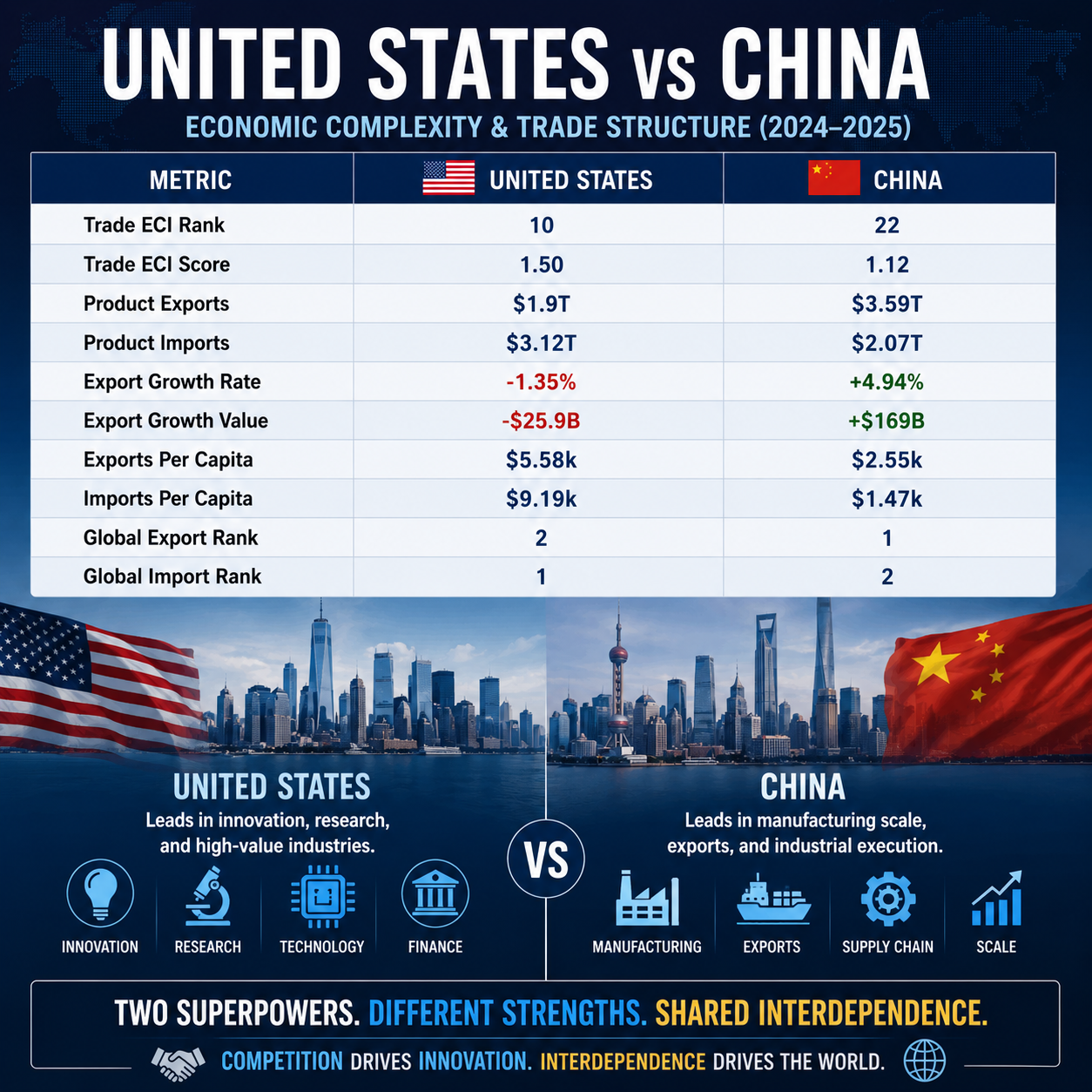
The results of 2025 illustrate that distinction particularly well. U.S. tariffs dramatically reduced direct bilateral trade with China, but they did not prevent Chinese exports from expanding globally. Instead, trade increasingly shifted toward other markets, demonstrating the difference between reducing American imports from China and fundamentally reducing China’s role in global production.
China Absorbed the Tariff Shock and Redirected Exports
China’s goods exports reached 26.99 trillion yuan in 2025, increasing 6.1% from 2024, according to China’s National Bureau of Statistics. Exports to the United States, however, fell 19.5%, while exports to ASEAN increased 14% and exports to the European Union rose 9%.
Those numbers reveal one of the central limitations of bilateral tariffs. Washington succeeded in sharply reducing direct U.S. purchases from China, but Chinese producers simultaneously increased sales elsewhere. Reuters reported that China’s goods trade surplus approached a record $1.2 trillion in 2025, supported by stronger exports to markets including Southeast Asia, Africa and Latin America.
The trade war therefore altered the geography of Chinese exports more clearly than it dismantled China’s export machine. China became less dependent on direct access to the American market while continuing to use its manufacturing scale to compete internationally. That does not mean tariffs had no economic effect on China, but it complicates the argument that bilateral import reductions alone demonstrate successful industrial decoupling.
The United States also remained a massive trading economy. In 2025, U.S. goods exports actually increased to approximately $2.20 trillion, rather than contracting, while goods imports rose to roughly $3.44 trillion. The overall U.S. goods deficit reached approximately $1.24 trillion.
The China Trade Deficit Fell—but Production Did Not Simply Return Home
One of the clearest achievements of the tariff strategy was the reduction in direct U.S.–China trade. America’s goods deficit with China fell by approximately $93.4 billion in 2025 to $202.1 billion, as U.S. imports from China dropped by about $130.4 billion. U.S. exports to China also declined, falling by approximately $36.9 billion.
But another set of numbers complicates the reshoring narrative. During the same year, the U.S. goods deficit with Vietnam increased to $178.2 billion, while the deficit with Taiwan rose to $146.8 billion. Imports from Vietnam increased by $57.3 billion and imports from Taiwan increased by $85.2 billion.
That does not prove that Chinese production was simply rerouted through those countries; trade flows, investment and supply chains are considerably more complicated. It does demonstrate, however, that reducing direct Chinese imports did not correspond to an equivalent reduction in America’s overall dependence on imported goods. The U.S. goods deficit actually increased in 2025 despite the dramatic contraction in imports directly from China.
This distinction matters for industrial policy. Trade diversion is not the same thing as reshoring. Replacing a Chinese supplier with production in Vietnam, Mexico or another foreign manufacturing center may reduce strategic dependence on China, but it does not necessarily rebuild American manufacturing capacity.
Rare Earths Exposed a More Serious Industrial Vulnerability
China’s strongest demonstration of industrial leverage in 2025 came not from finished consumer products but from critical materials. In April, Beijing imposed export controls on seven rare-earth elements and magnets following the Trump administration’s tariff increases. These materials are important inputs for automotive, energy, electronics and defense manufacturing.
The consequences appeared quickly. U.S. automotive suppliers warned that restrictions could disrupt parts production, while China subsequently issued temporary export licenses to suppliers serving major American automakers. The episode demonstrated how control over relatively small but essential components can create leverage far beyond their direct monetary value.
China’s position is particularly important because its advantage extends beyond mining. Estimates cited by ING in 2025 put China at nearly 70% of global rare-earth production and more than 90% of processing. That concentration means building alternative mines alone does not immediately eliminate dependence because refining, magnet production and associated industrial expertise also have to be recreated.
The U.S. government’s own 2026 trade report described significant consequences from China’s controls, stating that factories in the United States and other countries temporarily halted production during 2025 because they could not obtain necessary rare-earth magnets and related products on time. Whatever one’s assessment of the broader trade strategy, the episode provided concrete evidence that parts of Western manufacturing remained exposed to Chinese industrial bottlenecks.
From Decoupling Toward Managed Economic Rivalry
The May 2026 Trump–Xi negotiations suggested a more pragmatic phase in the relationship. The two governments established new bilateral trade and investment mechanisms, while China agreed to address U.S. concerns involving rare-earth supply and expand purchases of American products. The agreements did not eliminate strategic competition, but they created mechanisms for managing areas where complete economic separation would impose significant costs on both countries.
China agreed to purchase at least $17 billion annually in U.S. agricultural products during 2026–2028, in addition to previous soybean commitments. It also approved an initial purchase of 200 Boeing aircraft, restored market access for hundreds of U.S. beef facilities and resumed poultry imports from eligible U.S. states. These were concrete concessions secured by Washington, even though implementation of some commitments remains an important issue to monitor.
The United States and China therefore appear to be managing an economic relationship that neither side has been able—or willing—to sever completely. Washington continues trying to reduce strategic vulnerabilities, while Beijing has incentives to preserve access to major export markets and American agricultural, industrial and technological products.
Describing this as managed rivalry is more accurate than describing it as full decoupling. Strategic competition continues, but economic interdependence places limits on how rapidly either country can escalate without creating domestic costs.
Trump’s Beijing negotiations did not demonstrate that the United States lacks economic power. The U.S. retains major advantages in technology, finance, energy, research and high-value services, while its enormous domestic market itself provides substantial negotiating leverage. The 2025 reduction in Chinese imports also demonstrates that tariffs can materially redirect bilateral trade.
But the negotiations exposed a different problem: reducing imports is much faster than rebuilding industrial capacity. China entered 2026 after another year of export growth, while its control over rare-earth processing demonstrated that American manufacturers remained vulnerable to specific Chinese supply-chain bottlenecks.
That makes the central question for U.S. industrial strategy larger than tariffs. If Washington wants to reduce strategic dependence, it must determine which supply chains genuinely need domestic or allied alternatives and whether the enormous capital required to create them is economically sustainable. Moving imports from China to another foreign producer can diversify risk, but it is not equivalent to rebuilding American production.
The longer-term U.S.–China contest will therefore be determined less by individual trade agreements than by productive capacity, technology, energy, critical materials and supply-chain resilience. Tariffs can change where goods are purchased, and negotiations can temporarily stabilize trade. Neither automatically creates the factories, processing capacity, skilled labor and supplier networks required to change the underlying industrial balance.