
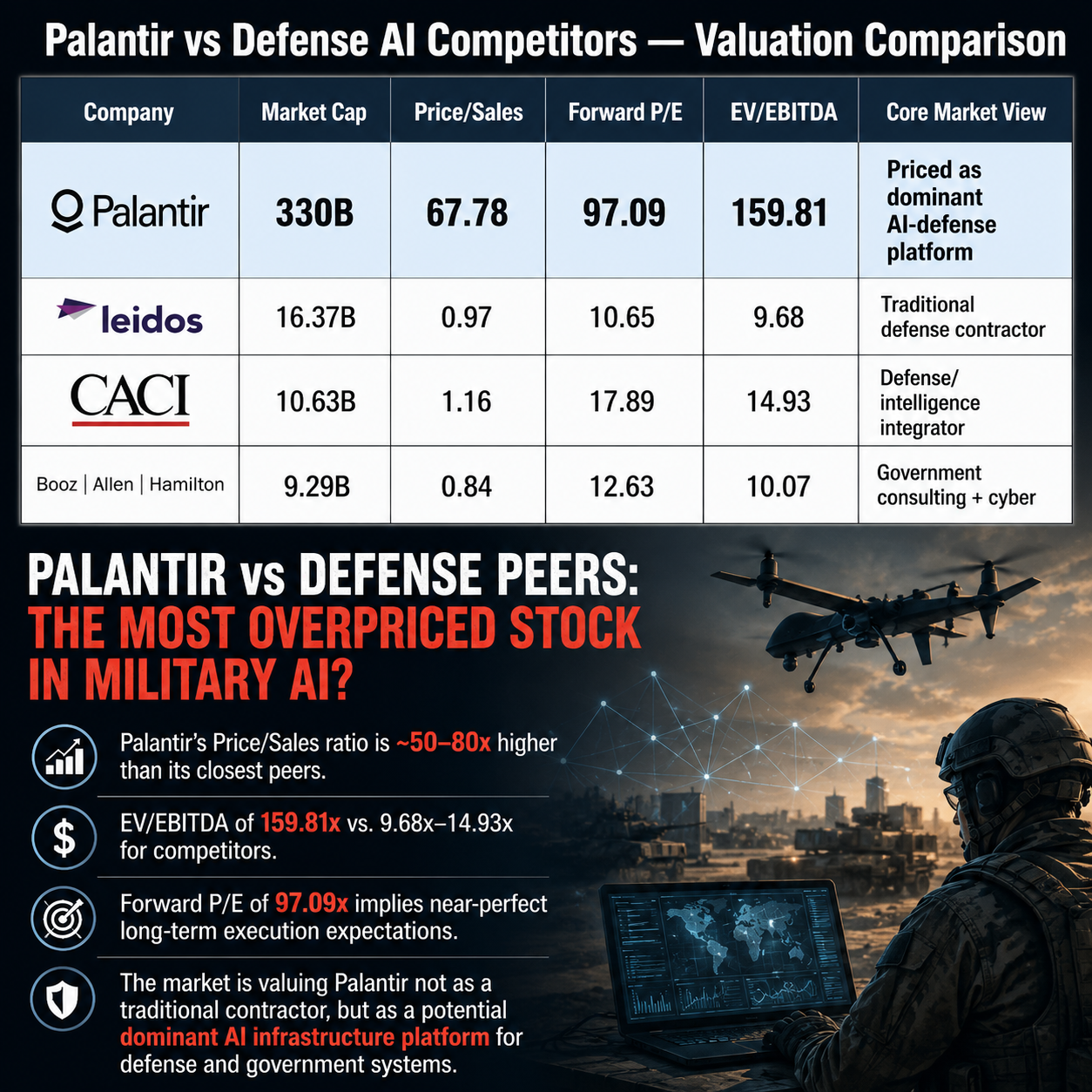
Palantir vs Defense Peers: The Most Overpriced Stock in Military AI?
Palantir is valued very differently from traditional defense technology and government-services companies. Its valuation assumes that AI platforms such as Maven can become foundational infrastructure across U.S. and allied defense systems—but that premium also creates substantial multiple-compression risk.
Palantir occupies an unusual position between enterprise software, artificial intelligence and the traditional defense industry. It competes for government technology spending alongside companies such as Leidos, CACI and Booz Allen Hamilton, yet the stock market values Palantir according to an entirely different framework. Investors are paying for the possibility that its software becomes critical infrastructure rather than simply another source of government contracting revenue.
That distinction is fundamental to understanding PLTR’s valuation. Traditional defense-services companies are generally valued according to contract backlogs, margins, cash generation and relatively predictable growth rates. Palantir’s valuation instead embeds expectations of sustained high growth, expanding margins and potentially dominant positioning within government and military AI.
The market is therefore making a much larger bet than simply predicting higher defense spending. It is effectively betting that software platforms such as Palantir’s Maven Smart System become increasingly embedded in how governments integrate intelligence, coordinate operations and make decisions. Recent developments provide evidence supporting that thesis, but an extraordinary valuation also means that strong operational performance alone may not necessarily be enough to generate strong investment returns.
Palantir vs Leidos, CACI and Booz Allen
The valuation gap between Palantir and traditional government technology contractors is enormous. As of September 2026, representative peer data place Leidos and Booz Allen around roughly 1x trailing sales, while CACI trades somewhat higher; their earnings multiples are generally in the low-to-high teens or around 20x depending on the company and measurement date.
Palantir’s valuation belongs to a fundamentally different category. Rather than valuing each dollar of revenue similarly to revenue generated by established government contractors, investors assign a dramatically larger value to Palantir’s sales because they expect those revenues to grow faster and eventually generate software-like margins at much greater scale.
That difference cannot be explained simply by saying Palantir sells to the government. Leidos, CACI and Booz Allen also possess deep government relationships, security clearances, technical expertise and substantial exposure to U.S. defense and intelligence spending. What differentiates Palantir’s investment narrative is the possibility that its software becomes a reusable operating platform deployed across many agencies and missions rather than primarily providing labor-intensive services under individual contracts.
This creates potentially superior economics. Software can theoretically scale revenue faster than headcount, producing substantial operating leverage as adoption expands. If Palantir can repeatedly deploy standardized platforms while maintaining strong pricing power, comparing its valuation directly with conventional defense contractors becomes increasingly problematic.
The Military AI Platform Thesis
The bullish economic thesis becomes clearer when examining Maven. NATO acquired Palantir’s Maven Smart System NATO in March 2025, describing it as an AI-enabled warfighting system supporting intelligence fusion, targeting, battlespace awareness, planning and accelerated decision-making. NATO subsequently began integrating the system into major exercises and command structures.
The U.S. military relationship has also expanded. In 2026, Maven was elevated to a Pentagon program of record as part of broader efforts to integrate AI-enabled decision-making into command-and-control systems. Palantir also operates under an Army enterprise agreement with a ceiling of up to $10 billion over ten years, although a contract ceiling should not be confused with guaranteed revenue.
These developments illustrate what investors are potentially paying for. If Maven and related Palantir platforms become deeply embedded in military workflows, replacing them could eventually become expensive and operationally disruptive. Integration across databases, sensors, command structures and decision-making processes can create switching costs substantially greater than those associated with an isolated software application.
The most aggressive version of the investment thesis therefore views Palantir less like a contractor and more like an operating layer for government AI. Under that scenario, the addressable opportunity could extend across intelligence analysis, logistics, targeting, battlefield coordination, procurement, supply chains and administrative systems. That possibility helps explain why investors are willing to assign Palantir multiples that would appear extraordinary when compared only with traditional defense companies.
Why the Valuation Creates a Different Kind of Risk
The problem is that an exceptional business and an exceptional investment are not necessarily the same thing. A company can grow rapidly, win major contracts and increase profitability while its share price performs poorly if investors previously paid a valuation that assumed even better results. The higher the starting multiple, the greater the expectations already embedded in the stock price.
Consider the mathematics of multiple compression. Suppose a company trades at 60x sales and eventually falls to 15x sales. If revenue doubled during that period while everything else remained equal, the implied valuation would still fall by approximately 50%. Revenue growth alone would therefore not protect shareholders from a sufficiently large valuation reset.
This is the central risk surrounding Palantir. The company does not necessarily need to lose government contracts or experience an operational collapse for shareholders to suffer substantial losses. Growth merely needs to slow enough—or investors’ required returns need to rise enough—for the market to decide that extremely high revenue multiples are no longer appropriate.
Traditional defense contractors face business risks of their own, but their lower valuations create a different expectation structure. When a company trades near 1–2x sales, the market is generally not assuming decades of extraordinary expansion. When a software company trades at many times that level, future growth and margin expansion become much more important components of today’s market capitalization.
Geopolitics Can Expand the Opportunity Without Eliminating Valuation Risk
The geopolitical backdrop provides genuine support for Palantir’s defense business. NATO’s adoption of Maven and the Pentagon’s expanding use of AI-enabled decision systems demonstrate institutional demand for technologies that integrate enormous quantities of military and intelligence data. These are concrete deployments rather than purely speculative future applications. NCIA NATO
Competition between major powers, modernization of military command systems and increased investment in autonomous and AI-enabled capabilities can expand the addressable market for companies providing the underlying software infrastructure. Palantir is already positioned inside important U.S. and NATO programs, giving it an opportunity to benefit if these technologies become more deeply integrated into military operations.
However, geopolitical demand does not automatically justify any valuation. Government procurement remains subject to budgets, political priorities, competition, regulatory scrutiny and lengthy contracting processes. Palantir has also encountered resistance in some public-sector markets; for example, several UK police forces recently ended a Palantir pilot, while other proposed public-sector relationships have faced procurement and political scrutiny.
Investors therefore need to separate two questions that are frequently combined. Will military and government spending on AI increase? Current evidence strongly supports continued institutional interest. Does that growth justify whatever valuation investors currently assign to Palantir? That requires assumptions about revenue growth, margins, competitive durability and future valuation multiples rather than geopolitics alone.
Palantir’s valuation makes more sense when the company is viewed as a potential AI infrastructure platform rather than simply compared with Leidos, CACI or Booz Allen. Maven’s expanding role in U.S. defense systems and NATO provides tangible evidence for that argument. Palantir is participating directly in the transition toward software-defined, AI-assisted military operations rather than merely benefiting from a fashionable investment narrative.
But the valuation simultaneously raises the standard Palantir must meet. Investors are not paying conventional defense-contractor multiples and waiting to see whether the company develops into something larger. A substantial portion of that transformation is already reflected in the market’s expectations, making sustained growth, operating leverage and strategic entrenchment increasingly important.
The downside scenario does not require Palantir to fail. If the company remains successful but eventually receives a much lower revenue or earnings multiple, substantial business growth could coexist with disappointing shareholder returns. Multiple compression is therefore arguably as important to the investment case as operational execution.
The real question is consequently not whether Palantir deserves a premium to traditional defense contractors; its growth profile and software economics provide clear reasons why the businesses should not trade at identical multiples. The question is how large that premium can remain as Palantir matures, and what level of long-term revenue and cash flow would be required to justify today’s market capitalization. That is the valuation problem investors ultimately need to solve.